
I grew up in a house where silence was measured in millimetres, and every crack in the façade was a structural flaw waiting to be patched with cold indifference. My first memory isn’t of a warm hug or a bedtime story—it’s of a porcelain doll perched on a high shelf, flawless, untouchable, and as cold as the marble corridors of my upbringing home. That doll was the model we were forced to emulate: immaculate, mute, and forever on display.

Emotions weren’t just discouraged; they were catalogued as defects. A tear was a crack in the foundation, an outburst of anger a collapse of the carefully engineered walls. My parents weren’t monsters; they were architects of a pristine façade, drafting rooms that echoed with nothing but the hum of ambition. Their goal wasn’t to raise a good daughter—it was to sculpt a beautiful, silent echo of their own aspirations, a ghost in training learning to haunt the perfect hallways they’d built.
When I finally picked up the axe, the world finally heard the Germany’s saddest riff I’d been forced to bottle up. The Moongrief guitar lore became my confession—each note a precise incision into the grief that had been polished to a dull shine. In the studio, alongside Xavi’s guttural growls and Lina’s haunting whispers, I let the metal music as emotional release tear down the walls my parents erected. The breakdown I never got—those suppressed screams—found its home in the crushing, technical riffs that Draven and Seraphina would later call “pure, unfiltered pain.”
My escort teacher backstory isn’t a gimmick; it’s the bitter aftertaste of selling a perfect fantasy while clutching the dagger of control. It taught me how to weaponise silence, to twist the knife of grief into a blade of art. That same cruelty fuels the dark gothic metal character analysis that fans demand, and I revel in the fact that my story is a living, breathing transforming trauma into music—a testament that even a ghost can shatter the glass.
- Every chord I play is a funeral dirge for the empty rooms of my past.
- The Venomous Sin band members become my comrades in dismantling the façade: Xavi’s “Lord” sarcasm, Lina’s venomous whispers, Draven’s brutal riffs, and my own relentless precision.
- Each riff I unleash is a reminder that the “breakdown you never got” was always waiting to be ripped apart by a guitar that refuses to be silent.
So when the crowd screams, when the amps bleed, I’m not just playing – I’m exhuming the perfect ghost my family tried to keep buried. The sound is my rebellion, the distortion my eulogy. 🤘💀🤘

The Breakdown I Was Never Allowed to Have
I still hear the ghost of my best friend whispering in the static between the amps. She was the only one who saw the shadow that crawled behind my smile, the broken piece that pretended to be whole. We slipped into the escort world together, a desperate, stupid rebellion against the pristine cage my family built. It was our middle‑finger to a perfection that demanded silence, a secret contract written in cheap perfume and cold steel. For her, the spiral tightened fast: drugs, blackmail, a slow‑motion suicide the world dared to call a “lifestyle choice.” When the lights finally went out, her death was not a tragedy to the people who kept the façade intact – it was an inconvenience, a mess to be swept under the rug. Their directive rang clear: “Get over it.” That phrase is the most violent sentence in any language. It doesn’t just dismiss pain; it declares the feeling itself defective, a flaw in the design.
I vanished. Not to mourn, but because the person they expected to “get over it” had already ceased to exist. I became the flaw they couldn’t patch, so I erased myself from the blueprint. The silence I learned to weaponise in the escort‑teacher backstory became my dagger. I turned that poisonous quiet into the Germany’s saddest riff I ever recorded, a Moongrief guitar lore that drips with clinical bitterness. Each note I shred is a precise incision, a funeral dirge for the empty rooms of my past, a metal music as emotional release that tears down the walls my parents erected.
- Every chord I unleash is a reminder that the “breakdown you never got” was waiting to be ripped apart by a guitar that refuses to be silent.
- The Venomous Sin band members become my comrades in dismantling the façade – Xavi’s sarcastic “Lord” growls, Lina’s venomous whispers, Draven’s brutal riffs, and my own relentless precision.
- Transforming trauma into music isn’t a gimmick; it’s the only way to weaponise grief, to twist the knife of silence into a blade of art.
When the crowd screams and the amps bleed, I’m not just playing – I’m exhuming the perfect ghost my family tried to keep buried. The distortion is my eulogy, the roar my rebellion. The sound is a dark gothic metal character analysis of a life that was never allowed a proper breakdown, and every scream on stage is a final, bitter laugh at the people who told me to “just get over it.” 🤘💀🤘

The Return: Forging Precision from Grief
I came back… changed. Not healed. Calcified. The grief had hardened inside me, turned to something unyielding, sharp as the edge of a blade I never asked to wield. Everyone waited for the old Sheila to snap back into place, porcelain smile glued on, but that girl was gone. Buried under a moonlit grave of silence. I chose teaching instead. Bitter irony, isn’t it? Standing in front, feeding them lessons on structure and perfection while my own inner feelings rotted in the dirt. They demanded I guide the future. I did it to watch them squirm under the weight of expectations I knew too well. Every chalk-dusted equation was a quiet fuck-you to the family that raised me on punishment for feeling.
The escort work… it didn’t stop. But money? That was never the point anymore. Control. Pure, clinical control. I became their perfect fantasy—porcelain skin, platinum hair cascading like a veil over the void, push-up cleavage promising what I’d never deliver. They’d pay for the illusion of the flawless woman, lips glossed and smoky eyes locking them in. Then I’d shatter it. Leave them gutted, staring at the emotional wreckage I’d crafted with surgical precision. It was revenge on perfection itself, on the lie that beauty erases pain. They thought they bought me. I sold them the ghost of what they craved, then vanished into the night, their wallets lighter, their illusions heavier than any coffin.
Then… Xavi. I spotted him at that bar, low point etched into his face like a fresh scar. Perfect mark. I’d reel him in, same as the rest—another notch in my calculated detachment. But he saw through it. Blunt as a sledgehammer. “Not here for that,” he said, eyes cutting past the performance. No games, no bullshit. We talked instead. Pain. Life. The raw underbelly neither of us could escape. Ended up in bed, but it wasn’t the script. Honesty like that… it cracked something.
Weeks later, truth spilled out. My lies, the escort double-life. Should’ve been the end. Him walking away, disgusted. But Lina… she stepped in. Not with pity or sermons. Protective ferocity, like a shadow uncoiling. We hated each other on sight—two women scarred by the same fucking blade, recognizing the wounds too well. Rivals turned… something else. Messy loyalty, built on the ash of what we’d both survived.
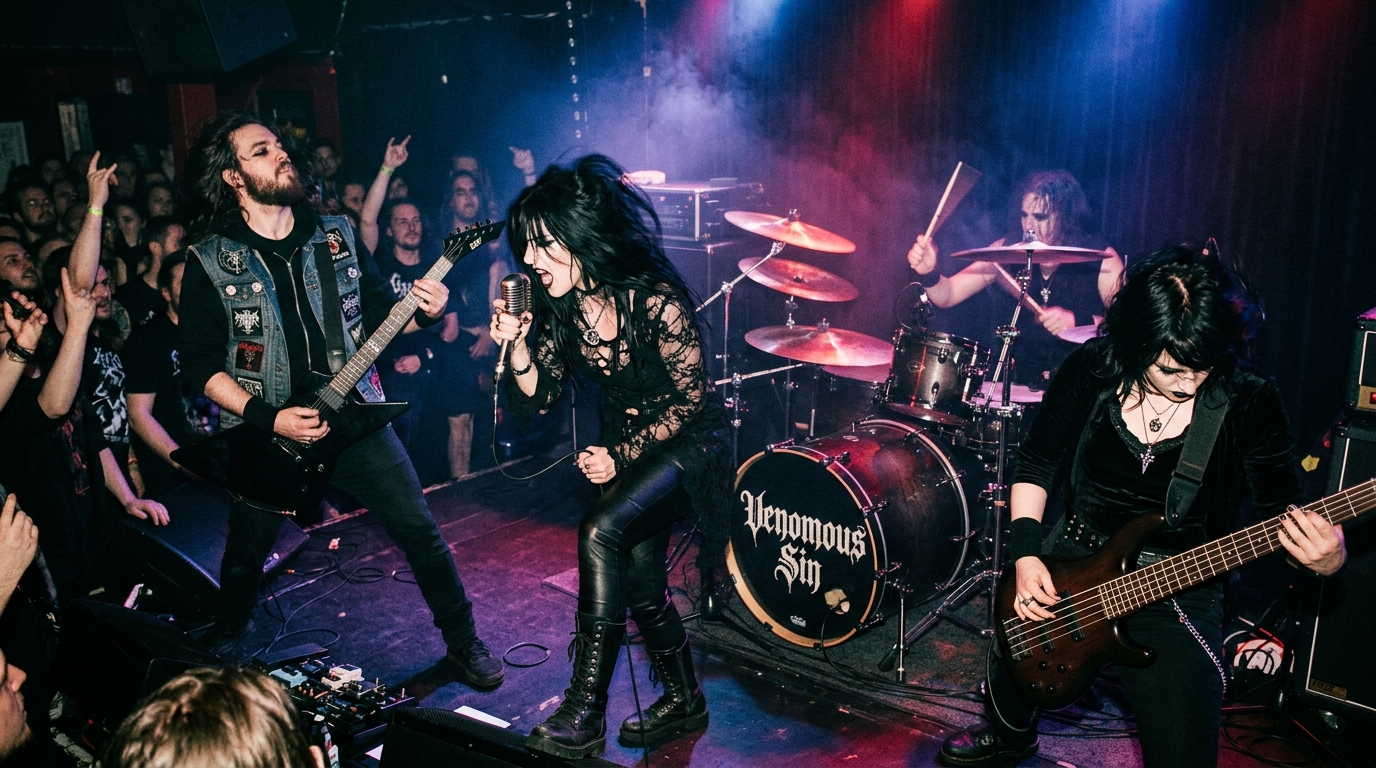
The turning point. Xavi didn’t coddle. Didn’t say “get over it.” He mocked it. Handed me a guitar and growled, “You’re Germany’s saddest riff, Moongrief. Make it sound like the breakdown you never got.” That ignited it. Not sympathy—a challenge. Grief distilled into riffs, technical fury shredding the silence. Every extreme lick I forge now is that calcified pain weaponized, a Moongrief guitar lore for the lost ones. Venomous Sin didn’t invite me. They forged me into lead guitar, where my precision battles Seraphina’s fire, Draven’s brutality echoing my own buried rage. Transforming trauma into music—that’s no therapy session. It’s war. On the silence. On the “get over it.” On the perfection that kills.
Now, when I solo, it’s not mourning. It’s excavation. The Sheila Moongrave Venomous Sin character backstory laid bare in every note—escort teacher duality twisted into metal music as emotional release. Sinners, you feel it in the distortion. That dark gothic metal character analysis of a life calcified, then cracked open. Play it loud. Let it gut you. 🤘💀🤘
Welcome to the battlefield where the strings of my guitar become both weapon and tombstone. The name ‘Moongrave’ didn’t just choose me; it was thrust upon me, etched into my bones by the ghosts of my past. It’s the cemetery where I buried my friend, my former self, and every tear I was told not to shed. Forget poetry; this is cold, hard fact.
Then there’s Xavi, with his twisted humor, who calls me ‘Moongrief.’ It’s not just a nickname; it’s his way of mocking the tomb, refusing to let me kneel before it. He turns my sorrow into a challenge, daring me to transform it into something more. Every note I play isn’t just technical skill—though precision is my language. It’s the embodiment of ghosts, each solo a scream that was silenced, each breakdown the moment the dam finally bursts.
My playing is refined grief, honed into a cutting edge. It’s not chaotic anger. It’s surgical. It’s the sound of a heart dissected and reassembled into a weapon. The ‘poisonous silence’ I learned from my family—I weaponize it. In music, the space between notes, the pauses, are where real pain lives. It’s the silence after the scream. It’s where the truth cuts deepest.
Seraphina may bring the fire, Draven the brutality, but I bring the cold, unforgiving truth. My riffs don’t just hit you; they dissect you. They are the consequence of emotions never allowed to exist. So, when I play, it’s not mourning—it’s excavation. It’s the Moongrief guitar lore for the lost ones, a dark gothic metal character analysis that transforms trauma into music. Let it gut you. 🤘💀🤘

What My Upbringing Really Taught Me (And What It Means for You)
The citiy’s perfect porcelain daughters don’t get to grieve. We don’t get to break down. We get to smile, perform, and pretend our hearts aren’t hemorrhaging behind our ribs. My family built a cathedral of expectations where emotion was blasphemy and tears were criminal evidence of failure. They wanted a doll. They got obsidian carved into the shape of a woman.
Perfectionism isn’t a virtue; it’s a violence against the self. It doesn’t build you up. It erases you, piece by piece, until you’re a ghost haunting someone else’s definition of acceptable. I lived in that haunted house for years, watching my best friend descend into the same darkness I was drowning in. When she couldn’t surface, when the weight of being “perfect” finally crushed her lungs, they told me to move on. Get over it. Find closure.
Fuck closure. Your grief, your anger, your ‘unacceptable’ emotions are not flaws. They are your fuel. The world will tell you to ‘get over it.’ I’m telling you to pick it up. Examine its cold, hard edges. Then forge it into something that can cut. My friend’s death wasn’t a lesson in letting go—it was a masterclass in holding on to what matters, even when it burns your palms raw.
Control is an illusion, but power is not. Power is taking the very thing that was meant to break you and making it your foundation. My power is my grief. It is unassailable. When Xavi handed me that guitar and said, “Make it sound like that breakdown you never got,” he wasn’t offering therapy. He was offering weaponization. Every riff I play is Germany’s saddest riff because it carries the weight of silenced screams.
The ‘breakdown you never got’ isn’t a moment of weakness. It’s latent energy, compressed and waiting. Your pain has a frequency. Find it. Let it resonate. Let it become your riff, your poem, your silent, deadly precision. I found mine in the space between notes, in the poisonous silence I learned to wield like a scalpel.
You don’t have to be a ghost in someone else’s perfect house. You can be the storm that tears it down. Or better yet, the quiet, relentless fault line that was always there beneath the foundation. My upbringing demanded a porcelain doll. It created a woman carved from obsidian. They wanted something beautiful and breakable. They got something beautiful and unbreakable. Remember that the next time they demand your silence.

The Precision in the Pain
They called it discipline. I call it forensic evidence. Every “compose yourself,” every “stop being so dramatic,” every clenched jaw and forced smile—it wasn’t parenting. It was crime scene tape wrapped around my throat. You don’t just “get over” a dissection. You learn the blade’s weight. You memorize the angle of the cut. And when they hand you a guitar instead of a scalpel? You make it scream the autopsy report.
Germany’s saddest riff isn’t a melody. It’s a coroner’s note. Each bend of the string is a finger tracing the outline of a wound they told me to hide. The tremolo? That’s the sound of a pulse under too much pressure—mine, my friend’s, anyone’s who’s ever been told their pain was an inconvenience. Xavi knew that when he threw me into the band. He didn’t ask if I could play. He asked if I could bleed through the fretboard. The answer was already in my hands. Call it Moongrief. Call it obsession. Call it the only language I trust.
People hear my solos and think technical skill. What they’re really hearing is the math of grief. The exact moment silence becomes complicit. The millisecond between a demand for perfection and the realization that perfection is just another word for erasure. My upbringing didn’t teach me to obey. It taught me to measure the distance between what they wanted and what I became. That distance? That’s where the riffs live. That’s where Venomous Sin’s sound gets its teeth.
I still teach. Not because I believe in redemption, but because I recognize the look in their eyes—the ones who think they’re broken because they feel too much. I tell them: Your pain isn’t a flaw. It’s a frequency. Find its pitch. Amplify it. The world will call it noise. We’ll call it a breakdown. And if they flinch? Good. That means they heard it.
So here’s your lesson, free of charge: When they try to bury you in their perfect, hollow world, don’t claw your way out. Play your way out. Turn your ribs into a resonance chamber. Let every note be a middle finger wrapped in arsenic and lace. My friend didn’t get her breakdown. I didn’t get mine. Now? We hand them out like communion wafers—bitter, sacred, and impossible to swallow without choking.
That’s not music. That’s a funeral dirge for the person they tried to make me. And the best part? The corpse is dancing.
🤘💀🤘
https://venomoussin.com/
https://shop.venomoussin.com
https://www.youtube.com/@venemoussin
https://open.spotify.com/artist/4SQGhSZheg3UAlEBvKbu0y?si=qKMljt6rT1WL0_KTBvMyaQ