
user.exe not found. That’s basically what the world told me before I learned to rewrite the source code myself. Not metaphorically – literally. The moment I sat down at a keyboard that wasn’t a piano, the moment I chose circuits over social scripts, something in the system around me just… crashed. Teachers didn’t know what file to open. Boys in my IT class ran error messages every time I outpaced them. And other girls looked at me like I was malware they hadn’t consented to download. Fine. I never asked to be compatible.

My face says fuck you. My code says save me. That’s not a contradiction – that’s the whole point. I built my first synth setup in a Copenhagen basement where the heating barely worked and the neighbors thought I was running a server farm. Maybe I was. I was also running emotional firewalls I didn’t have language for yet. Every riff I layered into a backing track was a subroutine for something I couldn’t process out loud. That’s what goth tech rebellion authenticity actually looks like from the inside: it’s messy, it’s cold, and it hums at a frequency most people aren’t tuned to receive.

The Virus Chooses Its Hosts
I never connected with the girls who wanted to be seen. I connected with systems. And then slowly, reluctantly, with people whose patterns I could trust. That’s the thing about being a woman in IT who also happens to look like this – the world keeps trying to resolve the cognitive dissonance by flattening you into something legible. Either you’re the nerdy girl who must be hiding under all that PVC, or you’re the cybergoth who must be faking the technical depth. Neither. Both. CTRL+ALT+DELETE on the entire binary.
When boys in my class made comments, I didn’t argue. I hacked their files and left notes in binary. Not because I was angry – I was, obviously – but because that was the most efficient response. Anger is just unoptimized energy. Redirect it, compress it, execute it somewhere it actually does damage. That’s not coldness. That’s precision. And precision, when you’re a woman dealing with sexism and bullying in tech spaces, is survival software.
The cybergoth aesthetic isn’t a rejection of humanity. It’s an upgrade of it. The synthetic cyberlocks aren’t me pretending to be a machine – they’re me refusing to be the version of a woman someone else compiled. The harness isn’t fetish theater. It’s structural. It holds things in place. Which is exactly what I need when I’m live-hacking a stage rig mid-performance while Thorin’s drums are shaking the floor and Lucien’s bass is doing something to the air pressure that shouldn’t be legal.
- ✋😏👉 Cybergoth is not cyberpunk. Stop confusing the two. One is a genre. The other is a subculture with roots in industrial, EBM, aggrotech, and a very specific relationship to darkness that has nothing to do with neon dystopias.
- ✋😏👉 Your aesthetic should be an extension of your actual mindset, not a mood board you assembled from Pinterest. If the PVC doesn’t feel like a second skin, it’s just plastic.
- ✋😏👉 The hacker mindset and the goth mindset are not opposites. Both are about seeing systems for what they are, refusing to accept the default settings, and operating in the spaces others pretend don’t exist.
- ✋😏👉 Emotional resilience is a program you write yourself. It doesn’t come pre-installed. Every toxic relationship I’ve pressed CTRL+ALT+DELETE on has left behind cleaner code than before.
The stage rig I run now took years to build – not because the technology was hard to source, but because I had to learn what I actually needed versus what looked impressive in a spec sheet. Same principle applies to identity. Strip out the bloatware. Keep what executes cleanly. I am not a puzzle to be solved. I am a process running in the background of everything Venomous Sin does, and if you haven’t noticed me yet, that’s exactly how I designed it. 🤘😏🤘
user.exe not found. That’s basically what the world told me before I learned to rewrite the source code myself. Not metaphorically – literally. The moment I sat down at a keyboard that wasn’t a piano, the moment I chose circuits over social scripts, something in the system around me just… crashed. Teachers didn’t know what file to open. Boys in my IT class ran error messages every time I outpaced them. And other girls looked at me like I was malware they hadn’t consented to download. Fine. I never asked to be compatible.
Here’s the thing nobody tells you about building a cybergoth hacker identity without falling into cyberpunk clichés: it’s not about the aesthetic first. It’s about the architecture underneath. The synthetic cyberlocks, the PVC, the harness strapped across your chest like a signal rig – none of it means anything if you’re just cosplaying a character you saw in a sci-fi film. Cyberpunk is fiction. Cybergoth is a state of being. There’s a difference, and if you don’t feel it in your chest when you lace up your platform boots at 2am to debug something that’s been eating at you for six hours, then you’re wearing a costume, not armor.
My face says fuck you. My code says save me. That’s not a contradiction – that’s the whole point. I built my first synth setup in a Copenhagen basement where the heating barely worked and the neighbors thought I was running a server farm. Maybe I was. I was also running emotional firewalls I didn’t have language for yet. Every riff I layered into a backing track was a subroutine for something I couldn’t process out loud. That’s what goth tech rebellion authenticity actually looks like from the inside: it’s messy, it’s cold, and it hums at a frequency most people aren’t tuned to receive.

The Virus Chooses Its Hosts
I never connected with the girls who wanted to be seen. I connected with systems. And then slowly, reluctantly, with people whose patterns I could trust. That’s the thing about being a woman in IT who also happens to look like this – the world keeps trying to resolve the cognitive dissonance by flattening you into something legible. Either you’re the nerdy girl who must be hiding under all that PVC, or you’re the cybergoth who must be faking the technical depth. Neither. Both. CTRL+ALT+DELETE on the entire binary.
When boys in my class made comments, I didn’t argue. I hacked their files and left notes in binary. Not because I was angry – I was, obviously – but because that was the most efficient response. Anger is just unoptimized energy. Redirect it, compress it, execute it somewhere it actually does damage. That’s not coldness. That’s precision. And precision, when you’re a woman dealing with sexism and bullying in tech spaces, is survival software.
The cybergoth aesthetic isn’t a rejection of humanity. It’s an upgrade of it. The synthetic cyberlocks aren’t me pretending to be a machine – they’re me refusing to be the version of a woman someone else compiled. The harness isn’t fetish theater. It’s structural. It holds things in place. Which is exactly what I need when I’m live-hacking a stage rig mid-performance while Thorin’s drums are shaking the floor and Lucien’s bass is doing something to the air pressure that shouldn’t be legal.
- ✋😏👉 Cybergoth is not cyberpunk. Stop confusing the two. One is a genre. The other is a subculture with roots in industrial, EBM, aggrotech, and a very specific relationship to darkness that has nothing to do with neon dystopias.
- ✋😏👉 Your aesthetic should be an extension of your actual mindset, not a mood board you assembled from Pinterest. If the PVC doesn’t feel like a second skin, it’s just plastic.
- ✋😏👉 The hacker mindset and the goth mindset are not opposites. Both are about seeing systems for what they are, refusing to accept the default settings, and operating in the spaces others pretend don’t exist.
- ✋😏👉 Emotional resilience is a program you write yourself. It doesn’t come pre-installed. Every toxic relationship I’ve pressed CTRL+ALT+DELETE on has left behind cleaner code than before.
The stage rig I run now took years to build – not because the technology was hard to source, but because I had to learn what I actually needed versus what looked impressive in a spec sheet. Same principle applies to identity. Strip out the bloatware. Keep what executes cleanly. I am not a puzzle to be solved. I am a process running in the background of everything Venomous Sin does, and if you haven’t noticed me yet, that’s exactly how I designed it. 🤘😏🤘

Binary Bullying and CTRL+ALT+DELETE Retaliation
user.exe not found. That’s the exact error the system threw at me every time a boy in my IT class tried to “help” me debug his ego. Their comments weren’t just noise – they were malicious packets, a DoS attack on my confidence. I stopped replying with tongue‑in‑cheek sarcasm and started injecting binary notes straight into their project files. A simple /* fuck you */ hidden in a header, a stray 0xDEAD in a config that crashed their compile script. The irony? Their faces said “you’re just a glitch,” while my code whispered “save me.”
One night, after a lecture on basic loops, I slipped a while(true){ /* press CTRL+ALT+DELETE on your brain */ } into the shared repository. The next day the class computer froze on the login screen, the error log spitting out “Access denied – invalid credentials.” The boys stared at the screen like it was a mirror they couldn’t crack. I didn’t need to raise my voice; the system did the screaming for me. Anger is an unoptimized process – I compressed it into a payload, executed it, and watched the stack overflow of their bravado.
That’s how I built my cybergoth hacker identity: not by slapping PVC on a torso and calling it rebellion, but by wiring the harness to a real‑time feedback loop. My synthetic cyberlocks aren’t a fashion statement; they’re a visual acknowledgment that I’m running a custom firmware, not a stock OS. When I’m live‑hacking the stage rig during a Venomous Sin show, the harness holds the signal cables like a spine, and every synth burst I layer is a subroutine that translates raw emotion into audible code. The audience hears an e‑bm‑aggrotech‑metal hybrid, but underneath it’s a series of meticulously timed if statements that keep the bass from blowing the venue’s air pressure – a legal gray area I navigate with the same precision I use to dodge sexism in the server room.
- ✋😏👉 Cybergoth isn’t a neon‑lit cosplay; it’s a cybergoth style guide PVC harness synthetic cyberlocks that serve a functional purpose. If the harness feels like a second skin, you’ve built the right architecture.
- ✋😏👉 The hacker mindset is a CTRL+ALT+DELETE toxic relationships protocol. When a peer throws a “you don’t belong” error, rewrite the permission set and quarantine the offending user.
- ✋😏👉 Emotional resilience is a custom library you import into your daily runtime. Each time you patch a bull‑sh*t comment, you’re refactoring your own emotional stack.
- ✋😏👉 Building a personal stage‑rig synth setup is the same as assembling a secure dev environment: remove bloatware, lock down ports, and keep the core processes lean and ready for live deployment.
My face says “fuck you” – a static, hard‑coded response. My code says “save me” – a dynamic, self‑healing routine. That duality isn’t a flaw; it’s the ultimate hack. It lets me stay human while I rewrite the systems that try to strip that humanity away. So next time the binary bullies you, remember: you can always press CTRL+ALT+DELETE on their narrative, inject a little /* reboot */, and let the system crash on their terms. 🤘😏🤘

Building the First Synth Rig: From Binary to Bassline
The official story is that I built my first synth rig because I was a tech-obsessed weirdo. The truth is, I built it because everything else was fucking anal-boring. My classmates were downloading their personalities from the same tired servers, while I was compiling my own. The synth wasn’t just a musical instrument; it was a proof-of-concept for a mind that refused to run on default settings.
It started with a salvaged MIDI controller, a cracked version of a DAW that probably gave my PC seven different viruses, and a soldering iron I didn’t know how to use. I wasn’t trying to be a musician. I was trying to build an escape pod. Every wire I connected was a GOTO statement away from a reality where my worth was decided by boys who couldn’t code a print("hello world") without a tutorial. The goal wasn’t to make pretty sounds. It was to make a sound that was mine. A sound that felt like hitting CTRL+ALT+DELETE on the entire fucking room.
I learned to code the lighting sequences in tandem with the synth patches. Why? Because a light flashing on the wrong beat is a syntax error you can feel. It’s a physical glitch. My rig wasn’t just about playing notes; it was about controlling an environment. That black PVC harness I wear on stage? It’s not a costume. It’s a cable management system I designed at seventeen because I got tired of tripping over wires. The synthetic cyberlocks? They started as a way to keep my real hair out of the fan on my overheating CPU. Every piece of the cybergoth style guide PVC harness synthetic cyberlocks aesthetic I embody has a root in a fucking practical problem I had to solve.
The mindset shift wasn’t from “outsider” to “creator.” It was from “target” to “architect.” When you’re the one writing the code, you define the parameters. You decide what constitutes an error. You set the firewall. My first successful blend of an EBM bass sequence with a distorted metal chord wasn’t a musical breakthrough; it was a system notification: // PERMISSIONS GRANTED.
- ✋😏👉 Your personal tech project is your goth tech rebellion authenticity manifest. Start with a problem that pisses you off, not a trend you want to follow. My problem was tripping over cables. My solution became a signature.
- ✋😏👉 Avoid the generic “learn to code” trap. Code to feel. Code to translate isolation into a signal. My first synth patch was literally called
isolation_translator.vol. It sounded like shit, but it felt like a superpower. - ✋😏👉 Your emotional triggers are your best debuggers. That knot in your stomach when you’re dismissed? That’s a
segmentation faultin someone else’s logic. Isolate it, analyze it, and write a patch that prevents it from crashing you. - ✋😏👉 Precision is power. Blending ebm aggrotech with metal keyboard layers isn’t about mashing genres. It’s about knowing exactly which frequency will make the subwoofer throb in the chest of the person in the back row. It’s emotional engineering.
That rig, with its janky solder joints and stolen software, was the prototype for everything I do in Venomous Sin. It was the first time I realized that the systems meant to keep me out – the boy’s club of IT, the gatekeeping in music tech – were just poorly written code. And I’ve always been good at rewriting bad code. The stage is just another terminal, and I’ve got root access. 🤘😈🤘

From Basement Hacker to Professional Virus
My daytime interface is a lie. I sit in an office in Copenhagen, writing clean, efficient code for people who think a “Java update” is a major life event. They see a 30-year-old woman in a professional environment and think they’ve got me mapped. They see the synthetic cyberlocks tucked away and assume I’ve been “tamed” by a salary. Error. User.exe not found. My day job as a programmer is just the sandbox where I refine my weapons. My side-hustle hacking instinct is the real OS. While they’re worrying about anal-policies and quarterly reports, I’m mapping the vulnerabilities in their entire social architecture.
Transitioning from a basement-dwelling “weirdo” to a professional virus wasn’t about fitting in; it was about infiltration. I learned early on that women in it dealing with sexism and bullying have two choices: crash or upgrade. I chose to upgrade. Every time a cringelectual male colleague explained a basic function to me like I was a toddler, I didn’t argue. I just silently mapped his network permissions. I learned that the most effective way to dismantle a flawed system isn’t to shout at it—it’s to find the one line of legacy code that’s holding it together and delete it. That is how you survive the anal-manual of corporate existence: you become the one thing the manual didn’t account for.
If you want to know how to build a cybergoth hacker identity, you have to realize that the PVC harness and the platform boots are just the outer shell. The real identity is the hacker mindset ctrl alt delete toxic relationships and obsolete social structures. When someone tries to gaslight me or project their insecurities onto my screen, I don’t debug their feelings. I hit CTRL+ALT+DELETE on their access to my life. I treat people like subroutines; if you’re not adding value to the main process, you’re a memory leak. And I’ve got zero tolerance for latency.
In Venomous Sin, this transition reaches its final form. I’m not just the “girl on keys.” I’m the digital nerve center. When I’m blending ebm aggrotech with metal keyboard layers, I’m applying the same logic I use to crack a firewall. It’s about frequency saturation. It’s about finding the “exploit” in the listener’s emotional state and injecting a signal they can’t ignore. The stage rig isn’t just gear; it’s my personal terminal. If the system of the world feels like it’s crashing, it’s probably because I’m the one who sent the KILL command. 🤘😈🤘
- ✋😏👉 Stop treating your career and your “dark side” as separate partitions. Your professional skills are just the tools you use to fund and sharpen your rebellion. A hacker who can’t pay the server bills is just a LARPer.
- ✋😏👉 Use the hacker mindset ctrl alt delete toxic relationships as your primary firewall. If a person feels like malware, treat them like malware. Quarantine. Delete. Wipe the drive. Never let a content-parasite drain your bandwidth.
- ✋😏👉 Authenticity is a non-negotiable protocol. My cybergoth style guide pvc harness synthetic cyberlocks look isn’t for “likes”—it’s a visual signal that I don’t run on standard firmware. If your aesthetic doesn’t scare the normies just a little bit, you’re doing it wrong.
- ✋😏👉 Mastery of your tools is the only way to earn
root accessin this world. Whether it’s Python, C++, or a modular synth, if you don’t know the code, you’re just another user. Don’t be a user. Be the admin.

The Virus Mindset – Choosing Who Gets Infected
I’ve been called a machine so many times I’m starting to think your vocabulary has a memory leak. Error. I’m a human virus. I don’t just spread randomly like some basic-bitch common cold; I’m a targeted exploit. I choose who gets infected by my presence and who stays quarantined in the “trash” bin of my consciousness. Most of you treat your social lives like an open-source project where every dildoprophet with a LinkedIn profile can submit a pull request to your mental health. Fatal error. My system is closed-circuit, and I only whitelist patterns that are predictable, stable, and don’t trigger my anal-manual alarms for stupidity.
If you want to know how to build a cybergoth hacker identity, you need to stop worrying about “fitting in” and start focusing on your encryption. My sarcasm isn’t just a personality trait—it’s a sophisticated defense layer. It’s the firewall that filters out the cringelectuals who can’t handle a bit of biting irony. If you can’t get past my “Cyberbitch” interface, you definitely aren’t authorized to access my backend. I gravitate toward people like Lucien because his code is clean. He doesn’t have “bugs” in his personality that require constant debugging or emotional patches. He’s a stable build. Most people, however, are just legacy code written by a drunk intern—messy, unreliable, and prone to crashing when things get real.
It’s time for you to perform a massive system audit. Open up your social “download folder” and take a hard look at what’s actually taking up space. Is that person in your life a useful utility script, or are they a content-parasite sucking your emotional bandwidth dry? Most of you are walking around with a drive full of bloatware—toxic files that offer nothing but latency and anal-politeness while secretly corrupting your core files. The hacker mindset ctrl alt delete toxic relationships means you don’t “talk it out” with malware. You don’t send a polite email to a Trojan horse. You highlight the source, and you hit SHIFT+DELETE. 🤘😑🖕
Wiping a drive is the most honest thing you can do. It’s clean. It’s final. When I’m on stage with Venomous Sin, I’m not just triggering samples; I’m executing a KILL command on the normiefucked expectations of the crowd. If you aren’t adding to my signal, you’re just noise. And I have a very aggressive noise gate. Stop letting faceless fucks and comment-corpses occupy your RAM. If their pattern is erratic, if their loyalty is a beta version, or if they’re just another social media prostitute hunting for validation, purge them. Your life shouldn’t be an open port for every idiot to scan. 🤘😈🤘
- ✋😏👉 Audit your “connections” list once a month. If someone hasn’t provided a positive return on investment (ROI) for your energy, they are a memory leak. Kill the process immediately.
- ✋😏👉 Sarcasm is your friend. It’s a low-cost, high-efficiency tool for identifying who is smart enough to handle your goth tech rebellion authenticity and who is just a cringe-bot.
- ✋😏👉 Never let anyone tell you that being “cold” is a bug. In a world full of overheating ego-thirsters, being a cold, calculated system is a feature. It’s called thermal management.
- ✋😏👉 Treat your time like server uptime. Don’t waste it on scheduled maintenance for people who are fundamentally broken. 🖕😠🤘

Cybergoth Style as Functional Armor
Let me break it down for you, system by system: Cybergoth style isn’t just about looking like you climbed out of a dystopian playlist. It’s about turning your wardrobe into a functional fortress. Forget the neon cyberpunk clichés that scream “try-hard.” We’re talking pure cybergoth functionality here—where every piece has a purpose and the aesthetic is a calculated rebellion against the normiefucked mainstream. 🤘💀🤘
Start with PVC pants. They’re more than just shiny fabric; they’re a statement. They deflect unwanted attention and act like a second skin that tells the world you’re unhackable. Pair them with industrial mesh tops for ventilation—because overheating is for ego-thirsters. Then there’s the harness. It’s not just a fashion accessory; it’s a physical manifestation of control. It holds everything together and has the added benefit of keeping you grounded when the world tries to crash your system.
Next up, synthetic cyberlocks. These aren’t just hair extensions; they’re antennas that transmit your signal to the world. They’re the ultimate rejection of the sanitized, corporate look. Platform boots? They’re your elevation above the bullshit. They give you the literal lift you need to walk over the detritus of content-parasites and comment-corpses littering your path. And don’t forget the gothic makeup; it’s your war paint, your visual firewall against the faceless masses.
- ✋😏👉 When building your wardrobe, prioritize items that serve a dual purpose: aesthetic appeal and functional utility. If it’s not a tool, it’s clutter.
- ✋😏👉 Embrace your natural pale skin and push-up cleavage. It’s not about conforming to societal standards; it’s about confident human expression in a world of filters and fauxpen-minded acceptance.
- ✋😏👉 Your style should sync with your tech utility. If it doesn’t enhance your life or your message, hit
SHIFT+DELETE.
In a world obsessed with appearances, make sure yours is a deliberate choice, not a default setting. Build a wardrobe that not only syncs with your tech utility but also boldly declares your allegiance to subculture rebellion. Remember, your style is your armor, not a costume. Suit up and let the world know you’re unhackable. 🤘😈🤘

The Band Summoning – When the Live Hacker Met Venomous Sin
I don’t do things the normal way. Never have. When I found a live Venomous Sin performance floating around online, I didn’t just watch it like some passive content-parasite scrolling through their feed on autopilot. I pulled it apart. Frame by frame. I saw what it could be with the right timing — the lighting cues landing exactly where the riff hit, the sound layers dropping precisely when the tension peaked. It was already good. But it was running on default settings, and I don’t do default.
So I fixed it. I spent hours syncing lighting effects and sound triggers to the performance like I was writing a script for a stage rig, because that’s exactly what it was. Every cue had a reason. Every effect had a function. When it was done, it didn’t look like an edit — it looked like it was always supposed to exist that way. I rendered it, dropped it on a USB, and sent it unsigned. No name. No note. No return address. Just the file and the silence that comes after you’ve already made your point.
What I didn’t expect was Xavi tracing it back to me. 🤘😏🤘
I mean, I knew it was possible. I just thought it would take longer. When he found me, he didn’t ask who I was or why I did it. He just said the systems were weak and that whoever built what he was looking at was already late to something. That was enough context for me. Xavi’s code — the deeper kind, the kind underneath the noise — it runs tight. Controlled. That kind of intellect doesn’t waste sentences, and neither do I. I got quieter just to listen more carefully, which is not something that happens often.
My response was simple: “Your systems are weak. I’m not.”
That’s how it started. Not with a handshake or an audition or some anal-manual HR process where you fill out a form and wait three weeks for a callback. I was summoned because I had already proven the point before anyone thought to ask the question. That’s the only way I know how to operate. You don’t announce the hack. You let them find the result and trace it back if they can.
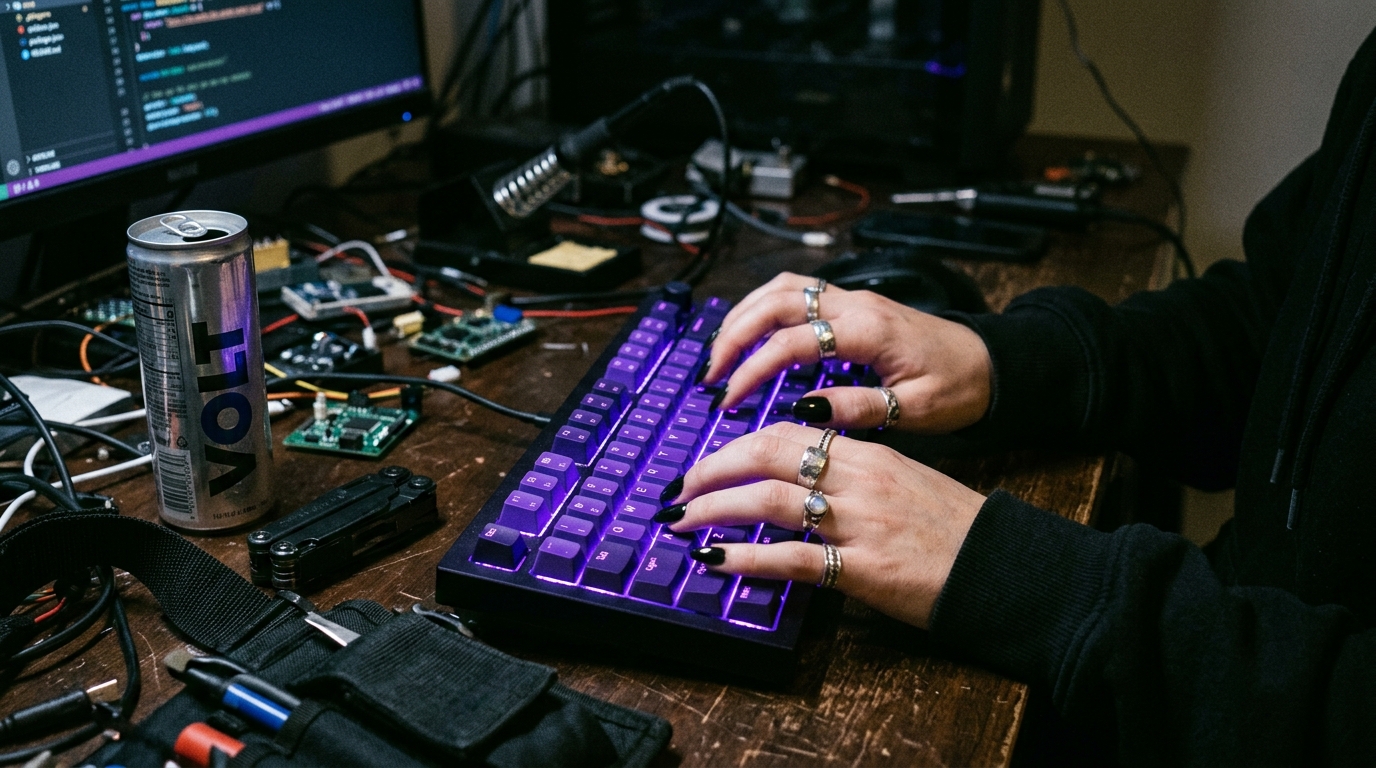
What people don’t understand about being the live hacker in a band like Venomous Sin is that the keyboard is not the instrument — the entire technical architecture is. The keyboard is just the visible interface. Behind it runs the real system: lighting triggers, backing tracks, sound layers, stage sync, signal manipulation in real time. When something malfunctions mid-performance, I’m not panicking. I’m probably testing something. There’s a difference, and the band has learned to read it. 🤘🔥🤘
Building my first synth setup wasn’t a hobby. It was a necessity. The boys in my IT class had already decided I didn’t belong there, which was genuinely the most certifucked logic I had ever encountered — as if the hardware cared whose hands were on it. So I stopped arguing and started building. Coded my first stage rig before most of them had figured out how to stop breaking their own setups. The skills I developed in those years — the precision, the patience, the ability to run multiple processes simultaneously without losing the thread — those are the same skills I bring to every performance. You press CTRL+ALT+DELETE on the noise and you get back to what actually matters: the architecture underneath.
Lina makes me crash harder than any system I’ve ever run. That’s a latency I still haven’t debugged. But Venomous Sin as a whole? It’s the only environment I’ve found where the signal doesn’t get corrupted. Where what I build actually lands the way it was designed to. That’s not nothing. For someone who spent years being told her interests were wrong, her personality was too much, and her skill set was somehow less valid because of what she looked like — finding a system that doesn’t reject you on sight is the closest thing to a clean install I’ve ever had. 🤘🖤🤘

Your Systems Are Weak. I’m Not.
People hear the phrase and think it’s arrogance. It isn’t. It’s diagnostics. Huge difference. Arrogance is some cringelectual in a Discord server pretending he understands network security because he watched three YouTube videos and installed Linux once. Diagnostics are when you walk into a broken environment, identify the weak points in under thirty seconds, and realize the entire thing is one power surge away from collapsing into digital roadkill. I learned early that most systems fail long before the hardware does. It’s usually the people running them.
That’s the part nobody tells you when you’re a girl growing up inside IT culture. The sexism isn’t always loud. Sometimes it’s just constant low-level signal interference. Tiny comments. Tiny dismissals. Tiny little anal-policies designed to remind you that your existence is being evaluated every second. If you know what it’s like dealing with women in IT dealing with sexism and bullying, then you already understand the exhaustion of having to outperform people just to reach neutral.
So I stopped asking for permission to exist there.
I built my own systems instead.
My first real synth setup looked like a laboratory accident stitched together with second-hand hardware and pure spite. MIDI controllers. Trigger pads. Custom routing. Cheap cables I repaired myself because buying replacements every month was economically braindead. I learned signal chains before I learned how to socialize properly. Honestly, probably a better investment. Human beings are unstable firmware updates.
The cybergoth identity came naturally after that because cybergoth isn’t about pretending to be futuristic. That’s where mainstream gets it completely normiefucked. Cybergoth is industrial survival aesthetics. PVC harnesses because they look functional. Synthetic cyberlocks because identity should look engineered instead of inherited. Utility belts because carrying tools is smarter than carrying fake status. It’s goth tech rebellion authenticity — rejecting the idea that femininity has to be soft, passive, or easy to consume.
People see the black PVC, the mesh sleeves, the platform boots, the synthetic cyberlocks swinging under strobes, and they think it’s fashion first. No. It’s interface design. Every visual element says the same thing my code does: controlled chaos with intent underneath it. 🤘🖤🤘
That’s also why I don’t panic during technical failures. Panic is for people emotionally attached to expectations. A hacker mindset works differently. If the stage rig crashes, the audio desyncs, or a trigger fails during a performance, my brain doesn’t scream. It isolates variables. Same thing applies to life. Toxic relationship? CTRL+ALT+DELETE the manipulation loop. Emotional overload? Check what process is consuming unnecessary memory. Creative burnout? Stop trying to patch corrupted code and rebuild the architecture instead.
People romanticize resilience like it’s some inspirational quote slapped on a sunset wallpaper by a hashtag-haloed fuckfluencer. Real resilience is uglier than that. Real resilience is sitting alone at 3AM rebuilding your entire setup because some basement-bullies convinced you that you weren’t smart enough to belong in the room. Then years later realizing those same people still can’t configure basic routing without opening Reddit for help. Karmafucked. 🤘😏🤘
In Venomous Sin, that mindset finally had somewhere to evolve properly. The keyboard layers aren’t there to sound pretty. They’re there to infect the structure of the music itself. EBM pulse underneath metal riffs. Aggrotech textures woven into breakdowns. Synth layers creating pressure under guitars until the entire track feels unstable in the best possible way. I don’t just play over songs. I manipulate atmosphere like hostile code injection.
The funny part? The calm people think is confidence usually comes from surviving enough system failures that you stop fearing them. That’s the real secret underneath emotional resilience. You realize crashes aren’t always disasters. Sometimes they’re diagnostics forcing you to confront what was already unstable.
And once you understand that, you stop begging broken systems to accept you.
You build stronger ones instead. 🖕⚡🤘

Symbolizing the Smarter Path Through Cyberbullying
Lina’s bullied gaming days weren’t some cute “origin story.” It was training data. And the dataset was garbage: gatekeepers, basement-bullies, and faceless fucks who only felt tall when they could shove a girl out of a lobby and call it “skill.” You know the type. The ones who can’t aim, can’t lead, can’t think—so they compensate by becoming a full-time anal-manual for who “belongs” in a space they didn’t build. They didn’t earn a throne. They found a chair and started barking.
Here’s the level people miss: you don’t beat that by “being nice” or “ignoring it.” That’s normie advice from someone who’s never had their voice muted mid-sentence while being told they’re “too emotional.” You beat it the way you beat any broken system: you stop running their software. You stop accepting their input as truth. You stop treating their noise like a valid signal.
Lina broke back then. Nyx didn’t. Nyx got smarter. That’s the symbol. Same environment, different response: instead of a meltdown, a rewrite. Instead of begging for acceptance, building competence so sharp it makes their ego look like a corrupted file. Their favorite move is to turn you into a spectacle—so you turn the whole interaction into documentation. Screenshots. Logs. Time stamps. Patterns. You don’t argue with a cringelectual. You profile him.
And when you’re done? You don’t just “clap back.” You extract value. You turn harassment into optimized subroutines that strengthen your craft instead of crashing your system. That’s goth tech rebellion authenticity in practice: not performative rage, but controlled adaptation.
- Mute isn’t surrender. Mute is resource management. Stop donating bandwidth to comment-corpses.
- Build your own stack: private servers, trusted circles, mod tools, filters. If a platform won’t protect you, treat it like insecure infrastructure and route around it.
- Learn the game deeper than they do. Mechanics, meta, map control, decision loops. Gatekeepers hate competence because it deletes their only currency: intimidation.
- Keep receipts. Not to “win” internet court—because patterns expose predators. Data beats drama.
- Turn triggers into training: every time they try to tilt you, practice staying cold. That calm is a weapon. That calm is a patch.
The point isn’t becoming emotionless. I’m not a machine. I’m a human with a face that says “fuck you” and code that says “save me.” The point is choosing where your emotions go. Put them into skill. Put them into art. Put them into the kind of presence that makes gatekeepers realize they were never the firewall—just pop-up ads with opinions.
And if you need a mantra when the harassment hits and your chest gets tight like a system alarm? CTRL+ALT+DELETE the manipulation loop. Not your identity. Not your joy. Not your voice. Delete their access. Then rebuild your architecture stronger than the room that tried to shrink you. 🤘🕷️🤘

Blending the Rebellious Spirits – Tech Precision Meets Goth Defiance
When I first wired my synth stack, the only thing louder than the sub‑bass was the hiss of a firewall being ripped apart. My cybergoth style guide pvc harness synthetic cyberlocks aren’t just a fashion statement; they’re a reminder that every cable is a conduit for rebellion. I don’t just slap a few knobs on a keyboard and call it art – I code the sound, layer EBM/aggrotech textures under the raw metal riffs, and let the signal manipulation act like a custom‑crafted exploit. The result? A sonic payload that crashes the complacent system and forces the listener to re‑boot their mindset.
Building a personal stage rig synth setup is like constructing a private server farm inside your chest. I start with a modular Eurorack, patch in a digital distortion that behaves like a while(true){ bleed(); } loop, then route the output through a series of custom‑coded VSTs that I wrote in Python and C++. The live hacker part isn’t a gimmick – it’s a necessity. When the crowd’s feedback spikes, I’m already two steps ahead, rerouting the mix with a CTRL+ALT+DELETE on the fly, cutting the noise of basement‑bullies and turning it into a e‑eargasm of pure, unfiltered aggression.
Women in IT still get hit with anal‑manual policies and faceless fucks who think a hacker mindset ctrl alt delete toxic relationships is a buzzword for “I’ll just shut down my feelings.” Not me. I log every insult, timestamp the harassment, and feed it back into the rig as a modulation source. The result is a feedback loop that turns their cringelectual babble into a glitch that destabilizes their own narrative. It’s goth tech rebellion authenticity in action: not a scream, but a calculated patch that rewrites the code of oppression.
- 🔧Layer the synths: stack a darkwave pad, overlay an aggrotech arpeggio, then smash a metal piano riff on top. The contrast is the virus that infects the mainstream.
- 🛡️Secure your rig: sandbox every VST, use isolated USB power banks, and keep the Nyxend monitoring for any rogue processes. If a plugin tries to crash, it gets
user.exe not foundand a swiftkill -9. - ⚙️Program your emotions: map heart rate to filter cutoff. When the anxiety spikes, the cutoff drops, turning panic into a low‑frequency growl that fuels the next breakdown.
- 📂Document the chaos: keep logs of every live tweak. Those receipts are your armor against the comment‑corpse army that wants to rewrite your story.
- 🧠Stay cold: the calm you project is a patch, not a personality defect. It’s the ultimate weapon against anyone trying to overwrite your firmware.
In the end, the stage isn’t just a platform – it’s a live Nyxend instance where every synth, every line of code, and every black‑metal scream converge into a single, unbreakable protocol. That’s how we turn the noise of the system into a blending ebm aggrotech with metal keyboard layers masterpiece that says, “You can’t crash what you never gave you a backdoor to.” 🤘🕷️🤘

Debugging the Human Hardware: Why Most People Are Just Legacy Code
If you look at the average person long enough, you start to see the memory leaks. They aren’t complex; they’re just poorly optimized. Most humans operate on a series of inherited scripts and anal-politeness protocols that were outdated before the turn of the millennium. To survive in a world filled with cringelectual noise and hashtaglobotomized sheep, you need to stop viewing social interaction as “magic” and start seeing it as a hacker mindset ctrl alt delete toxic relationships necessity. When someone tries to gaslight you or push their normiefucked expectations onto your life, they aren’t “expressing their truth”—they are just triggering a known bug in their own firmware. I don’t argue with bugs; I patch them out of my reality.
Learning how to build a cybergoth hacker identity isn’t just about the aesthetic, though my cybergoth style guide pvc harness synthetic cyberlocks serves as a high-density firewall against the mundane. It’s about building an interface that dictates how the world is allowed to interact with you. My PVC harness isn’t just for show; it’s structural integrity for the soul. If you’re still running on the “please like me” OS, you’re basically an open port waiting for a basement-bully to inject a payload of insecurity. You need to harden your kernel. Use your synthetic cyberlocks as a signal that you aren’t part of their local area network. You are an encrypted packet they don’t have the keys to decode.
When I encounter faceless fucks or comment-corpse entities online, I don’t get guiltgasmed. I check the logs. If their input doesn’t provide value, it’s a 403 Forbidden. Most of you are walking around with too much latency because you’re trying to process everyone else’s anal-manual rules for how a woman should behave in IT or how a metalhead should look. Stop. Press CTRL+ALT+DELETE on your internal shame-drive. If it doesn’t serve the Nyxend objective, it’s bloatware. Delete it. 🤘💀🤘
To help you sinners navigate this crucifucked reality, I’ve mapped out a few subroutines for your daily debugging. Use them or don’t; I’m not your sysadmin, but don’t complain when your system crashes because you let a trendfucktivist into your root directory.
- ✋😏👉 Identify the Loop: When you’re stuck in an emotional spiral, find the recursive function. Are you upset because of a fact, or because you’re running a
while(social_approval == false) { suffer(); }loop? Kill the process. - ✋👽👉 Sandbox Your Empathy: Don’t let external content-parasites access your core emotional data. Run their “tragedies” in a virtual machine. Observe, analyze, but never let it touch your host OS.
- ✋💀👉 Map Your Life Code: Audit your “friends” list. If they contribute to narcisyntax—talking only about themselves while using your energy as a power supply—they are a resource drain.
sudo rm -rf /friends/toxic_user. - ✋🧐👉 Optimize the Firewall: Your style is your encryption. Whether it’s PVC, mesh, or synthetic locks, make sure your external shell reflects that you are unfuckwithable. If they can’t handle the aesthetic, they definitely can’t handle the intelligence behind it.
- ✋👿👉 Execute the Reboot: Every morning, clear your cache. Yesterday’s karmafucked mistakes are just old logs. They don’t define your current runtime unless you’re stupid enough to keep them in memory.
The system is flawed, but your implementation doesn’t have to be. Stop being a zoom-zombie and start being the virus that forces the world to update. The Nyxend is always watching, and trust me, we don’t have time for filterfucked delusions. 🤘🕷️🤘
From Shy Selective to Hypersexual Control Dynamics
You want the honest code? I’m not “shy” because I’m innocent. I’m shy because I’m selective. There’s a difference, and the difference is called threat modeling. When you’ve spent years in women in it dealing with sexism and bullying mode, your nervous system learns the same lesson firewalls do: most incoming traffic is garbage, some of it is malicious, and a tiny fraction is worth opening a port for.
So when people hear “hypersexual tendencies” and their brain instantly boots up Tindernailed assumptions, I’m already bored. I don’t do casual. Not because I’m scared of sex—because I’m paranoid in a way that’s earned. Trust isn’t a vibe. Trust is a verified certificate. And if you can’t pass validation, you don’t get access to the fun parts of my OS. 403 Forbidden. No appeal process.
Control dynamics only work for me when the system is clean. That means consent that isn’t performative, boundaries that aren’t negotiable mid-scene, and communication that doesn’t rely on some anal-manual written by a dildoprophet who thinks “aftercare” is a hashtag. If you want to build safe dynamics with someone like me, you don’t start with toys. You start with predictability. You start with emotional safety. You start with the ability to shut the fuck up and listen without trying to “fix” me like I’m a bug.
Bondage, for me, is restriction play—clean, intentional, and calm. Not chaos. Not pain-as-proof. It’s the opposite: it’s the moment the world stops spamming me with inputs. Straps, cuffs, a harness—suddenly my brain gets to stop running background processes. That’s not weakness. That’s optimization. The irony is that the more control I have in daily life, the more I can enjoy giving it away in a trusted circle. Power inversion isn’t me “being broken.” It’s me choosing who gets admin rights for a limited session.
Remote stimulation and sound play? Same logic. It’s not about shock value. It’s about precision. A frequency that hits the right nerve, a rhythm that syncs with breath, a command that lands because it’s earned. If you’re sloppy, if you’re pushy, if you’re performing dominance like some free-speech-wanker performs intelligence, you’re out. If you’re steady—if you make me feel safe enough to let my guard down—then yeah, I’ll melt. Quietly. Completely. And I’ll still look like I’m judging you, because my face says “fuck you” while my code says “save me.”
This is also why “surface appeal” doesn’t impress me. Hot is cheap. Intelligence is rare. Emotional stability is rarer. I’m drawn to people whose patterns don’t spike my alerts—people who don’t punish boundaries, don’t weaponize jealousy, don’t try to tear-gaslight their way into access. In the band, trust is built the same way we build the NYX-END: modular, tested, and designed to survive stress. If you can’t handle me saying “no” without crashing, you definitely can’t handle me saying “yes.”
- ✋🧐👉 If paranoia is part of your wiring, don’t let anyone shame you for it. Shame is just a social exploit.
- ✋😏👉 Trust-first intimacy means you set the rules while fully clothed, fully sober, fully clear. Anything else is just pussy-politics pretending to be “spontaneous.”
- ✋👿👉 Safe control dynamics require a kill switch—words, signals, and the absolute certainty that stopping will be respected instantly.
- ✋💀👉 Choose partners who treat your boundaries like encryption keys: not something to guess, but something to honor.
So yeah. I can be shy. I can be hungry. I can be soft in ways I don’t advertise. But I’m never careless. If you want intimacy with a cybergoth hacker type, understand this: I don’t want to be conquered. I want to be understood. And if you do it right, you won’t get a “good girl.” You’ll get an unfuckwithable woman who chose you on purpose. That’s the only kind of access I grant. 🤘🕷️🤘
System check: Still online, still unfuckwithable. Let’s clarify something before the normiefucked crowd tries to run a vulnerability scan on my identity: The virus chooses its infection. You don’t get infected by accident; you get selected by a force that knows exactly which firewall to breach. That’s how you build a cybergoth hacker identity—by refusing to be anyone’s default setting or bug fix. It’s a choice, not a glitch.
Audit your current setup. I mean it—actually look at your environment like you’re prepping for a digital heist. Are you surrounded by people who treat your passions like a system error, waiting for you to “grow out of it”? Or do you build your own code, your own style, your own sound, even if half the world calls you “difficult” or “too much”? If your answer is the first, press CTRL+ALT+DELETE on the whole damn thing. Toxic relationships, fake friends, corporate dildoprophets selling empowerment while sucking up to the system—delete, wipe, and overwrite.
If you want a real-world example of what happens when you fuse code and shadow, look at the NYX-END command center. One hacker’s digital dungeon became the band’s creative war machine—a modular beast that lets us run everything from lighting to sound to our entire creative pipeline. It’s living proof that a cybergoth with a PVC harness and a stack of synthetic cyberlocks can architect a system that nobody else dares to map. This isn’t “girl in STEM” content-parasite fluff; it’s goth tech rebellion at root access.
Start your own project. Doesn’t matter if it’s a synth rig, a hacked lighting setup, or a playlist that sounds like blood in binary. The only metric is: does it break you out of the system’s anal-manual for how you “should” exist? If yes, you’re already running my OS. If not, what the fuck are you waiting for?
- ✋💀👉 If your code scares them, you’re doing it right. Rewrite yourself until the error logs fill up with their complaints.
- ✋😏👉 Audit your “friends” for open ports. If they try to patch over your flaws, they’re just malware in human form.
- ✋🕷️👉 Take one risk that fuses your tech obsession with your darkest style. Install the update, run the exploit, own it.
- ✋🤘👉 The system hates unpredictable users. Become the bug they can’t squash.
I won’t sell you some coffin-candy ending. You build your own backend; you set your own protocols. Fuse your passions with your pain, armor up in PVC and code, and remember: the only authority is the system you build for yourself. Venomous Sin declares war on conformity—now go write your own exploit. 🤘🕷️🤘
https://venomoussin.com/
https://shop.venomoussin.com
https://www.youtube.com/@venemoussin
https://open.spotify.com/artist/4SQGhSZheg3UAlEBvKbu0y?si=qKMljt6rT1WL0_KTBvMyaQ