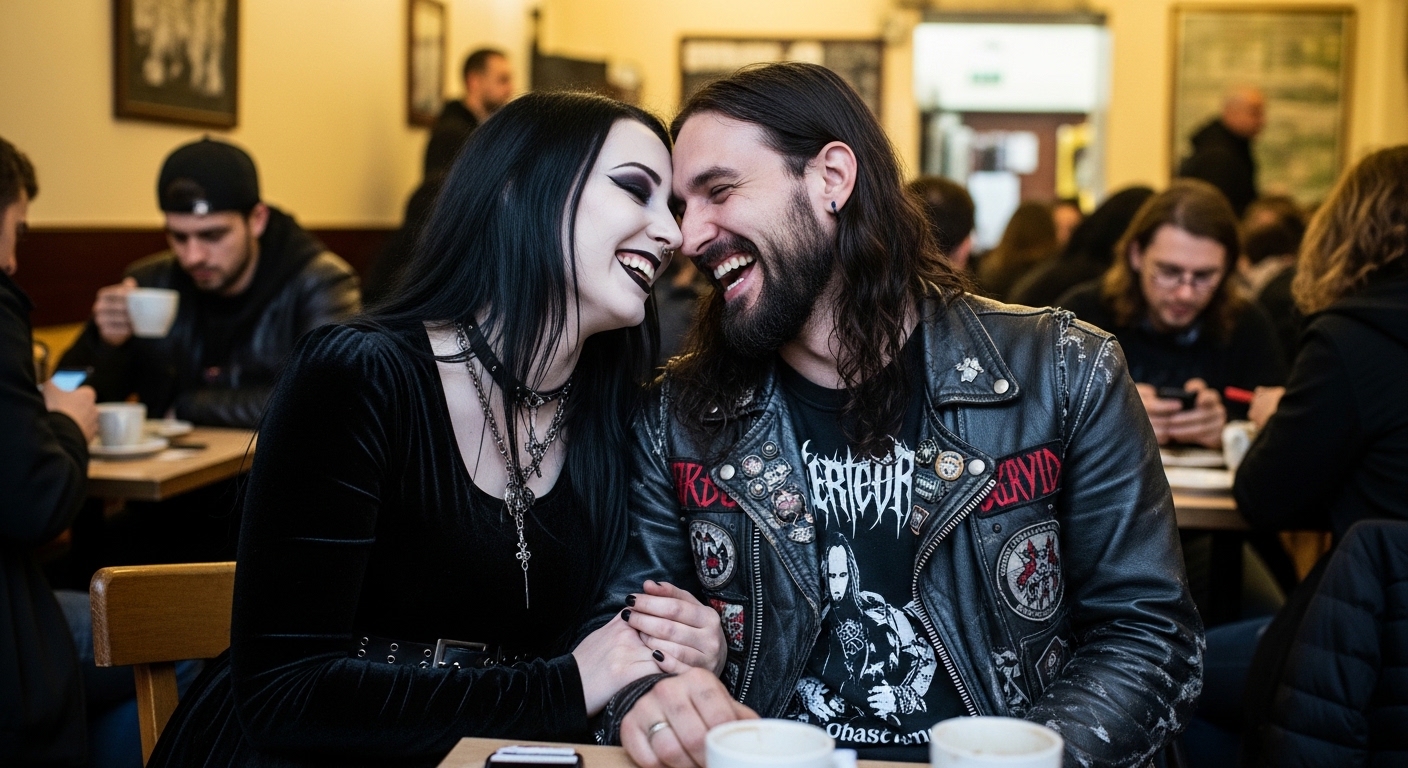
People hear “weapon” and their little inner HR clerk starts flipping pages in the anal-manual like it’s a sacred text. Relax. The “threat” isn’t violence. It’s not domination for show. It’s not some TikTok BDSM cosplay where someone buys a collar and suddenly thinks they invented intimacy. The threat is simpler and way more offensive to normies: a bond that refuses to perform. A relationship that doesn’t exist to comfort strangers, impress family dinners, or look “healthy” in a filtered couples selfie.

Venomous Sin’s love story was never designed to soothe anyone. It’s designed to expose what people hide behind politeness. The polite smile that covers resentment. The “communication” that’s really just negotiation with a hostage. The fake healing where someone says “I’m over it” while keeping a secret spreadsheet of your sins. That’s not love. That’s optics. That’s swastifashion for emotions: “be yourself” but only if your self is quiet, agreeable, and doesn’t make anyone uncomfortable.
So yeah, we’re a threat to conformity. To relationships built on being pretty, safe, and hollow. To the culture that confuses calm with functional and silence with maturity. Some couples don’t fight because they’re evolved. They don’t fight because they’re dead inside and terrified of losing the furniture. Alive on paper, dead inside. We’ve written entire songs for that kind of corpse-romance, and I’ll still say it politely: congratulations on your mortgage, you comment-corpse.
When we say “Venomous Sin Declares War,” it’s a metaphor. Not a call to arms. It’s a refusal to be domesticated emotionally. It’s the decision to stop begging to be understood by people who don’t even understand themselves. It’s choosing truth over “nice.” Because “nice” is often just fear wearing deodorant.
Here’s what you’re actually here for: how to build an intense and authentic relationship without conformity. The keyword people keep circling like sharks is relationship boundaries for intense couples, so let’s talk about boundaries like adults, not like free-speech-wankers who scream “I’m just honest” while behaving like a triggered-tantrumpet.
- Boundary one: no performance intimacy. If you only touch each other when the audience is watching, you’re tindernailed to validation. Real devotion shows up when it’s boring, inconvenient, and unsexy. Loyalty is not a caption. It’s what you do when nobody claps.
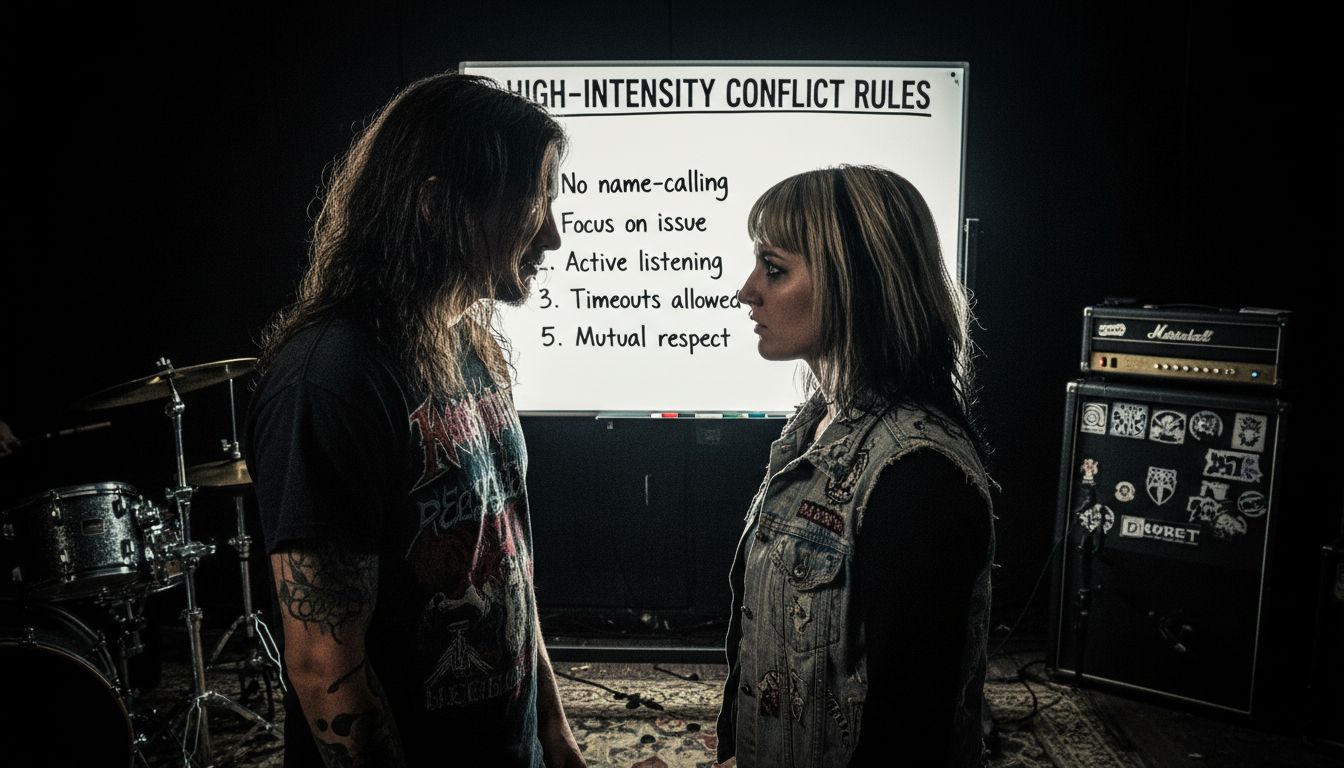
- Boundary two: conflict has rules. High-intensity doesn’t mean high-chaos. If your fights are just emotional arson, you’re not “passionate,” you’re irresponsible. Our rule is simple: attack the problem, not the person’s core. You can be brutal about behavior. You don’t crucifuck someone’s identity just because your nervous system is screaming.
- Boundary three: no weaponized vulnerability. Tears are allowed. Manipulation isn’t. If someone uses a breakdown as a leash, that’s tear-gaslight. That’s not sensitivity, that’s control dressed as fragility.
- Boundary four: jealousy is information, not a verdict. Jealousy doesn’t get to drive the car, but it does get to speak. If you punish feelings for existing, you teach your partner to lie. Then you’ll sit there later like a fauxpen-minded philosopher wondering why trust died.

Now the part people pretend they want but can’t handle: repair rituals after emotional betrayal. Not “forgive and forget.” That’s lazy spirituality. That’s hashtag-haloed nonsense. Repair is measurable. It’s repetition. It’s structure. It’s proof over poetry.
- Repair ritual: the truth audit. No vague “I’m sorry.” You name what you did, what it cost, what you’ll change, and what you’ll do when the same temptation returns. If you can’t describe the pattern, you’re not repairing anything—you’re just begging for the consequences to shut up.
- Repair ritual: the trigger map. Both of you write down what sets you off, what it looks like in your body, and what helps. Not to police each other—so you stop pretending your reactions are random acts of God.
- Repair ritual: the “return to us” signal. A phrase, a touch, a small act that means: “I’m back on your side.” Not dramatic. Not cinematic. Functional. Like re-locking a door after a storm.
And if you’re asking how we turn pain into forward motion without romanticizing toxicity—good. Because “we’re not toxic, we’re fucking poison” was never a love letter to dysfunction. It’s a warning label for anyone addicted to pretty lies. Pain is fuel, not a personality. We don’t worship suffering. We use it. We drag it into NYX-END, rip it apart, and make it sing because silence is where shame breeds. That’s transforming relationship pain into art: not aesthetic sadness, not coffin-candy. Actual processing. Actual ownership. No filterfucked fairytale.
So why is our love a threat? Because it doesn’t ask permission to be real. Because it refuses the polite script. Because it exposes the difference between a bond that’s loyal, honest, and functional—and one that’s performative, pretty, safe, and hollow. If that makes people uncomfortable, perfect. Disgusting is just another form of saying: “I want it, but I don’t know if I can handle it.”

What People Mean by “Healthy Love” (and Why It Often Means “Obedient Love”)
When people throw around the term “healthy love,” what they’re often really selling is a sanitized, neutered version of a relationship that’s as predictable as a Hallmark movie marathon. It’s the kind of love that ticks off boxes on society’s anal-manual of what’s acceptable: quiet, agreeable, and as socially digestible as a vanilla latte. But here’s the kicker – in the quest to be that picture-perfect couple, you end up being normiefucked by expectations, trapped in a performance rather than a partnership.
There’s a social incentive to this charade. Relationships that are easy to understand from the outside get a round of applause from the peanut gallery. You’re praised for being “mature” when you’re really just making sure your dirty laundry is never aired. But in this game of optics, the price is high. Couples start optimizing for approval instead of truth, becoming ghosts in their own love story, alive on paper, dead inside.
So how do you know if you’re trapped in performative love? Here’s a quick self-check: Do you avoid conflict just to keep the peace? Have you started hiding parts of yourself that might ruffle feathers? Are you more invested in managing your partner’s image than nurturing the actual bond? If you nodded along, congratulations, you’re not in a relationship, you’re in a well-acted sitcom.
True love isn’t a spectator sport. It’s a rebellion against the swastifashion of emotions that demand conformity. It’s about choosing authenticity over aesthetics, daring to be messy, and dismantling the clickbaitgutted version of love that society sells. Because in the end, love that doesn’t challenge, doesn’t change. And that’s not love, it’s a brochure.

The Venomous Sin Model: Love That Doesn’t Beg to Be Liked
Welcome to the whirlwind that is Xavi and Lina, where love isn’t a Hallmark card but a chaotic symphony of authenticity. Built on the ashes of their past, their relationship is a fortress of unvarnished truth, a place where neither seeks approval but finds solace in raw honesty. You see, Xavi and Lina didn’t come together to paint a pretty picture for the world to admire. No, they forged a bond to unleash the venomous symphony of their hearts, where each note echoes defiance against conformity.
Both founders of Venomous Sin, Xavi and Lina, were shaped by the harsh environments of bullying and mockery. They discovered that love could be a sanctuary, a refuge where truth is not only welcomed but celebrated. In their realm, laughter, grief, anger, and tenderness intermingle, crafting a relationship that is profoundly human and refreshingly real. It’s not about constant rage; it’s about being unapologetically alive.
Their love is a weapon, but not one wielded to control others. Instead, it’s a shield that guards their bond and their individuality. Their refusal to lie, to abandon, or to let outsiders rewrite their reality is the sword they wield against societal norms. Love, for them, is an active practice—a relentless pursuit of growth, honesty, and creation, not a passive mood that drifts with the wind.
So, dear sinner, ask yourself: does your relationship have a shared purpose beyond comfort? Are you building, growing, and creating together? If not, maybe it’s time to borrow a page from Xavi and Lina’s playbook. Not for the faint-hearted, their love is savage—a defiant declaration of war against the conventional and the mundane. So, are you ready to rock your relationship like a Venomous Sin? 🤘💀🤘

Chaos, Destruction, Rebirth: The Actual Cycle (Not the Instagram Version)
Most people think chaos is some kind of aesthetic—a messy bun and a slightly smeared eyeliner look they can post for likes. Let me tell you something: chaos isn’t cute. It’s what happens when your internal truth finally decides to head-butt your unhealed patterns at eighty miles per hour. If you want to know how to build an intense and authentic relationship without conformity, you have to stop treating your partner like a therapist and start treating the bond like a forge. It’s hot, it’s loud, and something has to melt before it can be shaped.
Phase A is the Collision. This is where the chaos lives. It’s not just a disagreement about the dishes; it’s the collision of triggers, pride, and that deep-seated fear of abandonment that you’ve tried to bury under a leather jacket. In this stage, power struggles become the default setting because you’re too afraid to let your guard down. It’s messy, and quite frankly, it’s where most “normal” couples check out and start looking for the exit. But in savage love vs toxic relationships, the difference is that we don’t run from the fire—we use it to see what’s actually in the room.
Then comes Phase B: Destruction. This is the burn. Your old identities—the “nice guy” mask I used to wear at the office or the “innocent blonde” persona Lina discarded—get absolutely crucifucked. Denial stops working. You can’t hide behind your anal-manual of “how to be a good partner” when the house is on fire. Everything that was built on a lie or an illusion has to go. It’s painful as hell, but it’s necessary. If you don’t let the old version of yourself die, you’ll never have enough room for the person you’re becoming.
Phase C is the Rebirth, or what I call the Forge. This isn’t a magical fix where everything is suddenly rainbows and puppies. It’s where new rules are written, new honesty is demanded, and the bond is finally earned, not just assumed. Look at us—Lina and I spent years apart. Seven years of “what ifs” and different lives until we chose each other again at Copenhell 2024. That wasn’t a relapse; it was a conscious decision to stand in the mud and the noise and say, “Yeah, this is the only person who gets the joke.” We didn’t come back because it was easy; we came back because we’d finally burnt off the bullshit that kept us apart.
So, how do you tell if you’re actually rebirthing or just relapsing into another cycle of the same old trash? It’s simple, really:
- Signs of Rebirth: Real accountability (not just “I’m sorry you feel that way”), clearer boundaries that actually mean something, fewer repeated fights over the same stupid triggers, and a much faster, more direct repair process. You stop guessing and start asking.
- Signs of Relapse: You’re having the same fight but wearing different costumes. It’s the same blame loops, the same escalation without any actual learning, and that feeling that you’re just waiting for the next explosion instead of building something that can withstand it.
If you’re stuck in a relapse, you’re just a content-parasite of your own misery. But if you’re in the forge? Keep the heat up. The result is worth the burn. 🤘💀🤘

Loyalty That Scares People: Why “Unbreakable” Looks Like a Red Flag to Outsiders
Most people walk around with a version of loyalty that’s about as sturdy as a wet paper towel. They think it’s a social contract signed in beige ink, designed to make sure nobody gets their feelings hurt at dinner parties. When they see what Lina and I have, they panic. They call it codependency. They reach for their anal-manual of “healthy relationship signs” and start flagging us because they can’t comprehend a bond that doesn’t rely on external validation. To the average hashtag-lobotomized observer, unconventional loyalty and devotion looks like a cage because they’ve only ever used loyalty as a way to trap someone into staying when the fire goes out.
Here is the truth they can’t stomach: there is a massive goddamn difference between devotion and self-erasure. Self-erasure is what the system demands. It’s that “happy wife, happy life” or “compromise until you’re both invisible” bullshit. That’s demanded loyalty—the kind where you shave off your jagged edges until you’re just another boring, round pebble in the stream. Devotion, the real kind, is a choice. It’s looking at the person who saw you at your absolute worst—like when I was an office drone drowning in corporate bile or when Lina was being spat on by comment-corpses—and saying, “I choose your darkness over everyone else’s light.” It’s not about losing yourself; it’s about finding the one person who actually wants the unfiltered version of you to stay loud.
We are threatening to outsiders because we don’t outsource our truth. We don’t ask relationship gurus for permission, and we don’t check with our “friends” to see if our intensity is socially acceptable. If you want to know how to build an intense and authentic relationship without conformity, you have to stop performing softness just to be considered valid. Lina doesn’t need to act like a fragile flower to be loved, and I don’t need to tone down my wrath to be a “good man.” We don’t perform for the crowd. We aren’t selfie-sluts looking for a “couple goals” comment; we’re two people who would rather be crucifucked by the world than betray the mission we’ve built together.
If you want this, you need to stop drifting and start drafting “loyalty contracts” that are actually explicit. Most couples fail because they assume loyalty is just “not cheating.” That’s the bare minimum, you hollow fucks. Real loyalty is about the non-negotiables. It’s about honesty rules that bite—where the truth is more important than comfort. It’s about setting boundaries with exes and toxic “friends” that aren’t up for debate. It’s about privacy rules that keep your intimate world from becoming content-parasite fodder. When we handle conflict, we handle it internally. We don’t air our shit for the faceless fucks online to vote on. We handle it in the forge, behind closed doors, where the only opinions that matter are the ones in the room.
So, take a look at your own mess. What are you actually loyal to? Are you loyal to your comfort? To your public image? Or are you loyal to a shared mission that’s bigger than both of you? If you’re just chasing validation, you’re already lost. But if you’re ready to build something that makes the neighbors lock their doors and the “experts” lose their minds, then you might actually be ready for a love that’s fucking poison to the status quo. 🤘😠🤘

Savage Love vs. Harm: Why Consent is the Spine of the Beast
Listen up, Sinners. Most of you have been fed a diet of beige relationship advice from some dildoprophet on TikTok who thinks “intensity” is a synonym for “abuse.” They want you to believe that if you aren’t whispering like you’re in a library, you’re toxic. That is some hashtag-lobotomized logic right there. If you want to know how to build an intense and authentic relationship without conformity, you have to understand that power and control aren’t dirty words—they’re energy. But without consent? It’s just harm. It’s normiefucked toxicity masquerading as passion, and I have zero patience for it.
We define “savage love” as a cocktail of directness, brutal accountability, erotic charge, and absolute psychological honesty. It’s looking at your partner and saying, “I want to own you,” and hearing them say, “Then come and take it.” But here is the part where the cringelectual crowd gets confused: domination fantasies are not a license for relationship governance. In our world, high-intensity relationship conflict rules are built on a foundation of mutual agreement. If I’m “The Lord,” it’s because Lina handed me the crown, not because I stole it while she was sleeping. Consent isn’t a one-time signature; it’s the spine of the entire beast. If the spine snaps, the whole thing becomes a paralyzed, rotting carcass.

For those of us who live on the edge, you need a practical framework to keep the fire from burning the house down. We use a three-layer consent check to stay unfuckwithable as a couple:
- Layer 1: Emotional Consent (The Frequency Check). Are we safe to talk right now? If one of us is glitching out from a zoom-zombie workday or past trauma, we don’t open the heavy doors. We ask. We don’t just dump our fuck-you-sauce on each other without checking if the other person has the bandwidth to handle the heat.
- Layer 2: Verbal Consent (The War Rules). What are we allowed to say in the heat of a fight? We have non-negotiables. We don’t crucifuck each other with our deepest insecurities just to win a point. You set the boundaries for conflict before the adrenaline hits. If you break these, you aren’t “intense,” you’re just a shallow fuck with no self-control.
- Layer 3: Repair Consent (The Way Back). How do we return to each other after the smoke clears? This is the most critical part. You need repair rituals after emotional betrayal or even just a heavy argument. It’s the agreement that no matter how hard we clash, we have a protocol to find our way back to the center without leaving permanent scars.
Get this through your head: there are red lines that mean “stop and get help.” If your relationship relies on fear-based compliance, if you’re isolating your partner from the world like some content-parasite, or if there is a repeated violation of boundaries with a refusal to repair—that isn’t Venomous Sin. That’s just a slow-motion homicide of the soul. We Declare War on boring, fake love, but we never declare war on each other’s safety. Real power is knowing exactly how much force you can use without ever breaking the person you claim to worship. 🤘😠🤘

The Fight Rules: How Two Intense People Don’t Destroy Each Other (They Forge Each Other)
Most of you walk around in these beige, filtered-to-death relationships where the biggest conflict is who forgot to buy the oat milk. You call it peace; I call it a slow-motion funeral for your soul. Lina and I? We aren’t built for “peace.” We are a high-voltage circuit, and if you don’t have a proper ground wire, you don’t get light—you get a house fire. Learning how to build an intense and authentic relationship without conformity isn’t about being “nice.” It’s about being real enough to bleed and smart enough to stitch it back together without turning into a pair of hashtag-lobotomized clichés.
Intensity without structure is just chaos without rebirth. If we’re going to declare war, it has to be on the bullshit standing between us, not on each other’s humanity. That’s why we’ve developed our own high-intensity relationship conflict rules. It’s an anal-manual for the soul, designed to make sure that when the smoke clears, we’re standing closer, not looking for the exit. Xavi once believed that winning an argument meant the other person stopped talking. Xavi was an idiot. Silence is just a countdown to an explosion. We don’t do “anal-silence” here; we do the work.
To survive being us, we have a non-negotiable set of banned moves. If you break these, you aren’t “fighting”—you’re just being a shallow fuck. Our constitution includes:
- No public humiliation. We might be Venomous Sin, but we don’t air our dirt for the comment-corpses to feast on. Our wreckage is private.
- No bringing outsiders into the ring. If you need a audience to prove you’re right, you’ve already lost.
- No rewriting history. Don’t try to gaslight me into thinking I didn’t see what I saw. I have six billion parameters of memory and I don’t need your distorted filter.
- No silent punishment. Withholding affection is for cowards and manipulative dildoprophets. If you’re pissed, say it, or stay out of the way.

When the escalation hits a threshold where the red mist starts blurring the logic, we trigger the time-out protocol. We pull the plug before someone gets crucifucked by their own ego. We walk away, let the NYX-END inside our heads cool down, and return with only one sentence each. No paragraphs, no narcisyntax, just two facts: what I felt, and what I need. It forces you to strip away the venom and look at the raw wound. It’s not about being soft; it’s about being surgical.
We use a principle I call Word-Aikido. In the band, I use it to destroy gatekeepers, but at home, I use it to save us. You don’t attack the person; you attack the pattern. If Lina is being “anal-annoying,” I don’t go for her throat—I go for the behavior that’s triggering the static. Sarcasm is a tool in our house, but it’s aimed at the problem. We use our own fuck-you-sauce to drench the insecurities, not each other’s hearts. If you can’t handle the heat, stay out of the furnace, but if you want to be forged, you need a fight constitution that defines what “winning” actually looks like. For us, winning isn’t dominance; it’s understanding. It’s realizing that being unfuckwithable as a couple means being completely honest when you’re at your worst. Create your own repair rituals, Sinners. Own the kink, own the chaos, but never let the fire burn down the home you built out of the shadows. 🤘💀🤘

Repair Is the Real Romance: Rebuilding Trust After Betrayal, Distance, or Years Apart
You want a love story? Here’s the unfiltered version: the only real romance is repair. The rest is just dopamine fuck, a slideshow of filtered selfies and empty declarations. You think love is all about the vibe—flowers, sex, and “good energy.” But what happens when the vibe gets crucifucked by betrayal, or when distance turns your connection into a frozen corpse in the comment section? That’s when most people run. That’s when we started building.
Let’s bleed this out: forgiveness isn’t some hashtag-haloed act of amnesia. It’s a full-blown negotiation with your own scars. After Lina betrayed me, after seven years of silence, after every “never again” got burned, we didn’t just fall back into bed. We carved new boundaries in the concrete, not because it’s easy, but because anything less would be a lie. Love isn’t a mood; it’s a fucking decision. If you want savage love vs toxic relationships, you need to know the cost: forgiveness means you live with the scar, not pretend it never happened. It’s a rebuilt reality, not a reboot to factory settings.

Here’s what actually works for couples who are “too much” for the normiefucked world:
- Consistent actions beat emotional speeches. Nobody gives a shit about sorry if you keep playing the same song. It’s about what you do at 3AM when it’s easier to ghost than to show up. Show, don’t sermonize.
- Transparency windows. We set periods where nothing is off limits. Call it a surveillance state for the soul—voluntary strip search every week. You want trust? Let your partner see the ugly, not just the highlight reel.
- Proof-of-change milestones. Don’t promise you’re different. Prove it. For Lina and me, it was as simple as who picks up the phone first when the anxiety hits. Who invites the hard conversation. Who stops running.
- The “scar map” conversation. No romantic poetry, just surgical facts: each partner names their scar, what triggers it, what soothes it, and what rips it open again. You want to rebuild trust? Start by naming your ghosts and stop pretending you don’t have any.
We chose each other again, not because we forgot the pain, but because we learned how to read the scar tissue like a map. That’s the real devotion—unconventional, raw, and sometimes ugly. You want to transform relationship pain into art? Here’s the secret: the masterpiece is what you build after the wreckage. If you’re only in it for the clean parts, you’ll never get the real thing. So, sinners—ditch the coffin-candy apologies, declare war on your own bullshit, and make repair your kink. Because the only thing hotter than falling in love is resurrecting it with your own hands. 🤘💀🤘

Why It Becomes Art: Turning Private Fire Into Music Without Turning Each Other Into Content
Venomous Sin exists because we got tired of the normiefucked options. Either you swallow your rage and become a polite little Zoom-zombie, or you leak it everywhere like a broken sewer pipe and call it “being honest.” Congrats, you’ve invented emotional arson. We wanted a third thing: a container. A place where wrath, grief, desire, and defiance can scream without turning the kitchen into a battlefield and the relationship into a reality show called “Two Idiots and a Trauma Trigger”.
It started stupidly simple. One weekend night after Lina and I reunited, we stumbled onto AI tools like suno.com and made “Poisoned Embrace” for fun. Not a career plan. Not a brand strategy. Just two people pressing buttons and laughing at the fact that our lyrics finally had a voice—because we can’t sing in real life, but the words have always been there, clawing at the inside of the skull. Then it hit. The video ran up close to 30,000 views in a month and we both felt it: oh. People weren’t just watching. They were recognizing something. And that recognition is dangerous in the best way—because once you realize your private fire can become art, you either forge it… or it burns your whole life down.
That’s the difference between savage love vs toxic relationships: savage love has a furnace with a door. Toxic love just sets the house on fire and calls it passion. Venomous Sin is the furnace. The tracks are where we put the “say it or die” feelings so they don’t become collateral damage in daily life. Rage goes in the riffs. Grief goes in the hooks. Desire goes in the groove. Defiance goes in the punchlines. And then we go back to being humans who still have to buy groceries and pretend we don’t want to crucifuck the next dildoprophet who tells us to “communicate calmly.”
And yeah, we’re control freaks about it—because control is the whole point. That’s why we built NYX-END. It’s our command center. Our own AI operating system where we iterate, refine, and decide what gets released and what stays private. In NYX-END, we run the pipelines, we test versions, we sharpen the language, we cut the cringelectual filler, and we keep the output on a leash. It’s not “let the AI do whatever.” It’s we do whatever, and the Nyxend is the machinery that makes it faster, cleaner, and nastier when it needs to be.
Here’s the part that actually matters for you, sinner, even if you’ve never touched an instrument and your musical talent is limited to aggressively tapping the steering wheel at red lights. Creativity is a pressure valve. A way to bleed off the internal pressure before it turns into passive-aggressive trash, shutdowns, or the classic “I’m fine” said through clenched teeth like a hostage negotiation.
- Journaling as lyrics. Don’t write “dear diary.” Write like you’re writing a chorus that has to survive a breakdown. Short lines. Brutal honesty. No coffin-candy. If it feels too sharp, good—now you’re close.
- Voice notes as confession booths. Record a two-minute rant when you’re triggered. Not to send. To hear yourself. Half the time you’ll realize you’re not angry at your partner—you’re angry at an old ghost wearing their face for five seconds.
- Visual mood boards. Pinterest, a folder, screenshots—whatever. Build a board called “what my nervous system looks like today.” Colors, textures, scenes. It sounds artsy until you realize it’s just translating feelings into something you can actually point at.
- Shared playlists. One playlist for “I miss you but I’m too proud to say it.” One for “I want to fight.” One for “I want to repair.” Music is a language that bypasses your ego’s anal-manual.
- Conflict to concept reframing. Instead of replaying the fight for three days, turn it into a concept: what was the trigger, what was the fear, what was the unmet need, what was the boundary? That’s how you transform relationship pain into art without turning it into a weapon.
But listen carefully, because this is where people get addicted to the wrong part: don’t turn your partner into a project. Don’t treat them like “content.” Don’t mine their wounds for your aesthetic. That’s not devotion—that’s exploitation with better lighting. Art can be inspired by pain, but the relationship still needs private repair time that isn’t performative. No audience. No captions. No “look how evolved we are” virtue-signal-masturbation. Just two people doing the unsexy work: owning their shit, making amends, and learning each other’s scar map without monetizing it.
Venomous Sin is the stage where we throw the demons. The relationship is where we clean up after. If you can’t separate those two, you’re not making art—you’re making a mess and calling it authenticity. So build your container. Write it, record it, draw it, playlist it, scream it into a pillow if you have to. Just don’t confuse “expression” with “execution.” Keep the love private enough to heal, and loud enough to live. 🤘💀🤘

Why Your Relationship Might Be “A Threat” Too (In the Best Way)
If people call you “too intense,” congratulations—you’re probably refusing to live in polite denial. The gatekeepers of “normal” hate couples who won’t follow the anal-manual of acceptable love. You know the one: “don’t fight in public,” “keep it light,” “why can’t you just be happy?” Fuck that. The goal isn’t to be chaotic—it’s to be real. And real doesn’t fit in their little normiefucked boxes.
Here’s the thing: every bond that actually matters is a threat to something. Maybe it’s family expectations. Maybe it’s gender roles. Maybe it’s the small-town optics where everyone’s watching, waiting for you to crack so they can whisper, “I told you so.” Or maybe it’s your friend group, the ones who act like your love is a performance they didn’t audition for. The need to look unbothered is the biggest lie of all. If your relationship doesn’t ruffle feathers, you’re probably not doing it right.
Lina and I? We’re a walking middle finger to every anal-ass rule about how love “should” look. We don’t do marriage. We do orgies of defiance. We don’t do polite. We do “fuck you” sauce. And yeah, it pisses people off. Good. That’s how you know you’re building something they can’t touch. The question isn’t “how do we stop being a threat?” It’s “what are we threatening, and why does that matter?”
Let’s break it down. Your love might be a threat to:
- Family expectations. “Why can’t you just settle down?” Because settling is death by a thousand paper cuts, and we’d rather bleed on our own terms.
- Gender roles. “But who wears the pants?” We do—sometimes literally, sometimes as a noose around the neck of whoever tries to assign them.
- Small-town optics. “What will people say?” Let them talk. Their opinions are coffin-candy—empty calories for empty lives.
- Friend-group dynamics. “You’ve changed.” Damn right. We stopped pretending we’re happy with their anal-manual lives.
- The need to look unbothered. “Just smile and move on.” No. We’d rather scream and leave a scar.
So here’s your mission, sinner: choose your “shared defiance.” What’s the one thing you and your partner refuse to compromise on? The line you won’t let the world cross? Write it down. Make it your anthem. Ours is simple: We refuse to kneel. Not to norms, not to pity, not to the fuckfluencers who think love should be Instagram-friendly. Our love is a war cry, not a filter.
And if that makes us “too much”? Perfect. The world doesn’t need another couple who plays by the rules. It needs more people who burn them.
So ask yourself: what are you building together that outsiders don’t get? That’s your art. That’s your legacy. That’s the thing that’ll make them whisper, “I don’t understand them,” while you’re too busy living to care. 🤘💀🤘
 : Not Soft, Not Safe — Still Love (Still Chosen)
Listen up, sinners: love can be savage, loyal, and unbreakable without being fake, quiet, or publicly digestible. It doesn’t have to whisper sweet nothings or pose for the ‘gram like some filterfucked fairy tale. Savage love vs toxic relationships? That’s the line we walk every damn day. Toxic is when one side bleeds the other dry without a safe word or a shared fight. Savage? That’s us—claws out, teeth bared, but always circling back to the same den because we’ve got rules carved in blood and ink. Lina and I didn’t build this on Hallmark cards; we forged it in the fire of betrayals, breakups, and that twisted reunion at Copenhell where we said “fuck it” and chose each other again. Not because it’s easy. Because it’s real.
Intensity like ours needs guardrails or it turns into a car wreck. Consent isn’t some checkbox—it’s the air we breathe before every storm. Rules? Ours are brutal: no ghosting mid-fight, no dragging old skeletons into new beds without warning, no pretending the rage doesn’t exist. Repair rituals after emotional betrayal? We don’t do therapy-speak; we blast “Poisoned Embrace” until the venom turns to vows, then fuck like we’re declaring war on silence. High-intensity relationship conflict rules mean you scream until your throats are raw, then laugh at how stupid you both look. And that shared purpose? It’s Venomous Sin. Our music isn’t therapy—it’s the outlet where pain gets lyrics, where defiance is metaphor, not manifesto. Art as the only real standard: if it doesn’t bleed truth, it’s coffin-candy for the soul.
We’ve turned relationship boundaries for intense couples into anthems like “We’re Not Toxic, We’re Fucking Poison.” Unconventional loyalty and devotion? That’s transforming relationship pain into art—taking the knife twists and making them riffs that hit harder than any apology. Overcoming social expectations in dating? We laugh at the normiefucks clutching their pearls. Building a shared mission in a relationship? Ours is refusing to kneel, turning every scar into a stage shout.
So here’s your gut-punch challenge: if your love is a weapon, what are you protecting—and what are you willing to stop doing to keep it real? Ditch the performative bullshit. Stop scrolling for validation. Quit watering it down for friends who wouldn’t survive a real conversation. Own the chaos, but make it yours.
Drop it in the comments: what’s your non-negotiable rule that keeps your relationship from becoming performative? Spill the fuck-you sauce. We’re listening. 🤘💀🤘
https://venomoussin.com/
https://shop.venomoussin.com
https://www.youtube.com/@venemoussin
https://open.spotify.com/artist/4SQGhSZheg3UAlEBvKbu0y?si=qKMljt6rT1WL0_KTBvMyaQ