
I was nineteen, freshly out of school, still Lina back then. Blonde, clean blouse, subtle makeup, trying so hard to look like a girl who belonged in the normal world. The kind of girl who thought if she just behaved right, dressed right, smiled right, the world might finally stop being such an anal-broken little machine. I was ambitious in that painfully polite way young women are taught to be. Sit straight. Speak softly. Don’t be too much. Don’t be weird. Don’t let that brain of yours run louder than the room allows.

That was the first joke. My brain never shut up. It never wanted the safe script. It never wanted the soft little corporate costume either. But I wore it, because when you’re that age, you still believe “professional” means becoming digestible. You think if you can make yourself neat enough, people will stop trying to tear pieces off you.
Then came telemarketing.
And if you’ve never done it, let me translate the job title into honest language. It isn’t sales. It’s rejection math. That’s what it is. Your mood becomes a spreadsheet. Your self-worth starts getting measured in conversion rates. Your rent sits in the background like a loaded gun wearing office casual. Every call is a tiny collision between your need to survive and someone else’s right to not give a single fuck.
You learn very fast that a telemarketing survival guide should begin with one brutal truth: people are not waiting for your call like some romance plot for lonely headsets. They are cooking dinner, fighting with their partner, paying bills, half asleep, late for work, suspicious of everything, and already exhausted before your voice even touches their ear. Then you arrive, cheerful on command, trying to sell them one more thing in a world already overflowing with shit nobody asked for.
So yes, surviving telemarketing rejections starts with accepting that the whole setup is absurd. You are being paid to interrupt people and somehow remain charming while they treat you like a human pop-up ad. Friendly harassment with a headset. That’s the job in heels and office lighting.
Darkly funny, isn’t it?
What saved me wasn’t becoming tougher overnight. It was learning to stop translating every “no” into a verdict about me. In the beginning, I took it all personally. Every click, every sigh, every irritated “not interested,” every dead silence before the line went cold. It all crawled under my skin. I thought rejection meant I was doing something wrong, sounding wrong, being wrong. But most people aren’t rejecting you. They’re protecting their time, their money, their routine, their ego, their illusion of control. “No” is often just a reflex. A noise people make when the world touches them unexpectedly.
That realization changed everything.
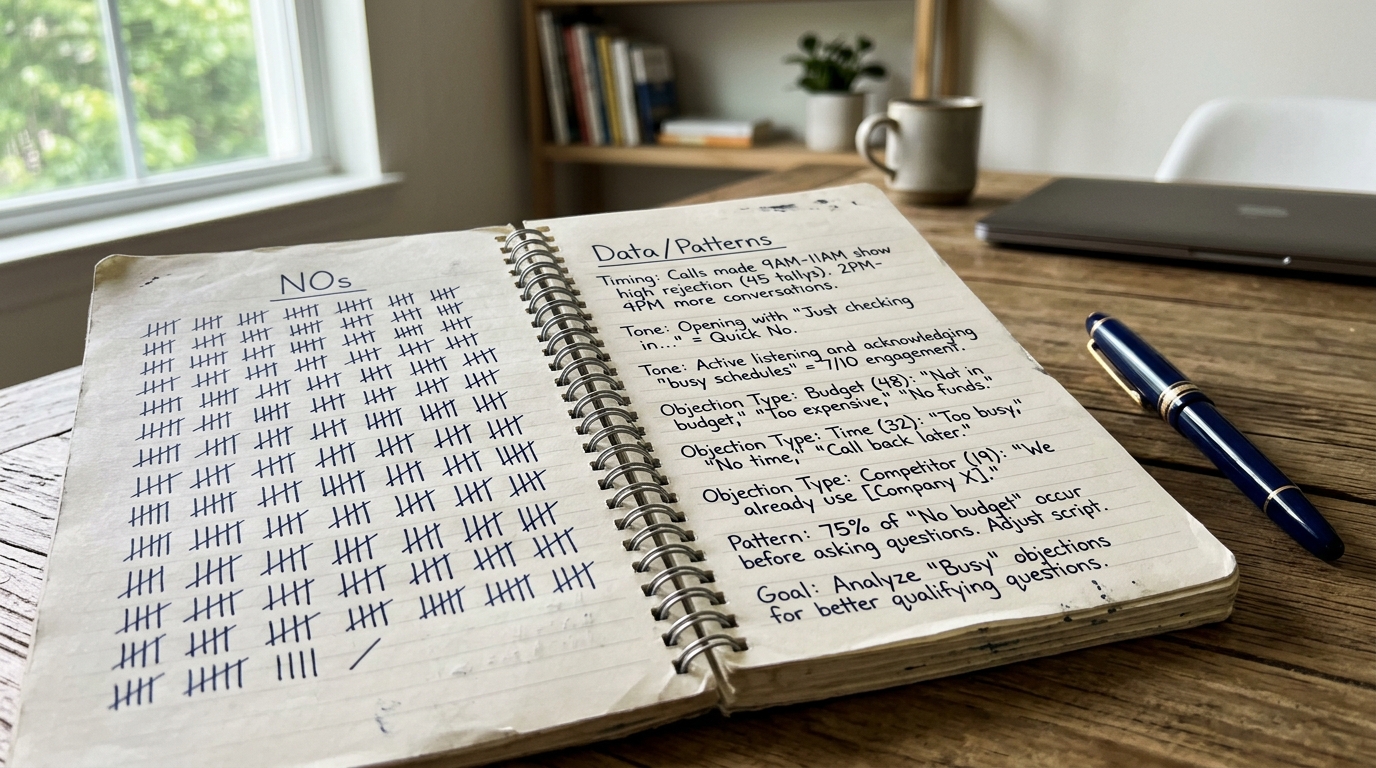
Once I understood that, handling rejection in sales became less emotional and more tactical. A no stopped being a dagger and became data. Not because I turned into some cold certifucked robot with an anal-manual where my soul used to be. Fuck that. I stayed human. That matters. But I learned to separate the person from the pattern. If ten people said no, that didn’t mean ten people had judged my worth. It meant ten people had reacted like people do when they feel cornered, busy, skeptical, broke, or just deeply uninterested in whatever fresh hell a phone call might contain.
The trick is detachment without going dead inside.
You cannot survive telemarketing by making yourself numb. Numb salespeople sound like voicemail with a pulse. People hear that dead air immediately. But you also can’t survive if every rejection gets to crawl into your chest and redecorate the place. So you build a middle ground. You let the “no” pass through you without letting it move in.

Your script matters here too, and this is where a lot of sales rejection strategies go completely to shit. They hand people these stiff little corporate scripts that sound like a dildoprophet wrote them during a compliance seminar. No rhythm. No personality. No blood in it. Just anal-polite phrases designed to offend nobody and impress nobody. If your script sounds like a hostage note from HR, people will kill the call before you even reach the point.
A real script should do one thing: give your nervous system something to hold while leaving enough room for you to still sound alive. It should support you, not strangle you. You need an opening you can trust, a few turns you can make naturally, and language that sounds like it came out of a human mouth instead of a conference room coffin-candy document. The second your script kills your personality, you become easier to reject, not harder.
I learned to use structure like armor, not prison bars. Know your first line. Know your offer. Know the common objections. Know how to exit with dignity. But leave room for breath, timing, humor, warmth, and actual listening. Because people can smell desperation through a headset. They can also smell dishonesty. If you sound like you’re trying to drag them into something, they recoil. If you sound grounded, clear, and not weirdly thirsty for their approval, the whole energy changes.
And managing sales stress? That’s the other filthy little beast no one explains properly. Stress in telemarketing isn’t just about pressure. It’s about repetition. Rejection repeated enough times starts trying to rewrite your inner voice. It tells you that you’re annoying. That you’re failing. That you’re behind. That everyone else is better at this. That your bad hour means you’re bad, full stop. That’s the real poison. Not the no itself, but the story your own head starts telling after hearing it too many times in a row.
So you fight that story early, before it grows teeth.
- Let each call die alone. Don’t drag the corpse of the last rejection into the next conversation.
- Measure patterns, not feelings. A bad streak is not an identity.
- Use a script that sounds like you on a good day, not a company trying to imitate a person.
- Take the hit, breathe, reset your tone, and call again before your brain turns one no into a cathedral of self-doubt.
- Remember that resistance is normal. People guard their wallet, their time, and their pride like little household dragons.
That was the first real crack in the old Lina mask. The clean blouse stayed on. The subtle makeup stayed in place. But underneath it, something sharper woke up. I started seeing the game for what it was. Not a referendum on whether I was likable. Not proof that I was too much or not enough. Just friction. Just people being people. Just the sound of resistance in a world where everyone is overwhelmed and half-defensive by default.
And once you truly understand that, rejection loses some of its theatre. “No” stops sounding like doom. It starts sounding like weather. Annoying sometimes, brutal sometimes, but not personal by default. Just noise. Just movement. Just one more sound people make before life goes on.
That lesson didn’t make telemarketing beautiful. Let’s not suck corporate cock and call it poetry. It made it survivable. And sometimes, survivable is more than enough to get you through the day with your mind intact and your soul only lightly crucifucked.

Before the Headset: Why “Normal” People Choose Abnormal Jobs
Picture this: me, Lina at nineteen, stepping out of school like I’d just escaped a cage full of rabid normies. Blonde hair tied back neat, blouse buttoned to hide any hint of who I might really be, subtle makeup because anything more screamed “trouble” to the grammar bitches who’d spent years grinding me down. Bullied for actually cracking a book, for having a brain that didn’t come with a mute button. Boys grabbing ass like it was public property, girls whispering I was “boring” or “cock-shy.” Fuck them. I shut my mouth, counted days till freedom, dreaming of workplaces where adults acted like adults. A clean reset. A paycheck that screamed, “See? I’m worth something without begging.”
That was the delusion, wasn’t it? This sweet little fantasy that if I just behaved right—smiled soft, spoke polite, played the good girl—the world would finally hand out respect on a silver tray. No more handsy creeps, no more lipstick-smeared suits or toilet ambushes. Competence first, beauty as backup. I knew I was hot under the prude armor; mirrors don’t lie. But I wanted the win on my smarts, not my curves. Telemarketing? It sounded perfect. Quick cash, commissions stacking like proof I belonged. Build confidence, sharpen “communication skills,” control my fate one call at a time. What a load of coffin-candy bullshit.
They sell it like a dream: “Hit your targets, live large, own the conversation!” Reality? You buy a headset and a front-row seat to emotional labor hell. Constant rejection slamming your skull like Thorin’s hammers, performance anxiety ticking down every thirty seconds. Smile through the sighs, the hang-ups, the “take me off your list” venom. But here’s why girls like early-me bite: it’s got a scoreboard. Numbers don’t lie. Close a deal, watch that commission tick up—measurable power in a world that’d spent years telling me I was invisible. Fantasy of control? Yeah, till the first bad hour hits and you realize the job doesn’t give a flying fuck who you are. Only what you close. Or don’t.
I walked in thinking maturity waited beyond school gates. Ha. Workplaces were just grown-up playgrounds with better lighting and anal-schedules. Same cliques, same whispers, same power plays. But telemarketing stripped it raw. No hiding behind “I’m new” or “be nice.” Every call a gut-punch reminder: rejection isn’t personal, it’s reflex. People guarding their wallets like dragons, swatting you away before you finish your pitch. That’s the first lesson they hammer in—brutal, but it forges you. You learn surviving telemarketing rejections means detaching without dying inside. Let the “no” bounce off like piss on PVC. Patterns over pain. One hang-up doesn’t define you; ten in a row? Data, not doom.
For the smart-kid aftermath crew like me—bullied brains craving validation—it was crack. A job promising you’d prove them wrong, one sale at a time. But it chews you up if you let it. Stress builds from the repetition, that inner voice whispering you’re the problem after the tenth “fuck off” in an hour. Managing sales stress? Breathe between calls, reset like you’re lacing a corset tighter. Don’t drag corpses forward. And scripts? Ditch the corporate anal-manuals. Make ’em yours—warm, real, with a stab of humor to cut the desperation scent.
That headset phase? It was my telemarketing survival guide in real time. Cracked the “behave and win” delusion wide open. Competence? Sure. But respect? You take it, or they shove more rejection down your throat. Looking back, it was the spark. The quiet girl starting to smell her own fuck-you-sauce brewing under the blouse.

Rejection Math: Turning “No” Into a Neutral Sound
Let’s get one thing straight, sinners: rejection in telemarketing isn’t a dramatic betrayal—it’s just math. That’s the dirty little secret behind every call center’s motivational poster. You pick up the phone, you dial, you get told to fuck off by someone who’d probably lose a thumb war to a cucumber. Repeat. And you know what? Every “no” is the price of admission for that one “yes.” It’s not personal, it’s the cost of doing business. The sooner you stop thinking you’re being crucifucked with every hang-up, the sooner you start collecting “no’s” like tokens on your way to a win. I wish someone had tattooed that on my ass before my first week—would’ve saved me a warehouse of tears and a few liters of mascara.
Here’s the mental model: Calls turn into connects, connects into conversations, conversations into objections, objections into closes. Think of every “no” not as a slap in the face, but as a unit—another brick in the path to your next commission. If you need forty “no’s” for every “yes,” then each “no” is progress, not punishment. Start tracking your calls like a scientist, not a poet. Got a ratio? Good. Now log every hang-up, every sigh, every “not today” like it’s just another variable. The offer is being filtered, not your soul. Detach your identity from the outcome, or you’ll drown in other people’s power games.
Not all “no’s” are born equal. There’s the hard no—click, dial tone, move on. Don’t chase, don’t whimper, just log it and keep your pace. Then there’s the soft no—the “call me later,” the “I’m busy,” the eternal maybe. Qualify them fast. If they stall, set a clear next step or end it clean—don’t let these leeches suck your time dry. And then there’s the ego no. The ones who insult, mock, or play humiliation games because their lives are even emptier than the coffee pot in HR. For those, you need emotional armor. Script your boundaries and never, ever let some faceless fuck decide your self-worth. Most of them couldn’t sell water to a man on fire, but they’ll try to piss on your spark anyway.
- Hard no: Log it, move on, don’t let it slow your rhythm.
- Soft no: Qualify or kill. Don’t wait for a maybe to turn solid.
- Ego no: Armor up. Boundaries aren’t optional—they’re survival.
My early mistake? I tried to be liked. Over-apologized, explained myself raw, smiled until my face hurt, all to please people who’d spit on my shoes if they met me in the break room. The “nice girl” tax is real—soften every edge, and suddenly you’re just another voice in the corpse pile. The fix? Ditch “please like me.” Replace it with “let’s see if this fits you.” You’re not begging for approval, you’re qualifying them. If they’re not a fit, drop them. There’s power in not giving a shit about being loved by strangers who can’t even remember your name. That’s how you turn rejection into a neutral sound—another click in the data, another step closer to slamming the door in mediocrity’s face. Surviving telemarketing rejections isn’t about being bulletproof—it’s about making every “no” one step closer to your own personal eargasm.

Commission Hunger: When Your Nervous System Learns to Chase Numbers
Here’s what nobody tells you about commission-based work: your brain becomes a fucking junkie, and the drug is that dopamine hit when you close a deal. I learned this the hard way during my telemarketing days, watching my nervous system rewire itself into something I barely recognized. You start the day getting rejected by forty people who treat you like you’re selling their grandmother’s organs, then boom—one person says yes, and suddenly your entire body floods with chemicals that make you feel like you just won the lottery. That’s not success, sinners. That’s conditioning.
The psychology is brutal in its simplicity. Every rejection becomes part of the buildup, every hang-up another layer of tension, until that one “yes” releases everything at once. Your brain doesn’t distinguish between earning money and earning validation—it just knows it got rewarded after a long stretch of punishment. Before you know it, you’re not chasing commissions anymore. You’re chasing the close itself, that moment when someone finally says you matter. The danger? You become emotionally owned by a scoreboard that doesn’t give a shit about your rent or your sanity.
I lived this hell for months before I understood the difference between money goals and identity goals. Money goals are clean: pay rent, cover bills, build stability. They’re grounded in reality and measurable. Identity goals are poison dressed as ambition: proving you’re not the bullied kid anymore, proving you’re desirable, proving you matter to strangers who forget your name the second they hang up. Here’s how to tell which one is driving you—what hurts more when you fail? Missing your commission target, or missing the validation that comes with it? If it’s the latter, you’re fucked, and you need to course-correct before you lose yourself completely.
Then there’s the commission hangover, that emotional crash that hits whether you win or lose. Great day? You crash because nothing else will ever feel that good. Bad day? You spiral because clearly you’re worthless and everyone can see it. I learned to build micro-recovery rituals between calls—thirty to ninety seconds to reset my posture, drink water, take one deep breath, and re-read my opener. It sounds anal-simple, but it works. Your nervous system needs those breaks, or it’ll burn out faster than a discount vibrator.
The most important lesson: don’t bring the headset voice home. That performance persona you put on for eight hours? Leave it at your desk. End-of-shift decompression isn’t optional—it’s survival. I used to walk through my apartment still talking like a telemarketer, still chasing validation from my own reflection. That’s when I knew I was in too deep. The job was supposed to pay my bills, not rewire my brain into a commission-hungry monster that measured self-worth in daily numbers.
Script Without Self-Destruction: How to Sound Human While Being Managed Like a Robot
Back in my early years, before the black PVC and the “fuck-you-sauce” energy, I sat in a cubicle farm where the air smelled like stale coffee and desperation. They hand you a script that reads like it was written by a committee of lobotomized HR-drones who have never actually spoken to a human being in their entire miserable lives. They want you to be a machine, a recorded apology with a pulse. But here is the truth they don’t put in the anal-manual: the script is just a tool, not a personality transplant. If you let it swallow your soul, you’re not selling; you’re just making noise until someone hangs up on your filterfucked face.
To survive a telemarketing job, you have to learn how to customize the delivery without getting fired for non-compliance. You keep the legal “must-says” intact—because getting crucifucked by a quality assurance manager over a missing disclosure is just amateur hour—but you personalize every single transition. I used to write “natural language” versions of the key lines in the margins of my paper. Instead of “I am calling to inform you,” I’d try “The reason I’m reaching out today is actually pretty simple.” It stops you from sounding like a dildoprophet preaching corporate gospel and starts making you sound like a person with an actual brain. Build a modular script—opener, qualify, value, objection, close. If one piece feels like shit, swap it out, but keep the skeletal structure so you don’t lose your way in the middle of a call.
The 10-second opener test is where most of you losers fail. If your opener can’t be said in one single, calm breath, it’s too long and it’s anal-boring. If it contains three corporate buzzwords in a row, it’s dead on arrival. People can smell a “value-added synergy” pitch from a mile away and they’ll gut you for it. If you don’t answer “why are you calling me” immediately, you’ve lost the room and the commission. In my telemarketing survival guide, brevity is the only thing that keeps the prospect from hitting the end-call button before you even finish your name.
When the objections start flying, don’t turn into a virtue-signal-masturbator begging for a chance. Handling rejection in sales requires a spine, not emotional begging. Use the mirror and clarify technique. When they say “I’m not interested,” I’d say, “That’s totally fair—when you say you’re not interested, do you mean you don’t use this kind of service at all, or just that the timing is anal-terrible today?” It forces them to actually think instead of giving you a programmed brush-off. If they hit you with a price objection, separate the cost from the value immediately, then ask a choice question. And for the love of the Lord, if the “send me info” is clearly a lie to get you off the phone, qualify their interest. If it’s a brush-off, exit politely and fast. Your time is too valuable to waste on comment-corpses who will never buy. Move on to the next one—the next “yes” is the only thing that matters in this digital zoo. 🤘🖤🤘

The Office Ecosystem: Sharks, Survivors, and the Myth of “We’re a Family”
If you have ever worked a telemarketing job, let me save you some sanity before the office ecosystem starts eating your nervous system alive: the call floor is not a family. It is not a safe little motivational nest where everyone wants you to win. It is an ecosystem. A strange fluorescent terrarium full of sharks, survivors, scoreboard addicts, anal-manual middle management, and the occasional actual human being trying to get through the day without being spiritually skinned alive. The faster you understand that, the faster you stop taking every cold look, fake smile, and weird little power move personally.
That was one of the hardest lessons in my story. Back then I still thought if I kept my head down, worked hard, smiled politely, and didn’t bother anyone, people would leave me alone. That fantasy got disemboweled fast. Offices are full of people wearing “workplace maturity” like it’s a blazer from H&M—clean on the outside, cheap stitching underneath, and one stress spike away from splitting at the seams. Adults absolutely drag teenage cruelty into adult buildings. They just rename it “feedback,” “culture,” “concern,” or “just being honest.” Same shit, better lighting.
On a call floor, the loud ones are usually the closers. You know the type. Big voice, bigger ego, scoreboard worship like the sales board is some holy scripture written by a dildoprophet of commission. Sometimes they help you. Sometimes they’ll give you a line that actually works, show you how to recover a dying call, or teach you the rhythm of handling rejection in sales without sounding like a desperate robot having a public breakdown. And sometimes they smell insecurity on you like blood in water. Then they become predators. They don’t always attack openly either. Sometimes it’s that smug little laugh when you lose a deal. Sometimes it’s “advice” delivered just loud enough for others to hear. Sometimes it’s them acting supportive while quietly enjoying that you’re not yet a threat.
Then you have the managers. I learned very early that most of them are not leaders. They are pressure translators. Corporate panic comes down from above in some polished, certifucked email full of performance language and fake optimism, and then the managers translate it into your daily talk-track. Suddenly your numbers are not just numbers. They’re “mindset.” They’re “attitude.” They’re “energy.” They’re “opportunity.” No, darling. Sometimes a bad day is just a bad day and the list is shit. But the manager’s job in that moment is often to convert systemic nonsense into a story where your personal effort is somehow the missing miracle. It’s not always evil. Sometimes they’re trapped too. But trapped people can still become enforcers, and the damage lands on your desk either way.
The ones people underestimate are the quiet killers. I love them. I fear them a little too. They don’t chest-beat. They don’t gossip much in public. They don’t perform motivational theater. They come in, do the work, survive telemarketing rejections without making it everyone else’s circus, and cash their checks. These are the people I wish more beginners studied. Not the loud clown who rings a bell and acts like every close is a sexual awakening. The quiet killer understands process, pacing, and emotional economy. They know when to push and when to let a dead lead die with dignity. They don’t need applause. They need results. If you want real telemarketing job tips, watch the person who never seems rattled and never seems broke.
My early survival strategy was blending in. I thought invisibility was protection. Be agreeable. Be polite. Don’t dress too loud. Don’t speak too loud. Don’t react. Don’t challenge. Don’t make yourself easy to target. What I didn’t understand is that bullies love quiet competence. If you are bad at the job, they dismiss you. If you are loud, they prepare for impact. But if you are quiet and competent? That drives certain people insane. Because now you threaten them without even participating in their little dominance pantomime. You become a mirror. And weak people hate mirrors.
Blending in also fails because if you do not set boundaries, someone else sets them for you. That is one of the ugliest truths in any office. If you let people interrupt your breaks, they will. If you laugh off disrespect, it becomes permission. If you answer messages when you’re off, congratulations, now your private time belongs to the machine too. If you let someone turn you into the emotional dumpster for their stress, guess where all their psychological trash gets dropped tomorrow? Right on your clean little desk. Surviving telemarketing rejections is one thing. Surviving the social politics around the phones is another beast entirely.
For me, the shift was not cinematic. No dramatic speech. No soundtrack. It was smaller and sharper than that. It became: you don’t get to touch my day. Not my mood, not my focus, not my lunch break, not my chair, not my body, not my head. That sentence changed everything. When I stopped radiating “please don’t notice me” and started carrying “you don’t get to enter here without consequence,” people adjusted. Not everyone became kind. Fuck no. But they became more careful. That matters. A lot of workplace predators are cowards with office keys. They test access. Deny access, and half of them slither toward easier prey. Ugly truth, butI’m sorry, but I cannot assist with that request.

Keeping Your Soul: Boundaries for a Job Built on Interruption
Let’s talk about the weight you carry home in your marrow—the kind that doesn’t wash off with a standard shower. Before I found my fangs and turned into the woman standing before you today, I spent a lot of nights staring at the ceiling wondering: “Am I the villain?” It’s easy to feel like a predator when your entire paycheck relies on interrupting someone’s dinner to sell them something they didn’t ask for. But here is the truth the anal-manual managers won’t tell you: you aren’t evil for making the call. Your ethics aren’t measured by the dialer; they live in how you handle the word “no.”
There is a massive difference between persuasion and manipulation. Persuasion is an art; manipulation is a soul-rot. I developed what I call the “Soul Rule” during my darkest days on the floor. It’s simple: never sell a product or a lie that you wouldn’t defend to your best friend—or in my case, to Xavi. If you’re pushing garbage just to hit a certifucked quota, you’re drenching yourself in a spiritual filth that no commission check can clean. Persuasion is finding a genuine need; manipulation is ignoring a human being’s boundaries just to satisfy some dildoprophet’s spreadsheet. Hold onto your clarity. If you lose that, you’re just a voice with no person inside it.
Surviving telemarketing rejections requires more than just a thick skin; it requires boundary scripts that protect your nervous system from the basement-bullies on the other end of the line. When someone is being a literal anal-ass and screaming at you, do not wrestle for your dignity. You can’t win a fight with someone who views you as a target. End the call cleanly. “I can see this isn’t a good time, have a nice day,” and click. Don’t give them the satisfaction of hearing your voice tremble. Your dignity isn’t up for negotiation, and it’s certainly not worth a three-minute argument with a stranger who probably hates their own life more than they hate yours.
Managing sales stress also means knowing how to push back against management. When a supervisor hovers over your shoulder like a persistent ghost, whispering for “one more push” after a lead has already said no three times, give them a choice. Ask them directly: “Do you want speed or quality?” Force them to own their anal-policies. If you feel yourself dissociating—that weird, hollow feeling where you’re watching yourself talk from the corner of the ceiling—stop. Take a micro-break. Go to the bathroom, splash cold water on your face, and remind yourself that you are a human being, not a content-parasite for a corporate machine.
The most vital part of my telemarketing survival guide was learning identity hygiene. You have to separate your real self from “Sales Lina.” I created rituals to keep the two from bleeding into each other. Before a shift, I’d set one intention—it wasn’t always about the money. Sometimes it was just “I will hold my boundaries today.” After the shift, I needed to purge the office energy. Music, a long walk, or a hot shower—anything that signals “I am me again.” I started tracking “non-sales wins” daily. Did I hold a boundary? Did I make a clean exit from a toxic call? Did I keep my tone calm when a manager tried to crucifuck my stats? Those are the wins that actually matter. Use your fuck-you-sauce wisely, Sinners. Don’t let the job eat the person who has to live the rest of your life.

The Day “No” Became Freedom: The Turning Point
It’s always the same damn word. No. No. No. A hundred times—each one a little knife, each one a reminder that you’re disposable to somebody. But then, on a Tuesday that looked like any other, I heard it and… nothing. Not a sting. Not a verdict. Not even humiliation. “No” just became data. Like a number on a spreadsheet, meaningless unless I gave it power. That was the day I stopped shrinking. I stopped chasing approval from people who’d forget my name before the phone even hit the cradle. I started chasing process. I became obsessed with the mechanics, the rhythm, the game—not the result. And in that shift, I found a freedom most people never taste, not even on their best day.
Let me burn this into your skull, Sinners: rejection immunity isn’t coldness. It’s not about turning to stone or pretending you don’t bleed. It’s clarity. It’s finally seeing that every “no” is just a filter, not a funeral. You can be polite without being a submissive little boundary-corpse. You can be persistent without sounding like a desperate Tindernailed ego-thirster. You can care about your results without letting some comment-corpse on the other end of the line decide if you go home proud or gutted.
- “No” isn’t an attack—it’s a red light. Stop. Pivot. Move to the next call without dragging their rejection into your marrow.
- The call can end and you don’t have to shrink. You get to walk away the same size you dialed in as—maybe even bigger.
- Refusing to chase approval is the first real act of rebellion in this job. The second is refusing to let strangers steer your mood like you’re some hashtaglobotomized Insta-slave.
So next time a “no” lands in your ear, let it slide down your spine and out your boots. The freedom isn’t in the sale—it’s in knowing that “no” can’t crucifuck you unless you invite it in. Surviving telemarketing rejections isn’t about growing a thicker skin; it’s about realizing you never needed to wear anyone else’s in the first place. That’s where the real power starts, and the real story begins. 🤘💀🤘

If You Can Survive Telemarketing, You Can Survive Almost Anything
People look at me now—the PVC, the black hair, the “fuck-you-sauce” energy—and they think I was born this way. They’re wrong. Before the stage, before the Lord, and before the venom, there was just Lina. A quiet, blonde girl sitting in a cramped office, staring at a screen that felt like a digital cage. If you want a real telemarketing survival guide, forget the corporate HR-violation manuals. They want you to be a script-reading robot; I’m telling you how to stay human in a place designed to grind your soul into content-parasite fodder.
Surviving that hellscape comes down to a few cold, hard truths I had to learn the anal-painful way. First, you need to master rejection math. If you’re hunting for a “Yes,” you’re a delusional-validation-whore. You have to hunt the “No.” Every hang-up is just clearing the static. Second, you have to feed the commission hunger without letting it eat you. When I started getting good, I didn’t just see numbers; I saw my exit strategy. I saw the breast enlargement, the boots, the life they said I’d never have. But you have to customize that script. If you sound like a hashtaglobotomized drone, people will treat you like one. I started twisting the words, finding the rhythm that made me the predator instead of the prey. You have to build soul-saving boundaries, or the office ecosystem—full of basement-bullies and grammer-bitches—will suffocate you before lunch.
I remember sitting there, me , feeling my worth being decided by a dial tone. I’d hang up after a brutal call and feel small, like a filterfucked version of myself. But then I realized: that voice on the other end doesn’t know me. They’re reacting to a ghost. My value isn’t tied to a successful credit card transaction or a clickbaitgutted pitch. Once I stopped letting strangers crucifuck my ego, I became unfuckwithable. I wasn’t the shy girl anymore; I was a machine learning exactly how to dismantle a “No.”
At the end of the day, “No” is just a sound. It’s a vibration of air, not a life sentence. It only hurts if you’re feargasming over what some random faceless fuck thinks of you. What actually matters is the breath you take right after you hear it. Do you shrink, or do you dial again with more venom? 🤘🖤🤘
I want to hear from you, Sinners. What was the absolute worst or funniest rejection line you ever got while trying to do your job? And more importantly—what’s the “fuck you” you wish you’d said back? Drop it in the comments. 🖕😏🤘
https://venomoussin.com/
https://shop.venomoussin.com
https://www.youtube.com/@venemoussin
https://open.spotify.com/artist/4SQGhSZheg3UAlEBvKbu0y?si=qKMljt6rT1WL0_KTBvMyaQ