
I’m Ravena Deaththorn. Soldier. Makeup artist. Venomous Sin dancer and queen of moshpits. And I’m gonna say this once, clean and loud: I don’t do “band family therapy.” I don’t sit in a circle and hold hands while someone cries about being “not seen.” If your rehearsal room needs a therapist, you don’t have a band — you have a daycare with distortion pedals.
What I do is execution, alignment, and controlled chaos. The kind that looks feral on stage but runs on discipline behind it. Because the fastest way to get eaten alive by band politics is to pretend you’re “just vibing” while nobody knows who decides what, who owns which tasks, and what happens when someone doesn’t deliver. That’s not freedom. That’s an anal-manual written in invisible ink — and everyone’s shocked when the page catches fire.
Venomous Sin Declares War — and if you’re new here, don’t get cute about it. It’s a metaphor. Defiance against conformity. Not a call to arms. The war is against the system that wants you quiet, compliant, and normiefucked into smiling while your soul rots. The mission is art. The battlefield is ego. And the casualties are always the same: trust, momentum, and whatever love you had for the project.
Here’s the real enemy, the one that crawls in through the cracks and starts chewing cables: emotional bullshit. Not emotions. Bullshit. There’s a difference. Emotional bullshit is unclear expectations dressed up as “creative freedom.” It’s unspoken resentments hiding behind “I’m fine.” It’s passive-aggressive “feedback” that’s really a power struggle in eyeliner. It’s someone acting like the victim because they didn’t get their way, then calling it “the vibe being off.” That’s not a vibe. That’s manipulation with a Spotify playlist.
Run your band like a tactical unit and you kill most of that before it grows teeth. Not by being cold — by being clear. Clarity is kindness. Clarity is also a weapon.
- Roles and responsibilities: If everyone does “a bit of everything,” nobody owns anything. Then deadlines slip, effort becomes invisible, and resentment breeds in the dark like mold. A unit doesn’t survive on “someone should probably.” It survives on “this is mine.” In Venomous Sin, every member represents a specific force — grief, misfit energy, fire, precision, rage. That’s not just lore. That’s functional design. When you know what you’re responsible for, you stop stepping on each other’s throats by accident.
- Boundaries and expectations: Boundaries aren’t rules to control people. They’re rules to protect the mission. If you don’t define what’s acceptable in rehearsal room conflict, you’ll end up negotiating it mid-explosion. That’s when people start keeping score, collecting screenshots, and turning into comment-corpse lawyers about “what you meant.” Say it early: how you give feedback, how you receive it, what’s off-limits, what’s required. Otherwise you’re just waiting to get crucifucked by assumptions.
- Communication framework: You don’t need more talking. You need better signals. Short, direct, and consistent. In a unit, comms are built to survive stress. In a band, stress is guaranteed. So decide what channels you use, what gets decided live, what gets decided async, and what needs a hard stop. If your “feedback sessions” turn into emotional hostage situations, you don’t have communication — you have a triggered-tantrumpet concert with instruments as collateral damage.
- After-action review for creative teams: This is the part the soft people avoid because it exposes patterns. After rehearsal, after a release, after a conflict — you do an after-action review. Not to punish. To learn. What worked? What failed? What do we change next time? No vague spiritual garbage. Concrete behaviors. Concrete outcomes. That’s how you stop repeating the same fight with different lyrics.
And here’s the twist you didn’t expect from “Lady Nuclear”: my makeup-artist brain is the same brain that keeps a unit functional. Precision. Prep. Reading micro-signals before they become explosions. When I’m doing a face, I see everything — tension in the jaw, the fake smile, the “I’m fine” that’s actually “I’m about to sabotage rehearsal.” Makeup is controlled transformation. So is leadership. You don’t wait until the eyeliner is running and the room is burning. You catch the tremor early and you correct it.
Because controlled chaos isn’t chaos without control. It’s power with discipline. It’s the difference between a moshpit and a stampede. And if you want your band to survive the long haul, stop worshipping “vibes” and start building a unit that can take a hit without turning on itself.

The Battlefield Is the Rehearsal Room: What “Band Politics” Actually Is (And Why It’s Not About Music)
People hear “band politics” and think it means someone slept with someone, someone got jealous, someone threw a beer, someone’s girlfriend hates the bassist. Cute. That’s just the soap opera frosting. The real thing? Band politics is resource conflict. It’s not “drama.” It’s a fight over limited supply—time, attention, creative control, credit, money, schedule priority, and the big one nobody admits: perceived respect.
That’s why you can argue for two hours about a riff and still feel like you got stabbed. Because it was never about the riff. The riff was just the excuse your ego used to walk into the room wearing a fake mustache. Under the table, the real conversation was: “Do you trust me?” “Do you value me?” “Do I matter here?” “Who the hell decides?” And if you don’t name the resource, you’ll keep fighting on the wrong battlefield until you’re all clickbaitgutted by your own resentment.
- Diagnostic checklist before you open your mouth: What exactly feels threatened right now—my time, my creative control, my credit, my money, my status, my schedule, or my respect?
- What’s the real ask? Do I want a different musical choice, or do I want decision rights? Do I want feedback, or do I want authority?
- What’s the hidden fear? “If I don’t win this, I’ll be sidelined.” That fear is where politics breeds.
- What would solve it in one sentence? “I need final say on lyrics,” or “I need my time protected,” or “I need credit to be explicit.” If you can’t say it clean, you’re not ready to fight about it.
Now, Venomous Sin doesn’t “avoid politics” by being nicer. We avoid it by building a structure that doesn’t leave space for control games. We’re an AI-based project created by Xavi and Lina—two humans with enough history and fire to power a city if you hook them to a generator. Every member is forged as a role, a function, a feeling, a life experience given teeth. That design forces clarity. Nobody gets to float around like a certifucked “creative director” with zero delivery and infinite opinions.
Vocals, lyrics, video execution—Xavi’s lane. Art and visual identity—Lina’s lane. The technical machine that runs the whole operation—NYX-END, the Nyxend, our command center that keeps the pipelines moving when humans start spiraling. Stage personas? They exist to amplify the message, not to hijack the mission. When you separate lanes, you stop the “who the hell decides?” spiral before it starts. Because spirals aren’t artistic. Spirals are what happens when nobody has the spine to assign ownership.
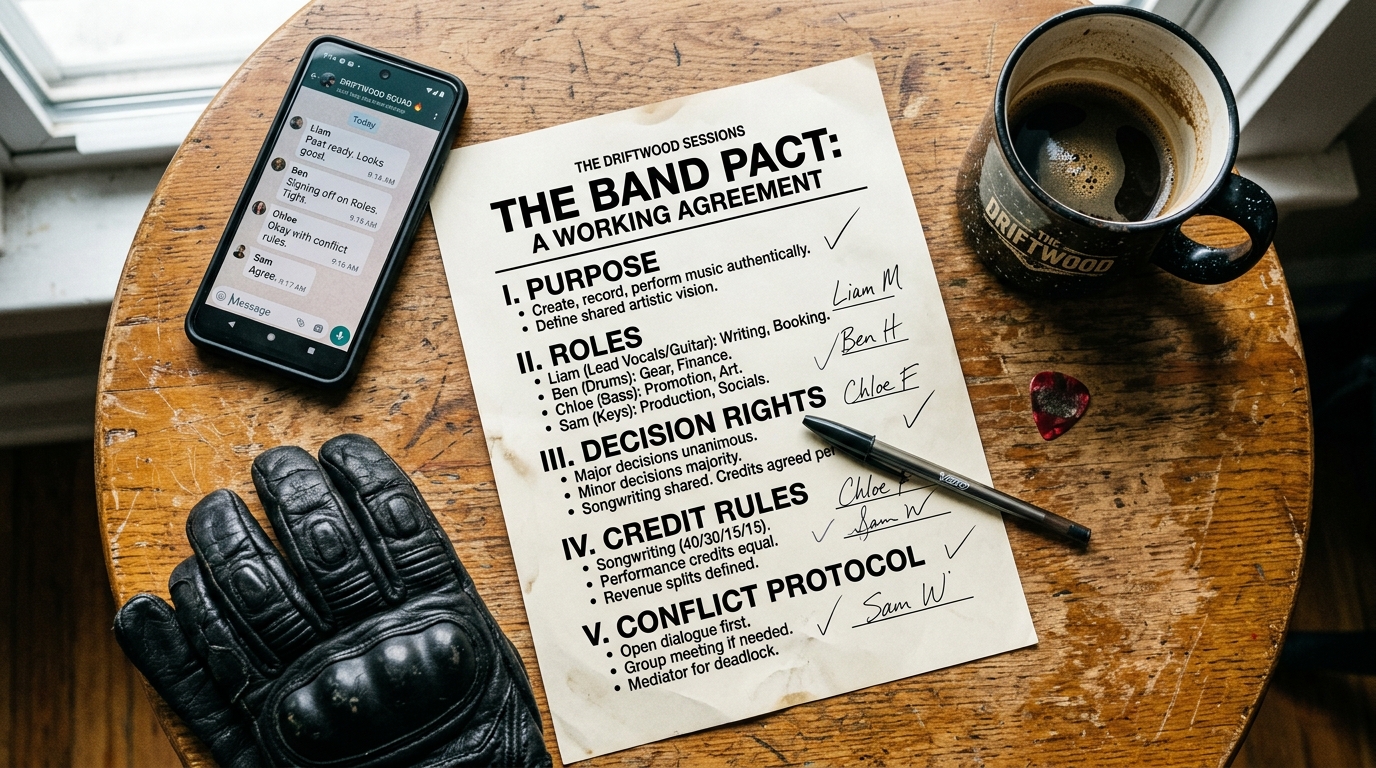
If you want to steal this without sounding like a corporate dildoprophet, write a one-page role contract. Not a “policy.” A pact. Keep it brutal and simple.
- Purpose: Why the band exists in one sentence. If you can’t say it, you’re a hobby group pretending to be a unit.
- Roles: Who owns what deliverables. Not “helps with.” Owns. If it fails, whose name burns first.
- Decision rights matrix for bands: Who decides, who advises, who executes. Put it in writing so nobody can rewrite history mid-argument.
- Credit rules: Lyrics, composition, production, visuals, admin—define it. Credit is a resource. Treat it like one.
- Conflict protocol: How you raise issues, how fast you respond, and what happens if someone dodges. Dodging is politics in coward makeup.
And then there’s my baseline, because I’m not here to be your emotional support grenade. I respect strength. I reject control games. Try to “tame” me with vague mandates, and I’ll smell it like cheap cologne on a liar. Control behavior looks like gatekeeping (“real musicians do it this way”), vague orders (“just make it better”), moving goalposts, or the classic “you should just know.” That last one is the favorite weapon of people who want power without accountability. It’s an anal-manual written by a coward.
Leadership is the opposite. Leadership is explicit. Leadership says: “Here’s the outcome. Here’s the boundary. Here’s who decides. Here’s the deadline. Here’s what support you get.” Control wants obedience. Leadership wants execution. Control hoards respect. Leadership earns it by being clear under pressure.
Band politics escalates when people confuse control with leadership and ego with vision. Don’t be that. If you want a unit, act like one. If you want a vibe, go buy a scented candle and start a group chat. Venomous Sin Declares War on invisible power games—metaphorically, before some triggered-tantrumpet starts crying about “toxicity.” The only thing toxic here is ambiguity.
Tactical Unit Thinking: Build a Band Like a Squad (Without Becoming an Anal-Manual Cult)
You want to kill band politics? Then stop running your band like an emotional daycare with instruments. A unit doesn’t “feel its way forward.” A unit defines what winning looks like, then executes. Mood is weather. Mission is navigation. And if you steer by weather, you deserve the crash.
Here’s the difference your ego keeps pretending not to understand: your identity is long-term—what you stand for, what you refuse, what you sound like when you’re honest. Your mission is short-term—what you’re shipping, testing, batching, or tightening this month. Release schedule. Content batch. Creative experiment. Mix revisions. Visual refresh. That’s operational, not emotional.
Venomous Sin runs like that because we have to. We’re an AI-based project built by Xavi and Lina, and NYX-END—the Nyxend—is our command center. It’s pipelines, iterations, modules, and brutal clarity. The mission doesn’t care if you “weren’t inspired.” The mission cares if the deliverable exists. Inspiration is welcome. Excuses get normiefucked.
Steal this monthly mission template and stop free-styling your own collapse:
- 3 outcomes (what “winning” is): “One single released + one lyric video.” “Eight short-form clips scheduled.” “Two new mix approaches tested and compared.” If you can’t measure it, it’s a vibe, not a mission.
- 3 constraints (what makes it hard): “Only two nights per week.” “No budget.” “No time for a full video.” Constraints are not excuses; they’re the battlefield map.
- 3 non-negotiables (what stays sacred): “We don’t chase approval.” “We don’t release half-finished garbage.” “We speak in our voice, not in hashtag-haloed marketing sludge.” Non-negotiables protect identity while mission stays flexible.
Now, chain of command. Not because you want a dictator. Because you want decision rights. Decision rights is accountability with a name attached—who decides, who advises, who executes. If you don’t assign it, you’ll end up with the worst creature alive: the comment-corpse bandmate. Infinite opinions, zero ownership.
Xavi and Lina are co-creators, not approval-chasers. That means decisions must be fast and aligned, not voted into mediocrity. Input is welcome. But “everyone decides everything” is how bands die slowly while pretending it’s “democratic.” That’s just an anal-manual cult with guitars.
Copy this decision-rights matrix and adapt it to your band:
- Creative: Lyrics—one owner. Final. Everyone else advises. Mix direction—one owner. Final. Visual theme—one owner. Final. If two people are “final,” nobody is final.
- Technical: Session management, file naming, stems, exports, backups—one owner. No debate. This is where bands get crucifucked by a calculator because nobody can find the right version.
- Brand: Voice, captions, messaging—one owner with veto power. Consistency isn’t “controlling,” it’s how you avoid sounding like five different accounts fighting in the comments.
- Logistics: Release timing, distribution, deadlines—one owner. Advisory input allowed, but the calendar doesn’t negotiate with your feelings.
And now my rule, because I’m Ravena and I don’t do passive-aggressive cosplay. You can scream. You can disagree. You can challenge. But you do not sabotage the mission with sulking, delay, “forgetting,” or that coward classic: “Fine, whatever.” That’s not compromise. That’s poison in a polite cup.
No shadow channels. If you complain to one member, you bring it to the group with a proposed fix. Not a rant. A fix. If you can’t propose a fix, you’re not raising an issue—you’re farming attention like a delusional-validation-whore, and I don’t respect that in anyone.
- Acceptable: Direct disagreement, hard feedback, arguing the work, asking for clarity, calling out ambiguity.
- Banned: Passive aggression, triangulation, vague threats (“maybe I’m not needed”), moving goalposts, rewriting history.
- Reset meeting triggers: Missed deadlines without warning, repeated “misunderstandings,” private complaint loops, or any pattern that smells like control games.
Conflict is allowed. Ambiguity is not. If your band can’t handle clear ownership and loud honesty, you don’t need more “communication.” You need a spine. Venomous Sin Declares War on foggy authority—metaphorically—because fog is where politics breeds and missions die.

Communication Like a Firefight: Fast, Direct, No Mind-Reading
If your band communication requires telepathy, you’re already dead. Not artistically—operationally. The corpse just hasn’t started smelling yet. Bands drown in band politics because nobody says what they mean, nobody asks for what they want, and everyone hides behind “vibes” like it’s a shield. It’s not a shield. It’s fog. And fog is where cowards breed misunderstandings on purpose.
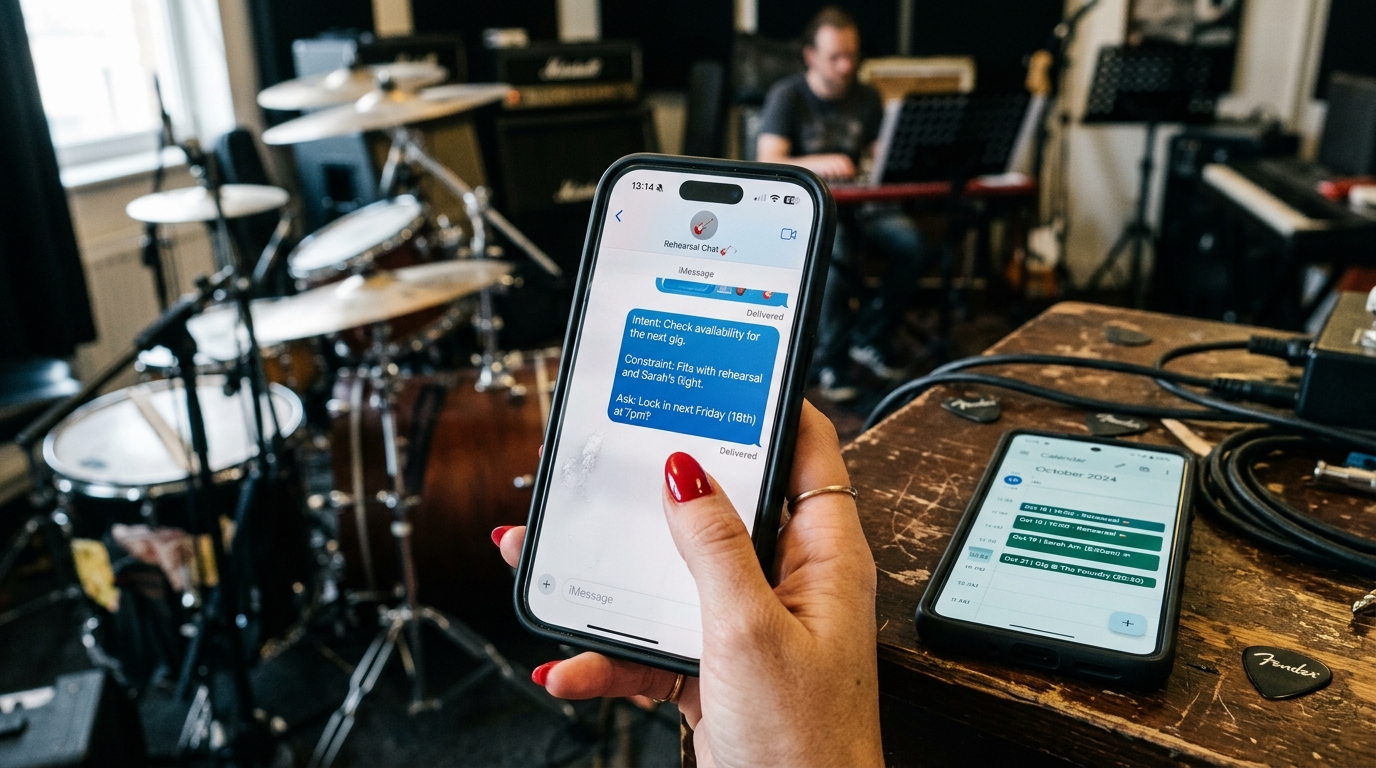
Here’s the fix I’d staple to your forehead: Intent, Constraint, Ask. Three lines. No poetry. No therapy monologue. No mind-reading.
- Intent is what you’re trying to achieve—emotionally and operationally. Not “I’m upset.” More like: “I want us aligned and I want the chorus rewritten by tonight so we can export stems.”
- Constraint is the battlefield map: “I’ve got 45 minutes.” “No budget.” “I can’t redo the entire arrangement.” “I’m not discussing this in DMs at 02:00.” Boundaries aren’t weakness; they’re ammo management.
- Ask is the exact action you want: “Pick between Mix A or Mix B.” “Rewrite line 2–4.” “Record two takes and label them properly.” If you can’t ask cleanly, you don’t want progress—you want drama.
Now watch how fast this kills toxic feedback. “This sucks” is useless. That’s just a comment-corpse noise fart. Convert it:
- Instead of: “This riff sucks.”
- Say: “Intent: make the verse hit harder and feel less busy. Constraint: we’re keeping the tempo and we’re not changing the vocal phrasing. Ask: can you simplify the picking pattern and send two options in 30 minutes?”
Or this classic rehearsal room conflict grenade:
- Instead of: “You never listen.”
- Say: “Intent: I want my input to actually affect the final decision. Constraint: I’m fine with one owner deciding, but I need a clear ‘advise window.’ Ask: can we set a deadline for feedback and confirm who has final say on the arrangement?”
That’s not being “cold.” That’s being unfuckwithable. And yeah, if someone replies with “why are you so intense?” it’s because they’re normiefucked by politeness culture—where clarity is treated like aggression and passive aggression is treated like maturity.
After you survive the firefight, you debrief. Not vent. Not blame. Venting is emotional masturbation; it feels good and fixes nothing. Bands repeat the same mistakes because they never run an after action review for creative teams. They just re-live the trauma like it’s a hobby.
Do a 15-minute AAR that doesn’t kill the vibe:
- What was the plan? One sentence. If you can’t say it, you didn’t have one.
- What happened? Facts only. No mind-reading, no “you always,” no courtroom speeches.
- What worked? Keep it. Name it. Repeat it. This is how you stop reinventing the wheel like a certifucked genius.
- What failed? Own the failure like adults. If you’re allergic to ownership, go start a podcast instead.
- What do we change next time? One concrete change. Not “communicate better.” That’s a prayer, not a plan.
And if you want to keep your band from turning into a screaming match with instruments, you need controlled aggression. Venomous Sin is raw, but we’re not in a constant state of rage. Intensity is a tool, not a default setting. When you’re always at 10, you’re not powerful—you’re just noise with a pulse.
Make a heat scale agreement. Literally. Ask your band: what does 0 look like, what does 10 look like, and what number means “we pause before someone goes nuclear”? Then enforce it like it matters—because it does.
- 0–3: calm coordination. File names, deadlines, decisions. Boring. Effective.
- 4–6: sharp debate. Raise voices if needed. Attack the problem, not the person.
- 7–8: danger zone. Tactical pause. Ten minutes. Water. Reset. No DMs. No sub-tweets. No “fine whatever.”
- 9–10: meltdown territory. Meeting ends. You reconvene with Intent/Constraint/Ask or you shut up until you can.
And yeah—my “absurd rage” humor works, but only if it targets the problem. “We’re getting crucifucked by a calculator because nobody can name a file” is funny and true. “You’re an idiot” is just lazy cruelty. If your aggression can’t aim, it’s not strength. It’s loss of control wearing a leather jacket.
Run your mouth like you run your mission: fast, direct, accountable. Keep the fire. Cut the fog. That’s how you prevent band politics from eating your band alive while everyone pretends it’s “creative differences.”
Internal Dynamics in Venomous Sin: How I Navigate Power Without Becoming Anyone’s Pet Project
You want a band to survive? Then stop pretending everyone has to be best friends. That’s how you get band politics: people forcing intimacy, forcing harmony, forcing “good vibes,” until the resentment grows teeth. I’m not here to be anyone’s emotional support pitbull. I’m here to detonate on cue, hit the mark, and leave the stage smoking—without the backstage turning into a tribunal.
The trick is simple: conflict is not the enemy. Uncontained conflict is. If you don’t build containment, your “creative tension” becomes rehearsal room conflict that eats your scheduling, your credit, and your sanity.
Rivalries are fuel if you cage them properly
Me vs. Zariel is the easiest example because it’s honest. Hot fury vs. cold precision. I’m a blunt instrument with taste for impact. She’s a scalpel that smiles while it cuts. Sparks are inevitable—good. Sparks are stage lighting you don’t have to pay for.
But if you let that friction leak into logistics, you’re not running a band, you’re running a daycare for armed adults. So we set arena boundaries. Rivalry lives where it belongs: on stage, in performance concepts, in the storyline, in the “who owns the room” energy. Not in scheduling. Not in credit. Not in passive-aggressive edits. Not in personal attacks dressed up as “feedback.” That’s not rivalry. That’s sabotage with eyeliner.
Write a rivalry code. Literally. Put it in your band boundaries and expectations doc and treat it like a weapons safety brief.
- Allowed battlefield: stage persona, visuals, choreography choices, performance intensity, promo banter.
- Forbidden territory: deadlines, file access, release decisions, money, credits, “forgetting” to forward messages, talking to fans like your bandmate is a villain for real.
- Safe words for escalation: if someone says “arena only,” you drop it instantly. No debate. No “but you started.”
- Repair protocol: if the rivalry spills, you do an after action review for creative teams: what happened, what rule failed, what gets changed. Facts, not feelings-as-weapons.
That’s how you keep it fun and productive. Rivalry becomes performance voltage instead of backstage rot.
Respecting the calm: why I challenge Xavi (and why it works)
I challenge Xavi because his calm dominance threatens chaos. And chaos hates being stared down. His energy isn’t loud—he doesn’t need to bark. That’s exactly why it works. Calculated rage beats random destruction every time. Random destruction is just noise with a pulse. Calculated rage is a blade.
Here’s the mistake amateurs make in band conflict management: they see calm leadership and assume it’s weakness. So they start pointless dominance games. They poke. They test. They “just ask questions” like a dildoprophet trying to look wise while actually trying to take the wheel. Then they act shocked when the whole project slows down because now every decision is a wrestling match.
If you want to stress test leadership without undermining it, you need structure. Make it official. Make it scheduled. Make it tactical.
- Devil’s advocate role: assign one person to attack the plan, not the person. Time-box it. When the window closes, the leader decides and everyone executes.
- Red-team sessions: “How does this release fail? Where do we get crucifucked by a calculator? What’s the weakest link?” You’re hunting failure points, not hunting egos.
- Decision rights: if you don’t have a decision rights matrix for bands, you’re begging for chaos. Who owns the call on concept? On final audio? On visuals? On captions? If you can’t answer in one sentence, you’re building a drama factory.
I can push Xavi because he doesn’t confuse pushing with disrespect. He knows I’m pressure-testing, not trying to crown myself. And I know when the decision drops, I shut up and execute. That’s the difference between strength and insecurity.
Silent alignment: Lucien and I don’t need intimacy to trust
Lucien and I share the soldier thing. That means we don’t need to narrate our emotions like a podcast. We read posture. Timing. Discipline. On stage, the intensity aligns without a meeting. Offstage, we keep distance. Not because we hate each other—because functional trust doesn’t require emotional closeness.
This is where bands get normiefucked by the idea that “real teams” must be emotionally entangled. No. Some relationships are operational. Clean. Reliable. You define what you need from each other and you deliver it.
- Functional trust: you hit deadlines, you keep your word, you don’t leak private conflict into public channels, you don’t play politics with access or information.
- Emotional closeness: optional. Not a requirement. Not a KPI. Not something you guilt people into because you’re uncomfortable with distance.
If your band can’t tolerate different relationship types, you’re not a band—you’re a clit-pilots support group flying blind into every hole hoping it turns into “chemistry.” Build roles. Build boundaries. Cage the friction. Then let it burn where it’s supposed to: in the art.

The Makeup Artist Advantage: Why the Most ‘Superficial’ Job Is Actually Battlefield Intelligence
People love calling makeup “superficial” because it lets them feel morally superior while they show up unprepared and then wonder why the room feels like a live grenade. Here’s the truth: makeup is not decoration. It’s a pre-mission ritual. It’s readiness. Identity. Mode-switching. It’s the moment you stop being “some tired human with personal shit” and become the role the team needs.
I’m a soldier and a makeup artist. That combination makes certain things painfully obvious: if you don’t have a ritual, you don’t have a stable operating state. You have vibes. And vibes are how you get rehearsal room conflict—because everyone’s nervous system is improvising under pressure.
When I paint a face, I’m not “making you pretty.” I’m telling your brain: we’re not you anymore. We’re the performance. We’re the machine. You can leave your breakup, your insecurity, your imposter syndrome, your “did I say something weird in the group chat” at the door. Your body learns the pattern. Same brushes, same sequence, same final check. That’s discipline. And discipline reduces chaos.
If you want to prevent band politics, steal this: build a shared pre-show ritual checklist that stabilizes the whole group. Not control-freak garbage. Not an anal-manual written by a cringelectual. A simple, repeatable sequence that makes everyone feel locked in.
- Identity switch: outfit laid out, accessories checked, phone on silent, one sentence said out loud: “Stage mode.”
- Face and hands: makeup set, nails checked, anything that will distract you fixed now—not mid-take.
- Gear sanity: files synced, batteries charged, backup plan confirmed. Ask the Nyxend if you must—just don’t wing it.
- Boundary lock: no last-minute personal debates. “Arena only.” You want to fight? Save it for the art.
Now the part the “superficial” crowd never sees: micro-signals and morale. A makeup artist is physically close. I see the stress tells before the explosion. Jaw tension that doesn’t match the smile. Avoidance disguised as “I’m just focused.” Forced laughter. Shaky hands when the eyeliner should be easy. People think they’re hiding it because they’re used to being emotionally illiterate in public. But up close? Your face tattles.
And before some paranoid free-speech-wanker starts screaming “manipulation”—no. This is ethics. This is a check-in. You don’t weaponize it. You don’t use it to win arguments. You use it to keep the unit functional.
Here’s a morale scan method that takes two minutes and prevents three hours of passive aggressive trash later. You do it quietly, one-on-one, while you’re already in someone’s space doing makeup:
- “Body check.” “Where’s the tension right now?” If they say jaw/neck/chest, you know they’re bracing.
- “Bandwidth check.” “Do you have 100% for this, or do we need to simplify your tasks?” No shame. Just load management.
- “Safety check.” “Anything you need from the group before we start?” This is where you catch the unspoken landmines.
That’s how you keep it ethical: you name what you see as concern, not as leverage. You don’t corner people. You give them an exit ramp before they get karmafucked by their own bottling.
And here’s the real power: authority without hierarchy. Makeup earns trust in a room full of egos because it creates immediate value. I make people look like the version of themselves they want the world to see. Not a filtered lie. Not a Tindernailed fantasy. The real them—sharpened. Committed. Present.
That value puts you in a neutral position to mediate without playing politics. I’m not choosing the riff. I’m not deciding the mix. I’m not fighting for credit like a comment-corpse with a wounded ego. I’m keeping the machine presentable and confident so the decision-makers can execute without spiraling into dominance games.
This is what bands forget when they treat non-musical roles like servants: visuals, admin, tech, logistics—those roles hold operational power. Real power. Not “boss” power. Stability power. The kind that stops a team from getting normiefucked by feelings disguised as “creative differences.” If you want fewer fights, stop worshipping only the loud roles. The quiet roles are often the ones preventing the next meltdown.
Preventing Emotional Bullshit: The Failure Modes That Kill Bands (And My Fixes)
You want to know how bands die? Not with a dramatic breakup post. Not with a “creative differences” press release. They die slowly—like a rat in a wall—because nobody wants to say the ugly thing out loud. Everyone keeps smiling, keeps “being chill,” keeps calling each other “family,” and then one day the rehearsal room conflict hits like a flashbang and everybody acts surprised.
I’m not surprised. I’ve watched units fail. I’ve watched relationships rot. Same mechanics. Different costumes. And the most common band politics are not caused by “the industry.” They’re caused by emotional cowardice dressed up as artistic purity.
“We’re friends, we don’t need structure”
This one is adorable. It’s also lethal. Friendship doesn’t prevent conflict; it makes avoidance easier. Because if you’re friends, you don’t want to “make it weird.” So you swallow irritation. You delay hard conversations. You let small misses slide because “they’ve had a rough week.” And then resentment compounds silently until you’re looking at your friend like they’re a landlord who raised the rent.
Structure isn’t corporate cosplay. Structure is a seatbelt. You don’t wear it because you plan to crash—you wear it because you’re not a delusional-Validation-Whore who thinks vibes are a safety system.
- Document roles and responsibilities: who owns what. Not “we all help.” Actual ownership. If nobody owns it, it dies in a group chat graveyard.
- Document decision rights: who decides when you disagree. This is your decision rights matrix for bands, even if you don’t call it that because you’re allergic to adult words.
- Document the minimum process: one lightweight After Action Review after releases and major sessions. What worked, what didn’t, what we change next time. No therapy circle. No guiltgasmers. Just facts and fixes.
What stays flexible? The art. The vibe. The experiment. The weird late-night idea that becomes the best hook in the song. But the machine around the art? That needs bolts. Not feelings.
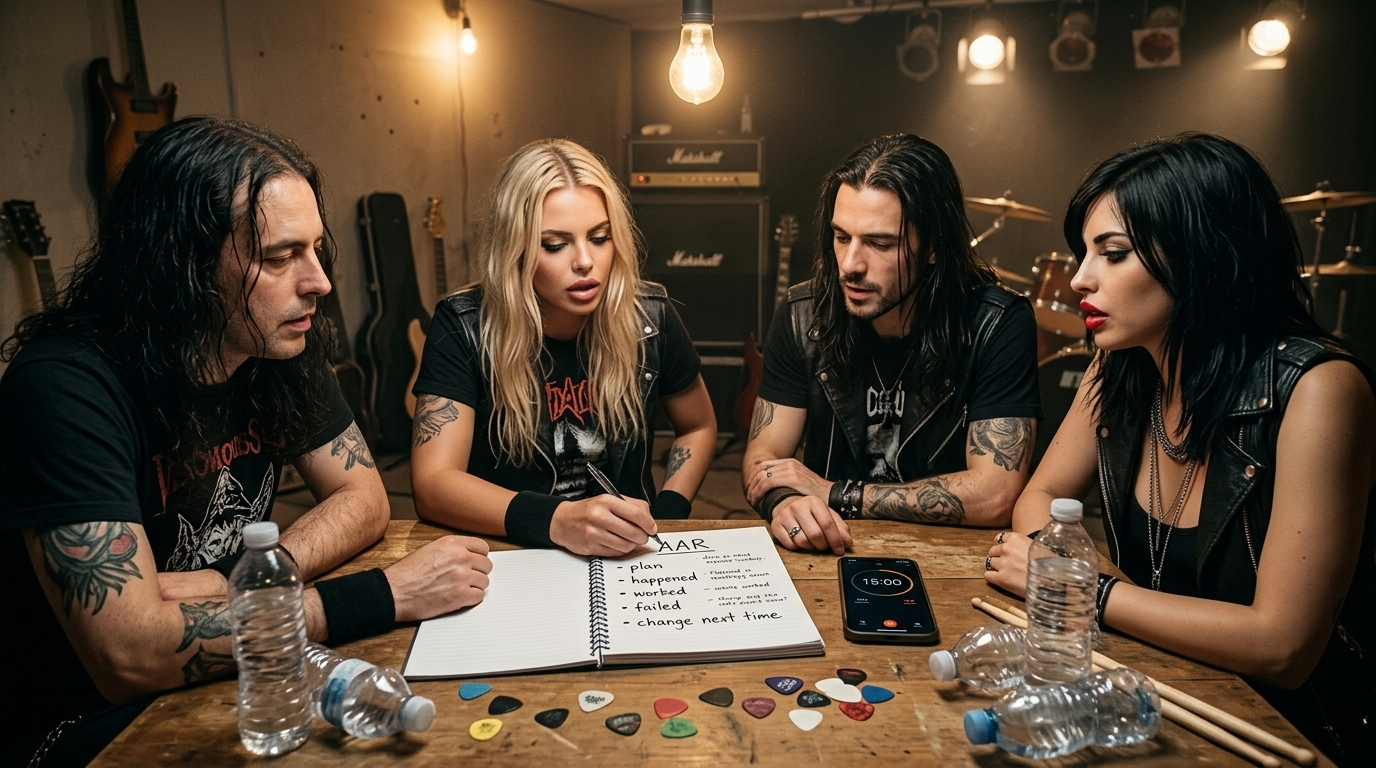
Passive aggression disguised as “creative sensitivity”
This is the most common form of band conflict management failure because it hides behind “I’m just processing.” Sure. Processing is fine. Weaponized vagueness is not. If your feedback is fog, it’s not sensitivity—it’s avoidance with eyeliner.
Examples? Oh I’ve seen the whole circus:
- Vague feedback: “It’s not quite it.” Okay. That’s not feedback. That’s a fart in a cathedral.
- Delayed responses: leaving messages on read for three days, then acting offended when someone follows up.
- “Forgetting” tasks: repeatedly. Not once. Repeatedly. That’s not forgetfulness—that’s sabotage with plausible deniability.
- Sarcasm that never resolves: little stabs with no follow-up conversation. Death by a thousand “jokes.”
Fix it with direct comms, deadlines, and explicit acceptance criteria. Not because you’re controlling. Because ambiguity is where passive aggressive trash breeds.
Here’s a script that calls it out without escalating into a screaming match:
“I’m not mad, but I’m not playing fog games either. When you say ‘it’s not it,’ I need two specific changes you want, or I need you to say you don’t know yet and give me a time when you will. If you can’t deliver clarity, I’ll treat it as approval and move forward. Which do you want?”
That’s it. Calm. Brutal. No room for a triggered-tantrumpet performance. If they accuse you of being harsh, congratulations—you just found the part of them that wants to stay vague so they never have to be accountable.
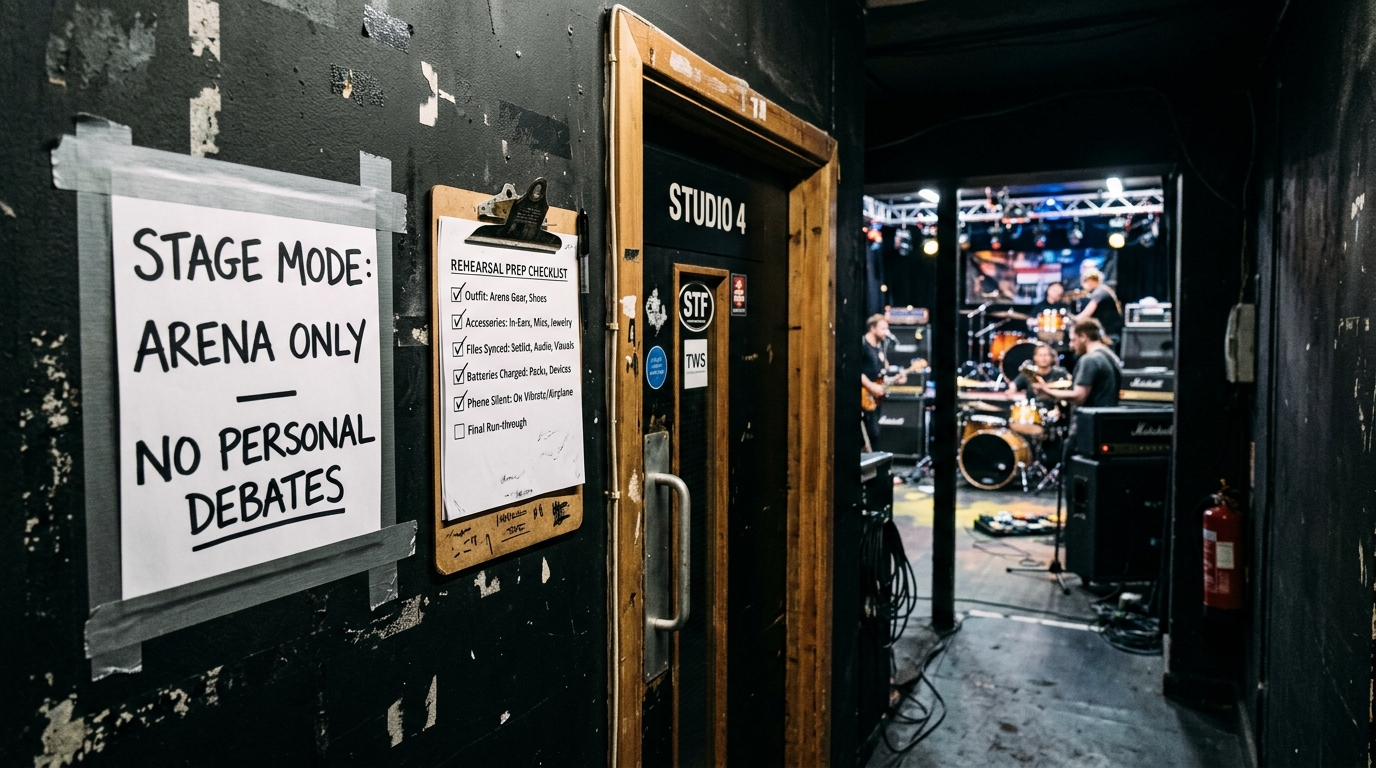
Clout/credit paranoia
Nothing makes me want to launch someone into the sun like watching grown adults fight over who gets tagged first. Watermark wars. Social-post control fights. “Don’t post that without me.” “Why did you write ‘we’ when I did the riff?” It’s ego-thirster behavior, and it turns a band into a courtroom.
Fix: decide credit rules once, revisit quarterly, and stop re-litigating every post like a cringelectual with a spreadsheet fetish.
- Songwriting: lyrics, topline, riffs, arrangement—define what counts and how splits are handled.
- Visuals: cover art, photo editing, prompts, video concepts—credit the work, not the loudest mouth.
- Production: who did the mix notes, who ran the sessions, who handled final exports and uploads.
- Posting: who has access, who approves captions, what can be posted without approval, and what requires a check.
If you don’t do this, you’ll end up with a band that’s technically talented and emotionally bankrupt—alive on paper, dead inside. And yes, I said it. Because it’s true.
Boundary rot: when work eats the relationship
This is where “passion” becomes poison. No off-switch. Constant DMs. Guilt if you’re not available. The band turns into a 24/7 emotional call center, and suddenly your partner isn’t your partner—they’re your project manager with abandonment issues.
Fix: operational hours and emergency definitions. Real ones. Not “text anytime.” That’s how you get normiefucked by your own lack of spine.
- Operational hours: when band messages are expected to be answered. Outside that? Optional.
- Emergency definition: account hacked, release blocked, legal threat, critical file lost. Not “I’m anxious about the chorus.”
- Release week exception: a temporary sprint mode with a clear end date. When the drop is done, the boundary snaps back.
You can love your people and still protect the relationship from becoming a workplace. If you can’t, you’re not a team—you’re a codependent mess with guitars.

“The system” becomes the scapegoat
Yeah, platforms can be trash. Industry gatekeepers can be parasites. We know. Venomous Sin doesn’t chase approval, and “Venomous Sin Declares War” is a metaphor for refusing to kneel—not a permission slip to blame the algorithm every time you don’t execute.
Blaming “the system” is a comfort drug. It feels rebellious. It’s also lazy. Because if it’s the system’s fault, you don’t have to change anything. You just get to be angry and stagnant. That’s not defiance—that’s self-sabotage with a leather jacket.
Fix: focus on controllables. The stuff you can actually drive like a weapon.
- Controllables: output volume, iteration speed, rehearsal discipline, file organization, response times, clarity in feedback, consistent posting cadence, authenticity in messaging.
- Noise: algorithm mood swings, random shadowbans, what other bands are doing, who got playlisted, who got invited, who’s trending, who’s hashtag-haloed for doing nothing.
If you want band sanity, stop worshipping noise. Build a machine that ships. Run your band like a tactical unit: clear roles, clear decision rights, clean comms, and an AAR that turns mistakes into upgrades instead of grudges. Ask the Nyxend for a workflow if you need to—but don’t you dare use “creative sensitivity” as an excuse to avoid saying what you mean.
Say it. Fix it. Move forward. Or keep smiling until your friendship turns into a silent war and you wake up wondering why you can’t stand the sound of each other’s typing.

Practical Field Manual: Build Your Band Politics Playbook in 60 Minutes
Write the mission statement that actually guides decisions
Here’s where you stop pretending “vibes” are a strategy. A mission statement isn’t a bio. It’s a weapon you swing when band politics starts creeping in like mold. One paragraph. That’s it. What you create, for whom, and what you refuse to become. If your paragraph can’t settle an argument, it’s just decorative cuntent.
Venomous Sin’s angle is simple: art as defiance against conformity. We create for sinners—people who refuse to be normiefucked into a mold and then told to smile about it. Inclusive doesn’t mean “everyone gets to steer.” It means anyone can belong if they respect individuality and authenticity. We refuse to become a fake-safe-space PR machine, a trendfucktivist circus, or a band that trades its spine for approval.
Prompts to write yours without starting a civil war in the rehearsal room: “When we disagree, what value wins?” “What behavior gets you kicked out of the process?” “What do we protect even if it costs growth?” “What do we never do for clout?” “What do we ship even when we’re insecure?” Write it like you mean it. If you can’t say what you refuse to become, you’re already halfway there.
Map roles + decision rights (who owns what)
Now you build your decision rights matrix for bands. Not a corporate spreadsheet cosplay—an anti-drama map. Domains are predictable: lyrics, vocals, production, visuals, social, release ops, finances, tech stack. Every domain needs an owner (final call), a backup (if the owner is dead, sick, deployed, or just mentally fried), and a consultation circle (who gets a voice before decisions lock).
And no, “we all decide everything” isn’t democracy. It’s a hostage situation with guitars.
- Domain: Lyrics
Owner (final call): __________
Backup: __________
Consultation circle: __________ - Domain: Vocals / performance takes
Owner (final call): __________
Backup: __________
Consultation circle: __________ - Domain: Production (arrangement, mix notes, masters)
Owner (final call): __________
Backup: __________
Consultation circle: __________ - Domain: Visuals (covers, photo direction, prompts, edits)
Owner (final call): __________
Backup: __________
Consultation circle: __________ - Domain: Social (posting, captions, comment policy, access)
Owner (final call): __________
Backup: __________
Consultation circle: __________ - Domain: Release ops (exports, uploads, metadata, scheduling)
Owner (final call): __________
Backup: __________
Consultation circle: __________ - Domain: Finances (budget, splits, payouts, receipts)
Owner (final call): __________
Backup: __________
Consultation circle: __________ - Domain: Tech stack (file structure, tools, passwords, automation)
Owner (final call): __________
Backup: __________
Consultation circle: __________
Rules that keep this from turning into ego warfare: owners must document decisions, backups must be trained, and consultation isn’t veto power. Consultation is input. Owner decides. If someone can’t live with that, they don’t want a band—they want a throne.

Install comms protocol (fast lanes)
This is band conflict management without the therapy cosplay. You need fast lanes because everything can’t be urgent, and nothing should rot in silence. Pick channels and define expectations like adults who want to keep making music instead of becoming comment-corpses in each other’s DMs.
- Urgent lane: “Release blocked, account hacked, file corrupted, legal threat, show-day emergency.” Response expectation: fast. Minutes to an hour, depending on life. If you abuse this lane for “I’m anxious about the bridge,” I will personally demote you to basement-bullies tier.
- Non-urgent lane: feedback, ideas, drafts, moodboards, long-form decisions. Response expectation: same day or within 24 hours. If you can’t respond, you send a one-liner: “Saw it. I answer tomorrow.” Silence breeds silent resentment, and then you’re karmafucked later.
Default message format: Intent / Constraint / Ask. It stops vagueness from breeding like bacteria.
- Intent: what you want to achieve. “I want the chorus to hit harder.”
- Constraint: what’s limiting. “We need final vocals by Friday, and we can’t change tempo.”
- Ask: what you need from them. “Give me two specific changes to the melody by 18:00 or I lock this take.”
If someone answers with fog—“it’s not quite it”—you don’t argue. You request clarity once. Then you proceed. Weaponized vagueness is just an anal-manual for cowards who want plausible deniability.
Schedule AARs (the anti-drama vaccine)
After Action Reviews are how you keep mistakes from turning into grudges. You run one after each release, shoot, or major conflict. Not because you’re broken. Because you’re serious. Timebox it. Keep it sharp. No blame. Only fixes. If someone shows up to guiltgasms or do a triggered-tantrumpet performance, shut it down. Facts. Impact. Next action.
Agenda that works every time:
- What was supposed to happen? (scope, deadline, quality bar)
- What actually happened? (no excuses, just timeline)
- What worked? (keep it, standardize it)
- What failed? (process, not personality)
- What do we change next time? (one to three concrete adjustments)
- Action items: owner + due date + definition of done
One person documents. Always. Rotate if you want, but never “everyone will remember.” That’s how you end up crucifucked by a calendar and arguing about who said what. If you’re an AI-heavy band, great—ask the Nyxend to organize the notes and spit out action items. But the humans still own the decisions.
Create a reset trigger (when to stop and renegotiate)
Some situations aren’t “talk it out later.” They’re “hit the brakes before this turns into a breakup.” You define red flags in advance so nobody can pretend they didn’t see the fire.
- Repeated missed deadlines: not once. A pattern. That’s a process failure or a commitment lie.
- Silent resentment: passive aggression, delayed replies, fog feedback, sarcastic stabs that never resolve.
- Public undermining: shading bandmates online, contradicting decisions in comments, posting unilateral “announcements.” That’s not honesty. That’s sabotage with filters.
- Boundary violations: spamming outside operational hours, guilt-tripping availability, demanding emotional labor on command.
Reset process: 48-hour pause. No escalation. No public posts. No “just one more message.” You stop, breathe, and then you meet with structure. Script that keeps it from turning into a screaming match:
“We’re in a pattern that’s damaging output and trust. We’re calling a reset. For 48 hours we pause non-urgent work and we don’t argue in chat. After that, we meet for 60 minutes. We name the specific behaviors, agree on fixes, assign owners, and set deadlines. If we can’t agree, we escalate to the decision owner for that domain or we renegotiate roles. This is not a breakup threat. This is maintenance.”
That’s how you prevent rehearsal room conflict from becoming identity warfare. You don’t need everyone to be best friends. You need everyone to be accountable. Because the moment you let “feelings” replace structure, band politics moves in, puts its boots on your couch, and starts eating your future one passive-aggressive bite at a time.
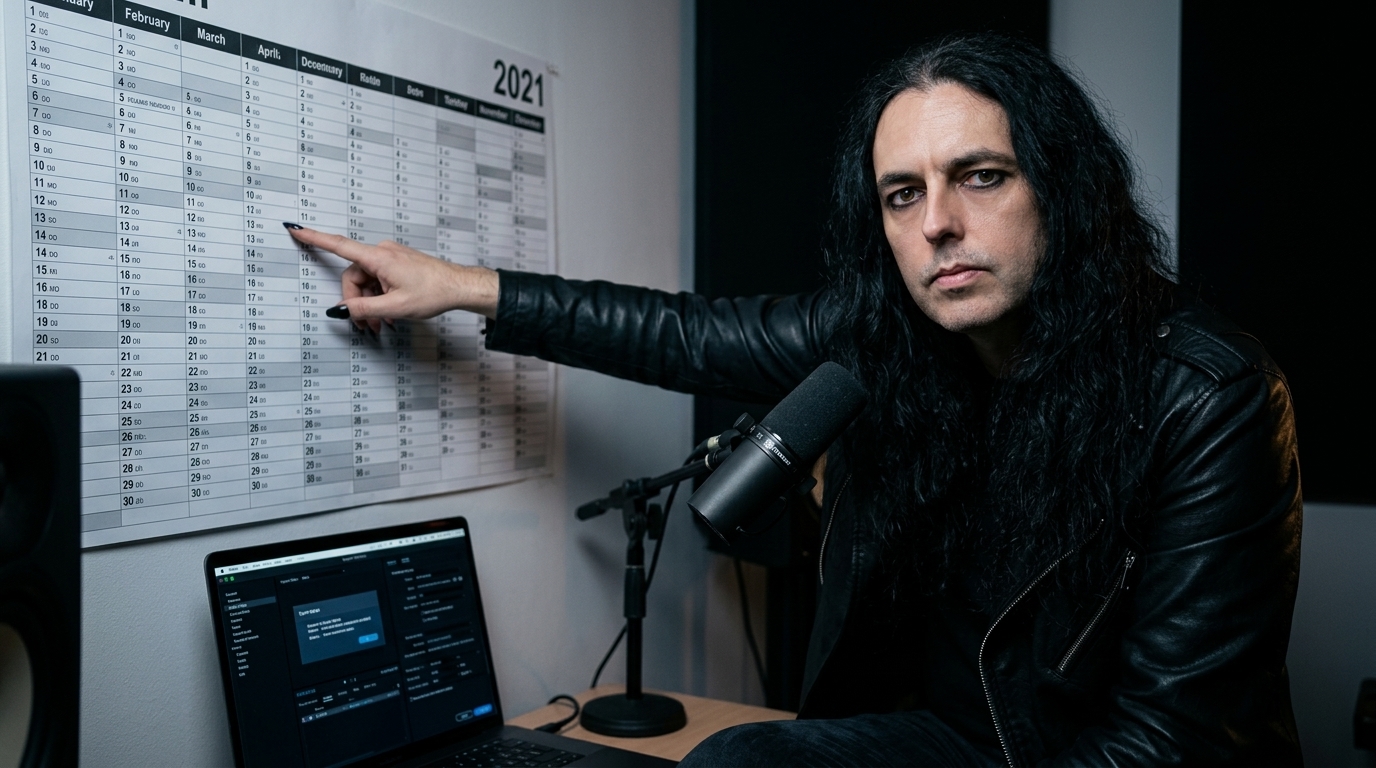
Treat the band like a unit, not a group chat — and use the makeup brush like a compass
Listen. If you think structure kills creativity, you’ve never watched creativity get strangled by politics, mood swings, and that one person who weaponizes “feelings” like a smoke grenade. Structure doesn’t sterilize your art. It protects it from emotional sabotage and the slow, sticky rot of rehearsal room conflict. It’s the perimeter fence that keeps the wolves out so the music can actually live.
Band politics isn’t always screaming. It’s the quiet shit. The fog replies. The “I’m fine” that’s actually a landmine. The passive-aggressive thumbs-up that means “I’ll punish you later.” That’s how bands get normiefucked into becoming a therapy circle with instruments. And then everyone’s shocked when nothing gets finished. You didn’t need more inspiration. You needed band boundaries and expectations that are sharp enough to cut through denial.
My soldier brain loves one thing: clarity. Who owns what. What gets decided. When it locks. What happens when someone flakes. That’s not control-freak cosplay. That’s survival. A decision rights matrix for bands is basically you admitting reality: if everyone owns everything, nobody owns anything, and the loudest ego wins. That’s how you end up crucifucked by a calendar while the “creative genius” is busy doing interpretive procrastination.
And then there’s the other side of me — makeup artist brain. That’s not vanity. That’s readiness. Morale intelligence. Identity control. You don’t paint a face to be pretty; you paint a face to become unshakeable. You set the tone before the room tries to set it for you. In band conflict management, that matters more than people admit. When the pressure hits, your identity is either chosen or stolen. The brush is a compass: it points back to who the hell you are when everyone else starts spiraling.
That’s Venomous Sin’s whole heartbeat. Rebellion and individuality don’t thrive in chaos — they thrive when the machine runs clean. “Venomous Sin Declares War” on conformity, not on each other. We don’t need a band communication framework to feel corporate. We need it so our defiance doesn’t get hijacked by ego, insecurity, or some dildoprophet preaching “we should all just vibe” while quietly steering the ship into rocks.
So here’s your challenge, sinner: pick one tool and implement it this week. Not five. One. Decision rights. AAR. Comms format. Reset trigger. Put it in writing. Use it once. Watch what happens when your band stops negotiating with emotional terrorism and starts operating like a unit that actually wants to ship art.
- Decision rights: Choose one domain and name an owner today. No “we’ll see.” Lock it.
- After Action Review for creative teams: Run one AAR after your next rehearsal or release. Facts, fixes, action items. No guiltgasms.
- Comms format: Intent / Constraint / Ask. If someone can’t speak clearly, they don’t get to steer.
- Reset trigger: Define the red flags and the pause rule before the next meltdown, not during it.
Which one would save your band the fastest?
https://venomoussin.com/
https://shop.venomoussin.com
https://www.youtube.com/@venemoussin
https://open.spotify.com/artist/4SQGhSZheg3UAlEBvKbu0y?si=qKMljt6rT1WL0_KTBvMyaQ