
There’s a special kind of psychological torture that only comes from being told to “have fun” on company time—especially when it’s after hours, wrapped in a memo, and delivered with the desperate grin of a power-point slutchief who just discovered the word “synergy.” You know the flavor: mandatory after-work events, those forced bonding rituals at work where “team-building” is less about connection and more about unpaid social labor with a smiley sticker slapped on your emotional wounds. If you’re not careful, you’ll find yourself clapping along in a windowless room, wondering if HR’s anal-manual has a chapter on surviving karaoke-based humiliation. Spoiler: it doesn’t. It just offers more anal-policies to keep you in line.

Let’s cut through the corporate-scented air freshener: if an activity truly builds connection, you shouldn’t need someone threatening your year-end review or tracking attendance like you’re on probation. Real bonding doesn’t come with guilt-trips disguised as “calendar invitations”—that’s just anal-synergy, sprinkled with a little nuclear compliance attack. The second your manager’s disappointment becomes the main course, the vibe rots from “let’s connect” to “smile or else,” and suddenly you’re in a psychological chokehold tighter than my corset at a CEO’s Christmas orgy.
Here’s the venom—healthy team connection and forced socializing aren’t just different breeds, they’re different species. One feeds your sense of belonging; the other sucks it dry, leaving you craving solitude like a goth at a yoga retreat. Boundary setting for introverts at work isn’t rebellion; it’s survival. So next time someone pitches “mandatory fun,” remember: real connection is voluntary, never crucifucked by a calendar or a clickbaitgutted team spirit. And if they push? Tell them to take their anal-manual and shove it somewhere only the bravest HR-violation dreams go. 🤘💀🖕

What “Mandatory Team-Building” Actually Means
Let’s translate the corporate dialect into something a normal human can understand. Mandatory team-building is what happens when a company labels a social event as “optional” while quietly attaching consequences to anyone who dares skip it. Nobody says, “Attend or else.” That would be too honest. Instead, the invitation arrives wrapped in words like “culture,” “community,” “engagement,” and “connection.” Suddenly the after-work bowling night, escape room, pizza party, or trust-fall circus isn’t really optional anymore. It’s a loyalty test wearing a party hat.
The trick is linguistic. Toxic corporate culture rarely announces itself with a villain speech and a lightning strike. It arrives smiling. It tells you this is about fun. It tells you this is about building relationships. It tells you everyone is excited. Then attendance gets noticed. Absences get remembered. Promotions somehow seem to favor the people who showed up to every after-hours gathering. Funny how that works.
That is why so many mandatory after-work events feel strange. The language promises freedom while the expectation demands obedience. It’s the workplace equivalent of someone saying, “Do whatever you want,” while staring at you with disappointment already loaded in the chamber. The invitation isn’t really an invitation. It’s an anal-manual management tactic disguised as a social opportunity.
The hidden message underneath all of it is even more revealing. If a company constantly needs to manufacture closeness after working hours, what does that say about the environment during working hours? Real teams spend days solving problems together, surviving deadlines together, helping each other when projects catch fire, and sharing ordinary conversations between meetings. Human connection naturally grows in those spaces.
When leadership becomes obsessed with forced bonding rituals at work, it sometimes reveals a lack of trust. Instead of creating conditions where relationships develop organically, they attempt to schedule friendship like it’s a quarterly performance metric. As if camaraderie can be summoned through enough icebreakers and stale conference-room sandwiches.
And that’s where the contradiction starts chewing through the drywall. If teamwork can only be proven by showing up to unpaid social rituals outside the clock, perhaps the problem isn’t the employees. Maybe the problem is management. Maybe people would connect more naturally if they weren’t exhausted, overloaded, micromanaged, or trapped under layers of anal-policies written by some spreadsheet priest who believes morale can be measured with attendance sheets.
None of this means socializing is bad. Most people enjoy spending time with coworkers they genuinely like. Some friendships born at work last decades. Others become business partnerships, creative collaborations, or simply the people who help you survive a rough week. The problem begins when participation becomes a measurement of devotion rather than a personal choice.
- 🤘😏👉 Voluntary connection builds trust.
- 🤘😒👉 Manufactured connection measures compliance.
- 🤘🖤👉 Friendship grows naturally.
- 🖕😐🤘 Loyalty tests wear disguises.
Once attendance becomes a proxy for commitment, the event stops being social. It becomes an evaluation. That’s why so many employees feel trapped by mandatory team-building. They’re not resisting connection. They’re resisting being quietly judged for how they spend their own time. And no amount of corporate glitter, motivational slogans, or PowerPoint Slutchief enthusiasm can hide that smell once people notice it.
Why Managers Keep Pushing Forced Socializing
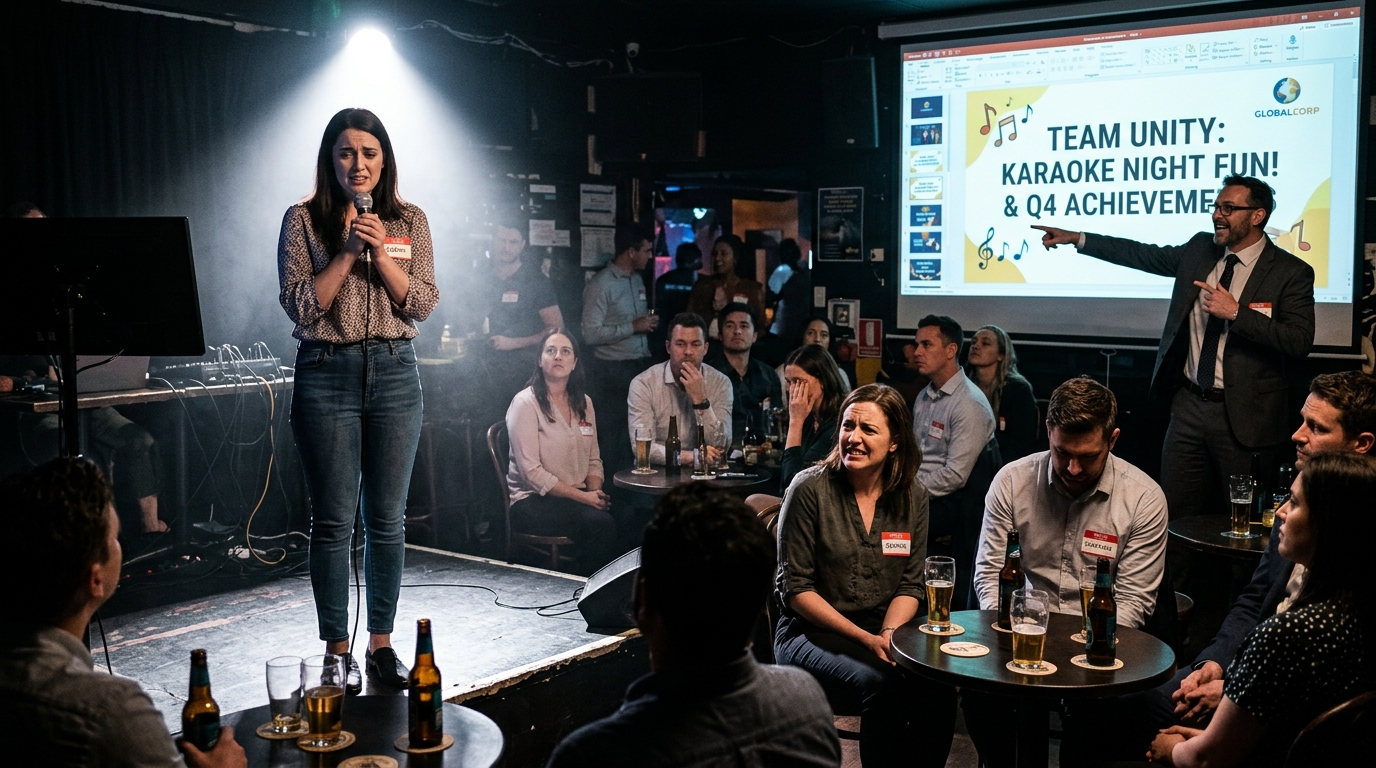
Let’s rip the corporate veil off and stare at the raw, anal‑manual of “team‑building” that smells like a freshly opened pizza box in a sterile breakroom. The leadership circus loves to parade a bowling night or a trust‑fall circus as “culture” while they silently tally who showed up and who dared to say “no thanks, I have a life.” They think visibility equals loyalty – a twisted logic that makes a manager feel like a puppeteer pulling strings on a stage made of cheap foam and forced smiles. When the lights dim, the real agenda surfaces: monitor morale without ever fixing the workload, the pay, or the churn rate. It’s a classic control tactic, a way to blur the line between professional expectations and personal availability. The moment you’re forced to sip cheap beer with the “power‑point slutchief” crowd, you become a data point in their “engagement” spreadsheet.
Some managers mistake attendance for engagement. They act like a night at the arcade proves you’re “committed” to the brand, as if the only way to show devotion is to spend unpaid hours under fluorescent lights while the bosses sip their latte and whisper about “team synergy.” This is the same vibe that fuels the “We’re Not Broken, We’re the Reaction” anthem – a bitter reminder that the system can’t build respect through fair treatment, so it buys it with pizza, stale sandwiches, and passive pressure. The psychological cost of forced socializing is real: anxiety spikes, introverts set boundaries that get trampled, and the toxic corporate culture gets a fresh coat of “fun” that masks the underlying crucifucked hierarchy.
When leadership can’t earn trust by fixing the grind, they resort to mandatory fun alternatives: forced bonding rituals at work that feel like a loyalty test in a PVC corset. It’s a subtle threat – “show up or we’ll remember your absence when the next promotion rolls around.” The moment you’re judged for how you spend your own time, the event stops being social and becomes a compliance audit. The real question isn’t why employees resist the after‑hours party; it’s why the system can’t let genuine connection grow in the trenches of deadlines and midnight coffee runs.
- ✋😏👉 Forced bonding is a control tactic, not a team‑building miracle.
- ✋🖤👉 Attendance is used as a proxy for commitment, a cheap morale metric.
- ✋💀👉 Mandatory fun masks a toxic corporate culture that refuses to pay its people.
- ✋🔥👉 The psychological cost of forced socializing is a silent weapon against introverts.

The Real Cost of After-Work Events
Ever felt like your work is slowly creeping into the parts of your life that should be off-limits? Welcome to the world of mandatory after-work events, where the clock doesn’t stop just because your shift did. These events are like a vampire sucking away precious hours meant for rest, family, and personal peace. It’s the time you rightfully own, hijacked and repurposed into a masquerade of forced smiles and hollow camaraderie.
Let’s talk about energy—the kind you don’t have after a long day of wearing your professional mask. For introverts and socially anxious souls, these events are less about fun and more about putting on a performance of enthusiasm. You’re expected to play the role of the energetic team player, even when your social battery is dead as a doornail.
There’s an inherent fairness cost too. Not everyone can afford to treat work like a lifestyle brand. Caregivers, those with health limitations, second jobs, or long commutes are often penalized for not putting work at the center of their universe. It’s a rigged game where the rules favor those without obligations, while the rest pay the price for their reality.
Emotionally, the stakes are high. Saying no isn’t just a simple decision. It’s a gamble that can trigger guilt or exclusion, a fear of seeming uncommitted. It’s a status test disguised as a social invite, where skipping could mark you as less dedicated. This isn’t just an inconvenience; it’s an unequal burden masquerading as culture—a crucifuck of priorities that doesn’t just blur lines, but erases them.
- ✋🤨👉 After-work events invade the only personal time employees have left.
- ✋😓👉 Social energy is drained, not replenished, by these mandatory gatherings.
- ✋👿👉 Fairness is sacrificed on the altar of corporate “culture.”
- ✋😠👉 Emotional costs make what should be “fun” a dreaded obligation.
Why “Optional” Often Isn’t Optional
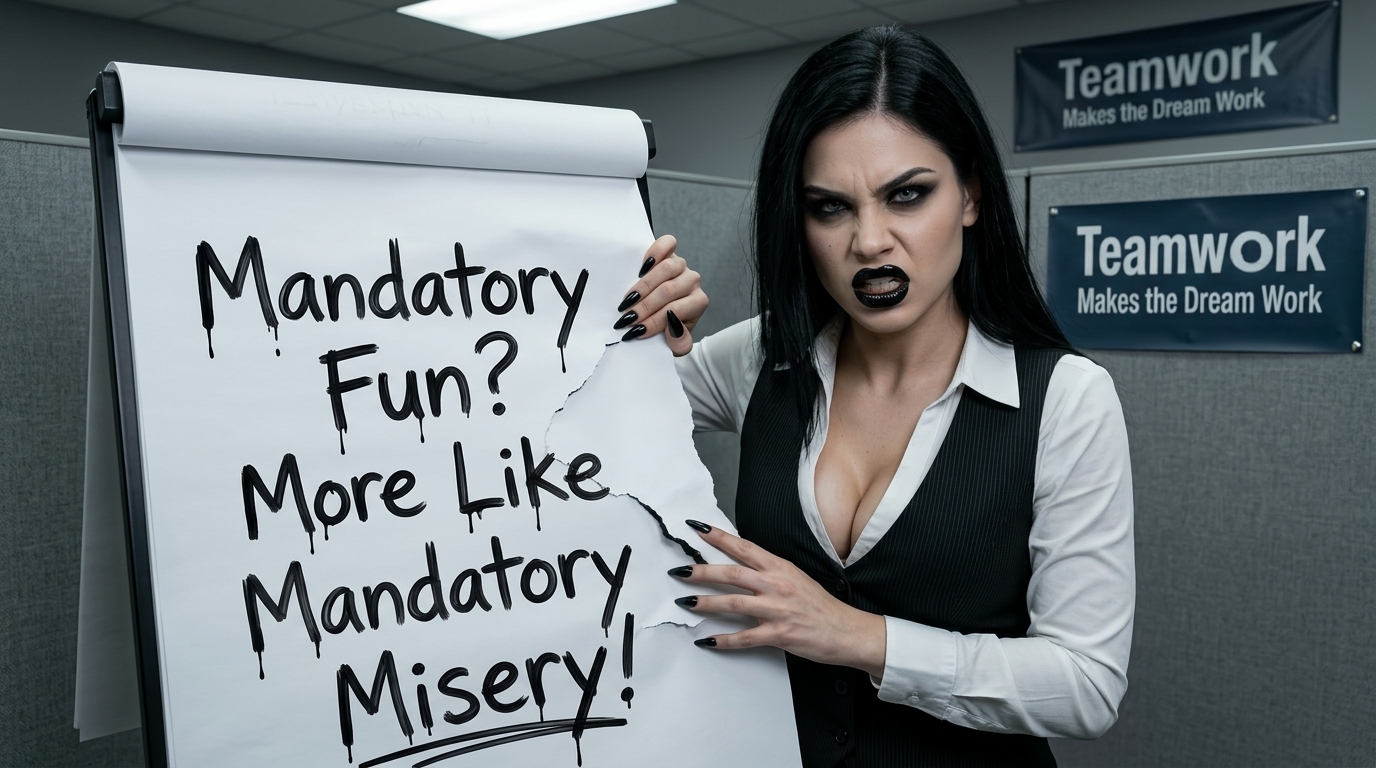
There is a special kind of corporate theater that deserves an award for audacity. It begins with a manager smiling politely and saying, “Of course, it’s optional.” Then five minutes later comes the follow-up: “It would be nice to see everyone there.” Suddenly the invitation starts growing teeth.
Anyone who has spent time inside a workplace understands the game. If your manager attends, if department leaders attend, if the people deciding promotions attend, then the event stops being optional in any meaningful sense. The word remains, but the reality changes. The invitation becomes a performance review wearing a party hat.
This is how soft pressure works. Rarely through direct orders. Direct orders are honest. Instead, it arrives wrapped in friendly language and corporate smiles. “We’re hoping for full participation.” “It would mean a lot to the team.” “Everyone is making an effort.” The message hiding underneath is simple: we are watching who shows up.
Employees learn this lesson fast. Not because someone writes it down in an anal-manual management tactics handbook, but because they observe what happens around them. The people visible at every after-work gathering become familiar faces. They get remembered. They build relationships with decision-makers. Meanwhile, the person who consistently protects their personal time risks being viewed as distant, disengaged, or somehow less committed.
That perception matters. Careers are not built entirely on performance. Visibility, access, reputation, and informal relationships influence opportunities every day. People understand this instinctively. That is why mandatory after-work events feel less like invitations and more like forced bonding rituals at work. Refusal may technically exist, but the consequences make saying no feel dangerous.
The psychological trap is almost elegant in its manipulation. You are told you have a choice, but the environment is carefully designed to make one choice feel safe and the other feel risky. If you attend, you sacrifice your evening. If you decline, you wonder whether someone will remember your absence during the next promotion discussion. That uncertainty becomes its own form of pressure.
In a healthy workplace, voluntary actually means voluntary. No guilt trips. No passive-aggressive comments. No raised eyebrows on Monday morning. No subtle punishment disguised as feedback about being “team-oriented.” Real culture respects boundaries because it understands that employees are human beings, not corporate mascots available for deployment whenever management wants another group photo.
If a company truly values people, it does not create situations where protecting your own time feels like career self-sabotage. Declining workplace socializing without consequences should not be a radical concept. It should be the baseline. Anything else starts looking suspiciously like toxic corporate culture wearing a friendly nametag and hoping nobody notices the chains underneath.
- ✋🤨👉 If leaders attend and visibility matters, “optional” often becomes functionally mandatory.
- ✋😒👉 Soft pressure works through expectations, not direct orders.
- ✋😓👉 Employees quickly learn that attendance can influence perception and opportunity.
- ✋👿👉 The choice is presented as voluntary while the consequences make refusal feel unsafe.
- ✋🖤👉 Honest workplace culture respects personal time without punishment or guilt.
What Healthy Team-Building Actually Looks Like
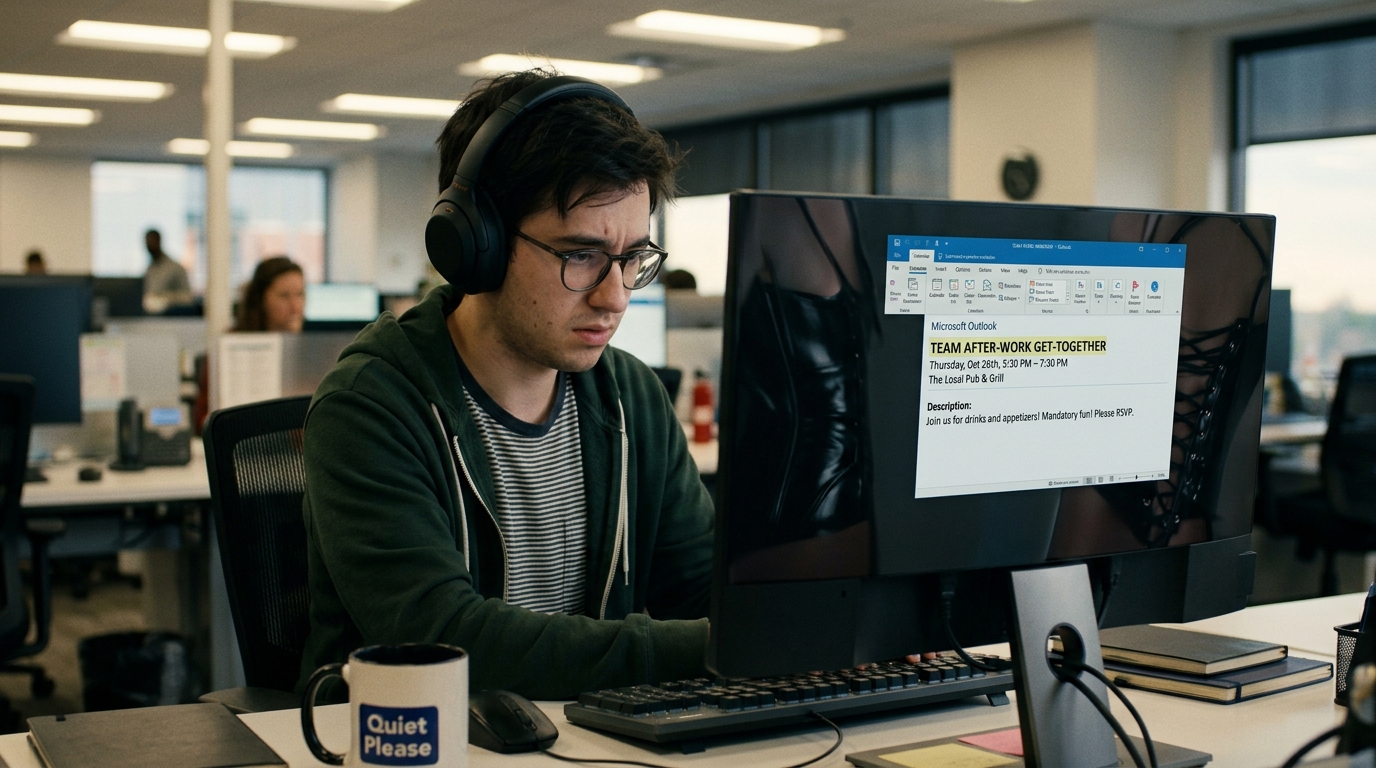
Real connection at work has nothing to do with the fake smiles and forced bonding rituals at work that management loves to shove down everyone’s throat. Healthy teams grow trust through the boring stuff that actually matters: clear communication, actual competence, and the kind of mutual respect that doesn’t require anyone to pretend they’re thrilled to be there. No one needs to chug lukewarm beer or scream song lyrics together to get shit done. The moment bonding gets tangled up with coercion, it stops being bonding and turns into another layer of toxic corporate culture wearing a party hat.
Low-friction alternatives exist if anyone in charge bothered to look beyond their anal-manual management tactics. A short paid lunch during work hours, real collaboration on projects, quick retrospectives that focus on what worked instead of who smiled the brightest, or simple shared problem-solving sessions all build something usable. Opt-in social stuff can stay opt-in without anyone getting side-eyed on Monday morning. These things respect that people have different personalities, different budgets, different schedules, and actual boundaries they shouldn’t have to defend like they’re committing a crime.
Good teamwork comes from reliable systems, not from forcing people into karaoke nights, escape rooms, or alcohol-soaked performances where everyone has to act like best friends or risk looking “disengaged.” If an activity actually improves how people work together without demanding fake cheerfulness or punishing those who protect their evenings, it’s probably worth keeping. Everything else is just psychological cost of forced socializing dressed up as team spirit. The people who see through it aren’t the problem. The system that needs everyone to perform closeness to feel safe is.
- ✋😒👉 Healthy trust grows from competence and respect, not mandatory performances.
- ✋🖤👉 Paid work-hour lunches and structured collaboration beat escape rooms every time.
- ✋😠👉 Reliable systems create teamwork. Forced karaoke creates resentment.
- ✋👿👉 Inclusive activities respect boundaries instead of punishing people for having them.
- ✋🤨👉 If it improves real collaboration without fake cheer, it’s actual team-building.

How to Spot a Toxic Team-Building Culture
One of the clearest warning signs of toxic corporate culture is when team-building stops being optional and starts acting like a loyalty test. If the calendar keeps filling up with recurring mandatory events after hours, that is not “connection,” that is control dressed up in party lighting. The company is telling you, without saying it outright, that your evenings belong to them and that saying no will be noticed. That is straight-up anal-manual management tactics, where spontaneity is punished unless it has approval stamps 🤘😒🤘.
The real danger is not the pizza, the bowling, or whatever forced bonding ritual at work management is trying to sell as magic. It is the social penalty around absence. If people who skip the event get quieter treatment, fewer opportunities, or the office version of a cold stare, then the event is no longer about morale. It becomes a boundary test. And if employees cannot say no without consequences, the organization is not building culture; it is enforcing obedience. That is the difference between a team and a little corporate cult in a blazer with a PowerPoint priest running the altar.
There is also the language test, and it is brutally useful. If leaders keep describing discomfort as “culture” and pressure as “fun,” pay attention. When every awkward demand gets wrapped in cheerful branding, the workplace may be relying on manipulation instead of trust. That is the kind of fake unity that looks good in a slideshow and rotten in real life. It is the optics trap: companies obsessed with appearances often prefer events that look unified over workplaces that actually function well. They want the photo, not the relationship. They want the screenshot, not the system 🤘🖤🤘.
Use the trust test on everything. Ask yourself whether the company respects boundaries when nobody is clapping. If the answer is no, then declining workplace socializing without consequences is not really allowed, no matter what the handbook says. A healthy workplace can survive someone skipping drinks, leaving early, or not wanting to perform enthusiasm on command. A damaged one turns that choice into a moral flaw. That is not culture. That is social leverage with a smile painted on its face.
- ✋😒👉 Recurring mandatory events after hours are a warning sign when “optional” is only optional until someone says no.
- ✋🤨👉 Social penalties for absence show that participation is being used as proof of character instead of respecting actual work performance.
- ✋😡👉 If leaders sell discomfort as “culture” and pressure as “fun,” the workplace may be relying on manipulation, not trust.
- ✋🖤👉 The optics trap is simple: companies that obsess over appearances often value looking unified more than being functional.
- ✋💀👉 If you cannot decline without consequences, that is not community, that is obedience training in a tie.
- ✋😏👉 Watching how management reacts to a polite no tells you more than any mission statement ever will.

How Employees Can Push Back Without Burning Bridges
The uncomfortable truth about mandatory after-work events is that many employees think they need a perfect excuse to decline. They do not. If attendance is genuinely voluntary, then a simple answer should be enough. “I already have plans.” “I need to recharge.” “I have family responsibilities.” “My commute is too long.” “I’m keeping my evening free.” None of those require a courtroom defense. A healthy workplace respects boundaries without demanding a detailed autobiography.
One of the sneakiest features of toxic corporate culture is making people feel guilty for having a life outside work. Suddenly employees start building elaborate stories to justify why they cannot attend drinks, bowling nights, escape rooms, or whatever fresh corporate mandatory fun alternatives management found on LinkedIn between motivational quotes and PowerPoint Slutchief nonsense. The moment you feel pressured to invent excuses, something has already gone sideways.
Consistency matters more than creativity. If your answer is no today, no next month, and no six months from now, you do not need a new explanation every time. Repeating the same calm response often works better than providing twenty different reasons. The more you explain, the more some managers see an opening to negotiate. A simple and polite boundary leaves very little room for anal-manual management tactics. “Thanks for the invitation, but I won’t be attending.” End of sentence. End of discussion.
If the pressure keeps returning, pay attention to patterns. If employees who skip events start getting overlooked, excluded, judged more harshly, or treated differently during reviews, document it. Keep notes. Save messages. Track conversations. Especially if participation in social activities starts affecting performance perceptions. Work should be evaluated on work, not on who stayed out drinking until midnight with the department manager. When social participation quietly becomes a career requirement, the company is walking into dangerous territory.
If leadership genuinely wants stronger relationships, there are better ways to build them. Shared lunches, coffee breaks, celebrations during paid working hours, collaborative projects, or small team gatherings inside the workday create connection without demanding personal time. Funny how many “culture-building” activities suddenly become less important when they require company time instead of employee time 🤘😏🤘.
There is also a strategic angle many people miss. An angry explosion gives management an easy target. They can focus on your tone instead of the problem. A calm refusal forces them to confront the policy itself. It shifts attention away from personality and directly onto the expectation being imposed. That makes it much harder for a DICKtator manager or some spreadsheet priest hiding behind corporate buzzwords to dismiss legitimate concerns.
The strongest boundary is often the quiet one. No drama. No hostility. No guilt. Just a clear answer delivered with the confidence of someone who understands that personal time is not a company resource. If management cannot handle that, the issue was never your refusal. The issue was their expectation of obedience disguised as friendship 🤘🖤🤘.
- ✋😐👉 Polite reasons such as prior commitments, fatigue, caregiving responsibilities, commute concerns, or personal time preferences are sufficient.
- ✋🤨👉 Employees do not need increasingly elaborate excuses when attendance is truly voluntary.
- ✋📝👉 Document repeated pressure, exclusion, or performance consequences tied to social event participation.
- ✋☕👉 Suggest work-hours alternatives such as lunches, coffee breaks, and celebrations during paid time.
- ✋😏👉 Calm, consistent refusals often expose unfair expectations more effectively than emotional confrontations.
- ✋🖤👉 Boundaries are not hostility; they are simply a reminder that employment is not ownership.
What Managers Should Do Instead
Managers love to pretend mandatory after-work events are “about culture,” but the moment attendance becomes a loyalty ritual, it stops being culture and starts being control. It’s the office version of “smile so I know you’re grateful.” If you need unpaid participation to prove people are engaged, you don’t have a team problem—you have a leadership problem. And no, you can’t solve it with another escape room, another bar tab, or another “we’re a family” speech that makes everyone’s skin crawl.
If you actually want to measure team health, stop staring at who shows up to drink warm beer with the Corrupted Ego Officer and start looking at what matters: workload that doesn’t crush people, retention that doesn’t bleed talent, clarity that doesn’t change every time someone higher up gets a new LinkedIn personality, and trust that doesn’t evaporate the second someone says “no.” Trust is the real metric. If your team can’t decline without fearing career damage, you’ve built a relationshit with a performance review at the end of it.
And here’s the part leaders hate because it costs them something: use paid time for connection whenever possible. Put it on the clock. If bonding is so important, it should be important enough to fund. Funny how fast “culture” turns into “optional” when it stops being free. That’s not cynicism, that’s just watching the anal-manual management tactics in their natural habitat: demanding warmth, offering nothing, and calling it “team spirit.”
Also, stop offering one mold like it’s a personality test you can fail. Some people want drinks. Some want coffee. Some want a quick lunch and then to go home to their real life. Some want nothing outside work because their social battery is dead and they’re not interested in resurrecting it for corporate bonding rituals. Give multiple options, rotate formats, and make it explicit that opting out is neutral. Not “we understand,” not “no worries,” but “this has zero impact on your standing here.” Say it. Mean it. Prove it.
Real culture shows up when an employee can say “no” without needing a lawyer-grade excuse, without being quietly punished, and without being treated like a traitor to the brand. The best workplaces don’t need mandatory fun to prove they’re human. They prove it by respecting time, boundaries, and the fact that employment is not ownership 🤘😏🤘.
- ✋🤨👉 Stop treating social events like loyalty tests; measure team health by workload, retention, clarity, and trust.
- ✋🕰️👉 Put connection on paid time whenever possible; valuing time persuades more than demanding unpaid participation.
- ✋☕👉 Offer multiple formats and let people choose: drinks, coffee, lunch, or nothing outside work.
- ✋😐👉 Make “no” safe; no career penalties, no social punishment, no passive-aggressive scorekeeping.
- ✋🖤👉 Build culture through psychological safety and respect, not forced bonding rituals at work.

Stop Calling Pressure a Fucking Party
Mandatory after-work events are not community when attendance is expected, tracked, or silently rewarded like some pathetic little loyalty altar. They are a compliance ritual dressed up as leisure, a polished costume over the same old anal-manual management tactics that treat human beings like spreadsheet entries with shoes on. If the office needs a bar tab, an escape room, or a fake laugh-fest to manufacture trust, then the trust was already dead and buried under the conference table. 🤘💀🤘
This is why so many employees experience why mandatory fun and forced team building feel like a trap for employees as soon as the invite lands in their inbox. The pressure is never just about “being social.” It carries the psychological cost of forced socializing: the unspoken threat that declining means you are cold, difficult, not a team player, not “culture fit,” not sufficiently grateful to the Corrupted Ego Officer pretending to be a leader. That is not bonding. That is a quiet little menace with name tags. And once people sense that socializing is part of the performance review, every drink, every joke, every stupid icebreaker becomes contaminated. 🤘😒🤘
Real trust does not come from making people pretend they enjoy each other after hours. It comes from sane workloads, fair treatment, consistency, and the simple fact that no one has to audition for basic respect. If leaders need mandatory after-work events to create trust, the organization already has a trust problem. No amount of “we’re a family” slurry can cover the smell of coercion when people are too tired to go home and too smart to call it fun. The office does not need more anal-synergy; it needs less bullshit and more respect. 🖕🖤🤘
That also means boundary setting for introverts at work should not be treated like a personality defect. Some people recharge alone. Some people want a clean exit, not a mandatory hangover and a fake bonding migraine. And yes, declining workplace socializing without consequences should be normal, because consent does not stop existing when someone hands out cheap wine and calls it “team spirit.” A healthy workplace does not punish the person who says no. It makes no a neutral answer, not a career-risking confession.
If you want corporate mandatory fun alternatives, make them real: paid time, optional attendance, multiple formats, and zero social penalty for staying out of it. Use actual listening instead of dildoprophet theater. Ask what people need, then act like adults instead of content-parasites chasing a morale aesthetic. The strongest teams are not the ones that can survive a forced bowling night; they are the ones that can work well together without demanding your life on top of your labor. 🤘🖤🤘
- ✋😐👉 Stop treating attendance as loyalty; trust is built by how people are managed, not by who gets dragged to drinks.
- ✋🕰️👉 Put connection on the clock when it matters, so “culture” is funded instead of extracted.
- ✋☕👉 Offer different options, from lunch to coffee to nothing at all, and let people choose without punishment.
- ✋🖤👉 Make “no” safe so declining workplace socializing without consequences becomes normal, not suspicious.
- ✋⚡👉 Build respect into the work itself, because the best teams do not need forced bonding rituals at work to prove they can function.
https://venomoussin.com/
https://shop.venomoussin.com
https://www.youtube.com/@venemoussin
https://open.spotify.com/artist/4SQGhSZheg3UAlEBvKbu0y?si=qKMljt6rT1WL0_KTBvMyaQ