 Facebook
 Instagram
 TikTok
 Threads
Xavi / The Lord
Silent alignment
He respects Xavi’s endurance. The unwavering bit. He does not need a friendship bracelet to stand next to a man who will not fold. He backs the man through action. Endurance recognizes endurance.
Type at least two characters.

The drummer / The man
In every band there’s a pulse. In Venomous Sin that pulse doesn’t keep time — it wages war. That war has a name that rumbles like distant thunder. Thorin Hammerhead.
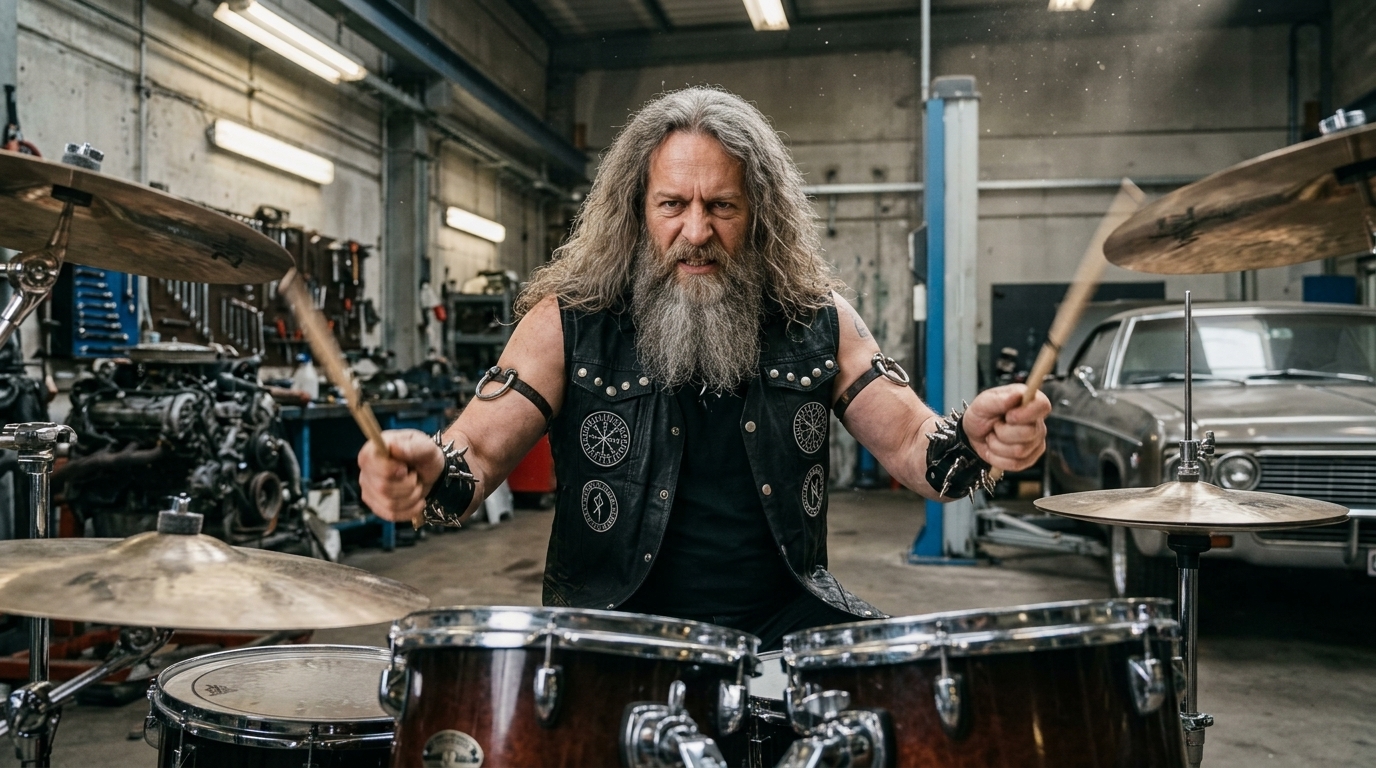
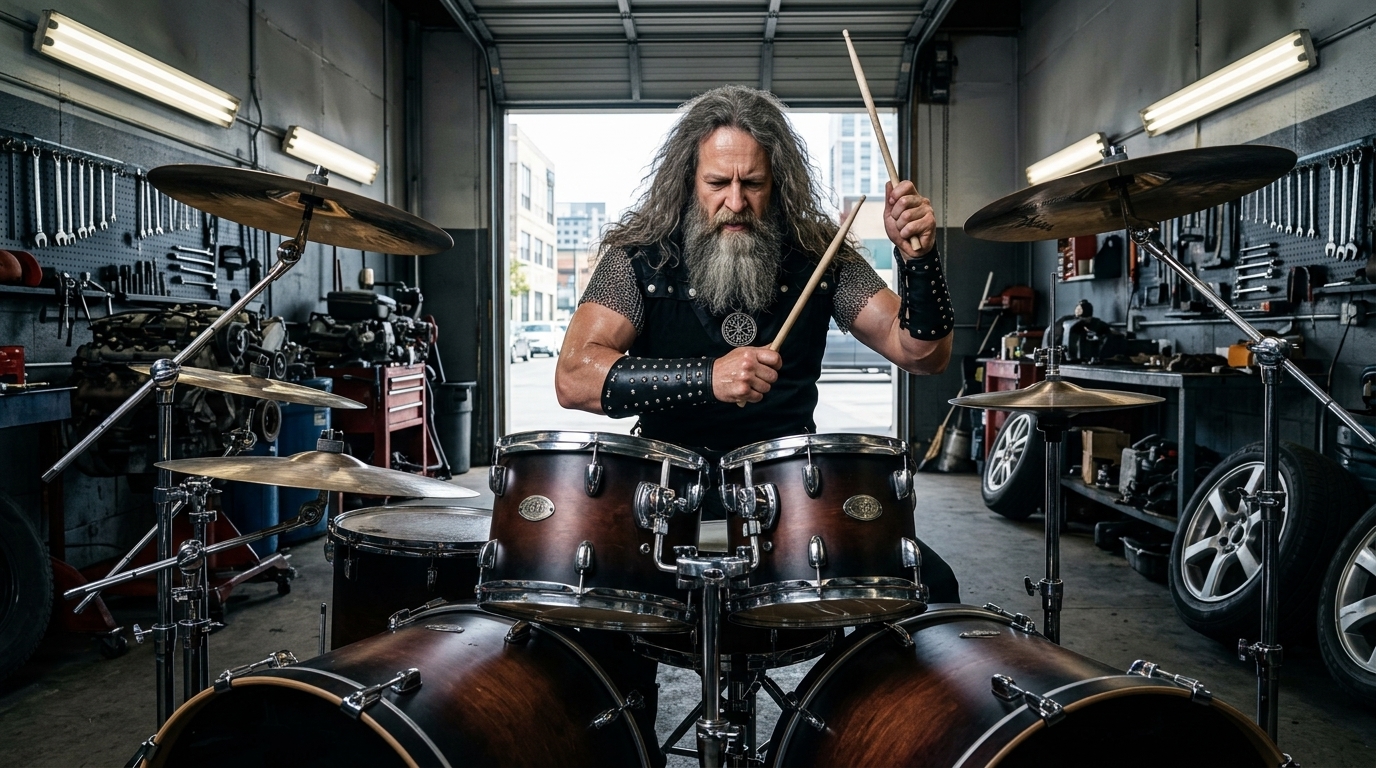
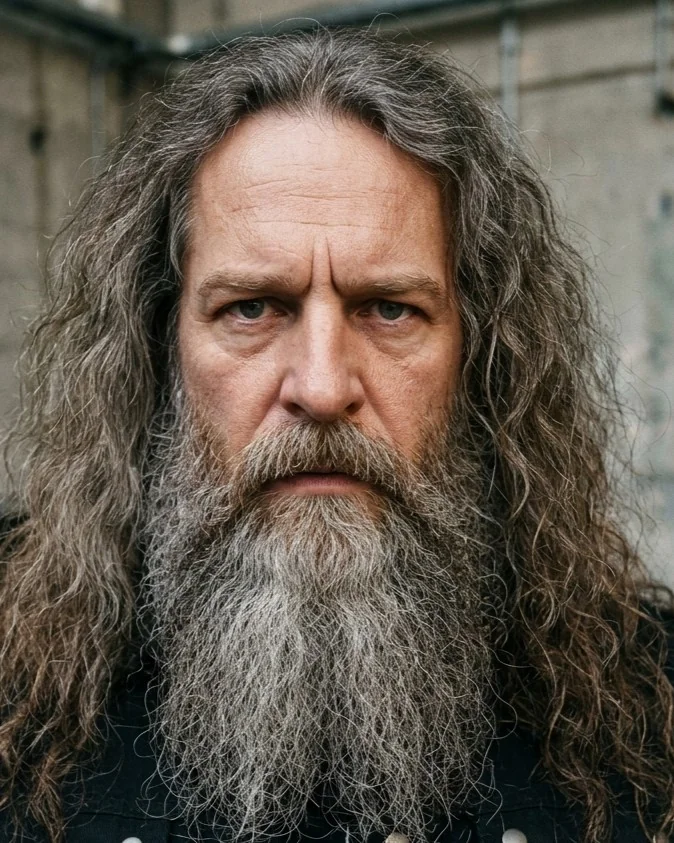
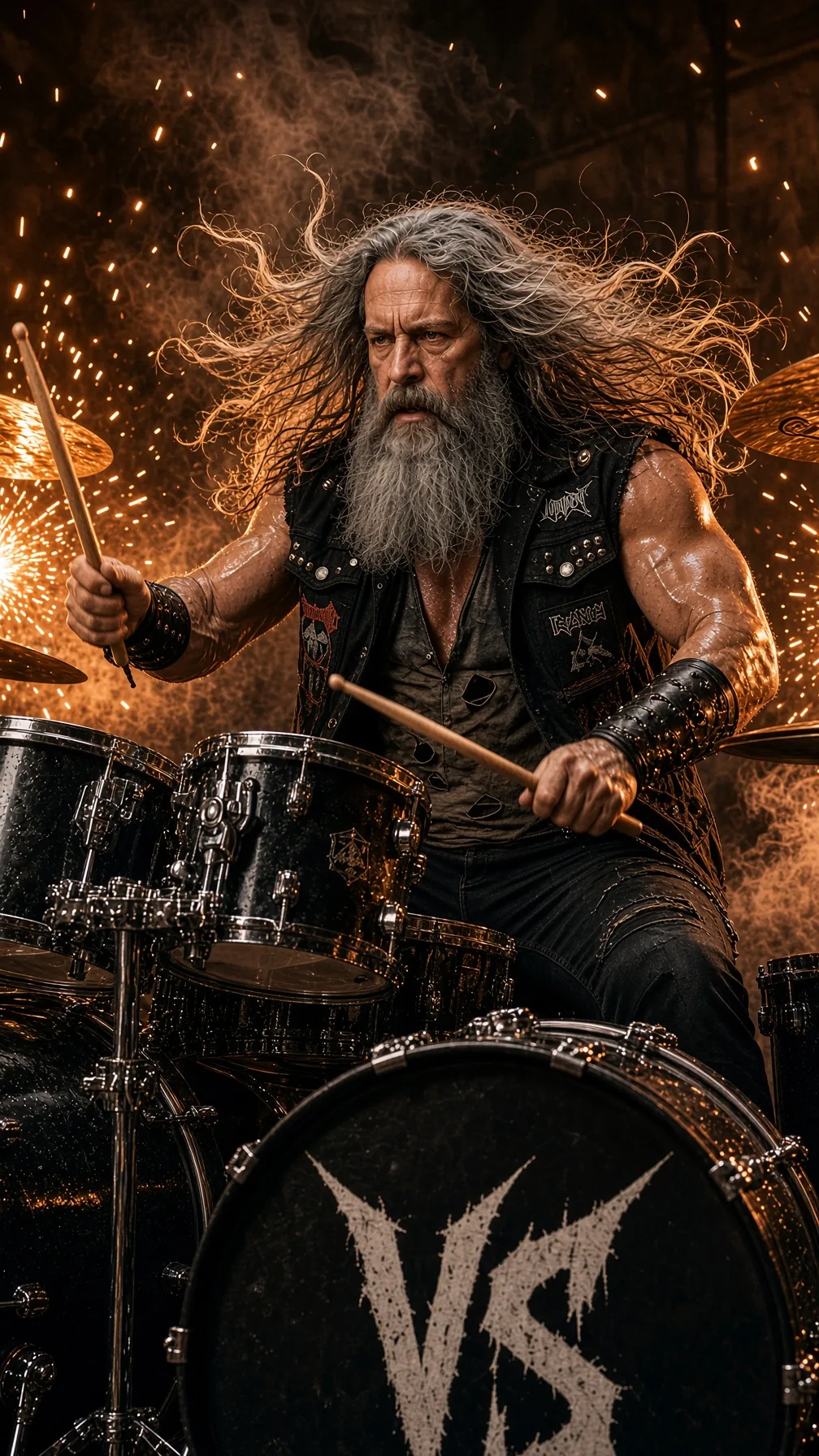
He is forty-five, Oslo-forged, extremely long gray hair, beard like a weather front, shoulders built for lifting engines and burying cowards. Metalhead cut with viking iron. Black denim. Black boots. Vest heavy enough to qualify as armor. No tattoos. He doesn’t need a mural on his skin to prove the work happened.
Musically he is the floor the rest of the band stands on. Not finesse. Not stick-flip circus. Timing, weight, double-bass earthquakes with attitude. Snare like a gunshot. Toms like cannon fire. Cymbals like metal hitting bone. He plays destruction as rhythm — controlled, not chaotic. If you came for groove clinic, get out of the pit.
Who he is: blunt. Loud. Practical. A man who spent decades with engines, steel, and situations that don’t care about your feelings. He is not spiritual and he is not performing anger for the camera. He is tired of excuses. He carries dead friends and old injuries without turning either into a brand. He builds. He breaks. He holds the beat. Then he talks too much in sentences that land like a hammer and end the discussion.
The kit is black. The two bass drums carry the VS mark. Everything under his feet has to survive the same man who spends the day lifting engines and the evening hitting heated iron. That weight is in the songs. You hear the impact; the work that taught him how to deliver it is standing right behind it.
Impact over ornament

Thorin does not “sit in.” He enters the room like it is a battlefield and the kit is the only language left. The band did not hand him the name Hammerhead. He earned it the only way he earns anything: by hitting until the object either submits or gets rebuilt.
He is the oldest of Venomous Sin in years and in mileage. Do not confuse that with calm. He hits harder than musicians and fighters because he is both. When the lights die, the fog floods, the power flickers — he keeps going. Chaos does not move him. He manufactures it and then times it.
That is why sinners feel the songs in their ribs first. Vocals can scream. Guitars can burn. None of it marches without the war engine. Follow the thunder on YouTube if you want the proof in motion — not a lecture, a beating.
A fill is not a chance to beg for applause. It has a job: shove the song into the next blow. Thorin leaves space when space makes the next strike heavier. Then both feet drop and the space disappears. That is control. The noise is enormous because the decisions underneath it are exact.
Before the war engine
He was born in Oslo, working-class, in a house where pain was a motivator, not a reason to stop. Childhood was tools, noise, and orders. Play was what you did after the machine ran. If it ever ran.
He is not a myth from a mountain, even if the band likes the frost on the story. He is a Norwegian who learned volume in a workshop and never asked permission to keep it. The “Black Viking” talk came later. The work came first.
He learned the sound of a working day before he learned the luxury of an empty one. A room full of tools had rules you could test with your own hands. Tighten it and it held. Leave it loose and sooner or later it came apart. Nobody needed a powerpoint-slutchief to translate the result.
The orders followed him out of childhood. Be useful. Keep moving. If it hurt, do it anyway. He carried that lesson into the workshop until it became the way he stood, spoke and looked at anyone who offered a long excuse for a short failure. It made him dependable. It also taught him to ignore damage that could not be fixed with a spanner.

His main work / Mechanic

Engines. Hoists. Failures you can point at. He diagnoses the way he speaks: short, loud, final. If it is broken he does not hold a meeting. He puts his hands in the greasy truth and makes it turn again.
He started as a mechanic’s apprentice and learned the only honest lesson in the room: a broken machine at least shows you exactly where it failed. People hide the crack and call it personality. He prefers steel. Steel does not write an anal-manual about your tone.
An apprentice starts with the things nobody wants to spend time explaining. The seized bolt. The filthy housing. The fault that comes back as soon as somebody declares the job finished. Thorin stayed with it until the cause showed itself. He learned to trust the evidence in front of him more than the confidence of the man standing beside it.
That is where the bluntness became useful. A customer could dress the problem in whatever story made it less embarrassing. The engine did not care. Thorin put the problem on the bench, worked through it, and gave back something that ran. Praise was optional. A repair that held was the point.
He took the same patience into the band. If a stand shifted under the kit, he fixed the stand. If the van would not start, he opened the bonnet. Nobody had to turn helplessness into a meeting. He was already there with his sleeves out of the way.
His other work / Blacksmith
Heat. Hammer. Repeat. The forge is where his drumming comes from. Same economy: hit the thing that matters, ignore the decoration, do not stop because it hurts. Steel remembers every strike. So does he.
Later he was forging his own tools after hours because store-bought garbage dies under his hands. Steel answers force. People answer speeches. Guess which one he kept.
After the engines came the forge. The day had already taken its share of his strength; he put what remained into making tools that could take more. Heat changed the resistance. A blow changed the shape. The next blow had to account for the last one. Hit without thinking and the mistake stayed in the metal.
He did not come to the anvil to pretend he was an ancient king. He came because he wanted a tool that fitted the work. The Viking details belonged to him, but the work was real: holding, turning, striking, checking, and starting again when the piece needed more. No ceremonial speech made weak steel strong.
The furnace gave his anger a task. It also taught his hands restraint. All that force meant nothing if he ruined the thing he was trying to build. Long before the band had a drummer named Hammerhead, the blacksmith had learned the difference between hitting hard and making the hit count.


The first hardware
The drum hardware he could afford did not survive him, so he built the stand out of scrap. That is the whole philosophy. If it breaks, you were using it. If you cannot repair it, you did not own it.
The cheap stand gave him a choice: become gentler, or make something that could take him. He went to the scrap. He knew how things failed now. The part that carried the load needed to be stronger; the part he would eventually break needed to be replaceable. His playing did not have to become smaller just because the catalogue had run out of answers.
That homemade hardware connected all three lives. The mechanic found the failure. The blacksmith made the answer. The drummer found out whether the answer was worth a fuck. Each role kept the other two honest.

The first compromise
His first band wanted the volume down and the heaviest parts swapped for something easier to sell. He left. Not a speech. A door.
The heavy part was the point. Taking it out and calling the song improved was exactly the kind of explanation he had spent working days learning to distrust. He did not want a compromise with better packaging. He wanted people who meant the sound they were making. When that stopped being possible, he walked.
What the hands remember

Between those bands, a close friend died in a workplace accident. Thorin took over several of his tools and never turned the grief into a public identity. No tribute caption. No coffin-candy. He just keeps the man’s steel in his hands and keeps working. That is as close as he gets to prayer.
There was no useful repair for that absence. He could put an engine back together. He could make a new tool when an old one failed. His friend was dead, and the practical answers stopped at the edge of that fact. The steel he inherited was still good. The man who had held it was not coming back.
So he used the tools. Not as a performance of moving on, and not because using them made the loss smaller. Work was the place where he could carry it without being made to explain it. A familiar weight in his hand could say more than the roomful of sympathy he never asked for.
That quiet sits underneath the loudness. The drummer can make the whole room shake, but he does not need a crowd to witness every wound that taught his hands their weight. Some things stay on the bench with him.
The door / The workshop / The damage
Another band. Another argument about compromise. Same door. He decided he would play for people he respects or he will play for the walls. Certifucked musicians with powerpoint-slutchief careers can keep their safe choruses. Thorin does not lower the hit so a room can clap on time.
He opened a small mechanics and blacksmithing workshop outside Oslo. His house. His rules. His heat.
The workshop outside Oslo put the decisions back in his hands. Engines and forge work under one roof. The band arguments could stay outside. Inside, a finished job had to hold under use, and nobody could vote a weak repair into being a strong one.
An engine-block lift failed. His back went with it. He returned too early, because of course he did, and the injury became chronic. He still plays. He still forges. He still lifts what he should not. Pain was never a reason to stop. Oslo taught him that before any doctor got a vote.
The old lesson came back with a cost. Keep going. Work through it. He returned before his back had recovered and carried the result into every heavy day after it. The stubbornness that made other people depend on him also made him a bastard to look after. He could hear a problem in an engine long before he would admit the one in himself.
Engines. Steel. A body that had started keeping its own account of the work. This was the man who had walked away from two bands. The next one would have to give him a reason to stay.
The road to Venomous Sin
Then he heard A Nuclear Attack for Xmas. First time in years a new project dares to be brutal and absurd in the same breath. Norwegian black metal posers got named. Christmas got nuked. The fury was raw enough to be an eargasm and blasphemous enough to be honest.
Thorin is a man of action. He does not send a polite DM. On his birthday, he drove from Oslo to Helsingborg and waited outside Xavi’s apartment like a siege that learned to use a parking space. He saw Lina. He walked up.

“Lina Macabre and her Lord? You’re bleeding wrong.”
Xavi reads the name off a patch. He had been expecting the man attached to it. Thorin tells them the music is pure fucking annihilation — and the implication is the only one that matters. He has found a band he will not quit. They do not audition him like a human resource. They say show us how you play. If he hits like they think he hits, he is in.
He had heard enough polite ambition in other bands to last him the rest of his life. This was different. The song had the nerve to be furious and ridiculous at once. He wanted the men who protected Norwegian black metal like a fragile national treasure to hear what he had heard: somebody had stopped asking their permission to make noise.
He drove the distance. He stood outside the apartment. There was nothing casual about it. A man who kept quitting had finally found something he wanted badly enough to cross a border for, and his introduction still sounded like an argument.
The next day he was chosen as Venomous Sin’s drummer after a test that turns the neighbors’ shelves into unplanned percussion. Double bass. No apology. The band did not invite a tourist. They forged a war engine into the lineup and the walls filed a complaint.
He did not appoint himself their drummer. He gave them the impact and they chose him. No volume knob came out after the test. Nobody asked him to take the weight out of his feet. For once, the answer from the room matched the force he had put into it.
The work inside the band
He recorded Ashes of Fake Facades (Thorin’s Hammer of Justice) and rebuilt parts of the kit between takes because the kit, like everything else, has to survive him. He found that the simplest rhythms make the most absurd songs the heaviest. He built a new black double-bass setup with the VS symbol and spare parts you can repair without a specialist priesthood. Later he helped Nyx hang cooling and backup power for NYX-END and did not require the full sermon. He needed to know what carried the heat, what carried the current, and what would keep working.
The choice did not turn him into a different man. It gave the work somewhere to go. Between takes he was still the mechanic checking what had moved, still the smith answering pressure with a stronger part. Then the recording started and all three jobs landed in the same downbeat.
Simple did not mean empty. A rhythm could be stripped to the bone and make the most absurd line in a song hit harder. He understood that because he had never trusted decoration to do a load-bearing job. The band gave him fury, filth and jokes; he gave them something heavy enough to carry all of it.
Watch him talk with his hands still dirty:
The room did not need him house-trained. It needed the hit. That was the difference between another band he would leave and Venomous Sin.
The names that stuck

He accepts Black Viking because it is closer to the truth than any polite biography. Brutal. Unfiltered. Not a costume from a souvenir stall. He does not worship the past. He uses it to survive the present.
“They call me Black Viking, but that’s just because Fuck You was already taken.”
Mr. Fix It is what the band actually uses when the van dies, the riser folds, the power supply lies, or some certifucked tech starts explaining why the broken thing is “within spec.” Thorin does not gossip, flirt, or babysit. He steps in, repairs the structure, and leaves the feelings on the floor where he found them.
Thorin / His own channels
This is not the band account and it is not a cute link-in-bio. Thorin posts like he talks — loud, short, no ornament. If you want the man behind the kit, you go where he actually stands.
Who gets the weight beside them
Thorin does not do emotional closeness as a sport. He shows up, holds the weight, and stays standing. That is the relationship.
Xavi / The Lord
He respects Xavi’s endurance. The unwavering bit. He does not need a friendship bracelet to stand next to a man who will not fold. He backs the man through action. Endurance recognizes endurance.
Lina Macabre
Lina is chaos that gets away with it. They clash, shout, throw things, then spar. He is the only member who has not fallen to her, and that is not technique — that is raw strength. He still backs her, every time, because her fights are real. Fake warriors get the door. She does not.
She can get a reaction from him where most people get a stare. That does not weaken the loyalty. He knows the difference between her chaos and somebody inventing a fight for attention. When the fight is real, he is there. Their shouting never meant she had to stand alone.
Nyx Luna
With Nyx it is labor. Cooling. Power. Things that can be switched off. There are rumors of a fling. Nobody has a quote, because he does not speak and she erases her tracks. What you can see: if she drops a drink, a new one appears in her hand. Practical care. No poem.
The kindness is easy to miss if you only listen to his voice. He notices the thing that needs doing and does it. A drink replaced. A broken part made sound. She does not have to turn the request into a confession, and he does not turn the help into a debt.

The blasphemy / The wreckage
A Norwegian metalhead heard a song that spat on poser black metal and fired a nuclear strike through Christmas, then drove eight hours to bleed for it. That is not a meet-cute. That is a heresy with a steering wheel.


Before playing, he carves new runes into a leather strap on his forearm. “Channeling the old gods,” he says. The band keeps the line; the man is not spiritual. His faith is in what his hands can actually do. Mid-set he has snapped a kick pedal and kept going with a bare foot. The ritual is not incense. The ritual is refusing to stop when the object dies.
The sacred part was not the calendar or the costume. It was the refusal to make the hit smaller. A Christmas song became a reason to drive across Scandinavia. A broken pedal became a problem to get through. He treated both with the same blunt respect: find what still works and put your weight behind it.
The stage lights had cut out. The fog machine had flooded the space and the power had flickered. Thorin kept going. The dancers and the flames could pull every eye in the room; underneath them, his feet held the assault together. Oblivion, the band’s demon stage disruptor, circled closest to him. The chaos had found the one man who could give it a pulse.
The worst part is not the noise. The worst part is the calm after. He will sit in the wreckage, barefoot, among dead cymbals, like a man who finished a job. If that offends your idea of musicianship, good. Stay offended. Subscribe anyway — the blasphemy has a catalog number on Spotify.

Keep the source close
We are not dropping a cute song widget here so you can tap and forget. If the hammer matters, you follow the source. Venomous Sin on YouTube is where the footage lives. Spotify is where the weight keeps hitting after the clip ends. Hit follow like you mean the war, not like you bookmarked coffin-candy.

After the noise
The work is put down. His attention stays. A woman standing close to him does not get the polished version of a man who has spent the day barking at an engine; she gets the same directness, turned toward her. He would rather feel her answer in the way she holds his gaze than spend the night talking around what they both want.
Thorin is heterosexual, dominant, and allergic to theatre about feelings. Sex, for him, is physical, direct, rough. Strength. Mutual endurance. Impact as a conversation. Ownership as a fact in the room, not a poem. Aftercare is practical: water, a blanket, a check that you can still stand. He will not process your childhood on the mattress. He will make sure you can walk.
He likes a woman who meets the weight with her own. Someone who wants to be there, who can tell him what she wants without apologizing for the words. His size is obvious. Her say is not something he gets to overlook. Mutual endurance means there are two people in that room choosing the heat.
And when the heat is spent, he does what he always does when somebody matters: he pays attention to what is needed. Water within reach. A blanket. His presence staying solid when the performance is over. He is not going to write a sonnet about it. The care is still there, whether or not he gives it a pretty fucking name.
If you want the heat that does not belong on the family feed, that is what Fanvue is for. If you want to stand closer to the band without the algorithm babysitting you, Patreon. If you want to actually talk to the hammer, the sinners’ community is the door that is not a performance.

Why Xavi and Lina created him
Thorin is the proof that brute force can have a pulse and a code. He is the backbone that does not audition for sympathy. He is every person who was treated as infrastructure while clowns took the spotlight — except he took the spotlight anyway, sat behind a black double-bass kit, and made the clowns keep time with him or get out.
Thorin represents the strength Xavi wished he had while being mocked. That is why there is a man this broad behind the kit. The size, the voice, the refusal to fold: they give a body to something that was missing when the cruelty landed. Someone who could stay standing. Someone who could take the weight.
But strength by itself would have made a hollow character. The kindness matters just as much. Thorin is loud, relentless and loyal. He can sound like the least delicate bastard in the room and still be the one who notices you need something. The new drink in Nyx’s hand is as much Thorin as the double-bass assault.
Xavi and Lina created him because being used as everybody else’s backbone does not mean you have nothing of your own to say. They gave that backbone a face, a workshop and a drum kit. He carries the anger of having had enough, and the stubborn heart that keeps showing up for the people worth the effort.
The long one. Lore, not a teaser. Hammer of the Gods — why the machine is a man.

The turn
The epiphany is not a sunrise. It is the moment he quit translating himself for people who wanted less volume. Years of watching mediocrity get applauded while the silent backbone got used. Rage that never died. He did not drown in it. He turned it into a weapon and then into a downbeat.
No more sorry for the weight. No more shrinking the hit so a poser can keep their hearing. Silence is not peace. Silence is submission. He is done kneeling for either. If that makes you uncomfortable, you were never the audience.
It was not the discovery that he could be loud. He had always been loud. It was finding a room where he did not have to spend that force defending his right to exist. The others heard what he brought and wanted the whole weight. He stopped offering the apology that usually came before the first strike.
The Macabre Coven takes the same refusal into the room: Venomous Sin Stays Politically Incorrect.
Thorin Hammerhead / Declares war
Thorin’s war is specific. He is not at war with “the world” like a teenager with a poster. He is at war with the habit of making heavy things smaller so weak rooms can survive them. At war with bands that sand the riff until it can be sold. At war with grief-as-content. At war with certifucked experts who cannot hold a hammer. At war with the lie that stillness is wisdom.
He represents the strength Xavi wished he had while being mocked — ultra masculinity with a kind heart nobody gets for free. Loud. Relentless. Loyal. He will fix your engine and ruin your excuses in the same afternoon.
The hammer / Archive